Find the unknown values in the problem involving trigonometry graphs

Click For Summary
SUMMARY

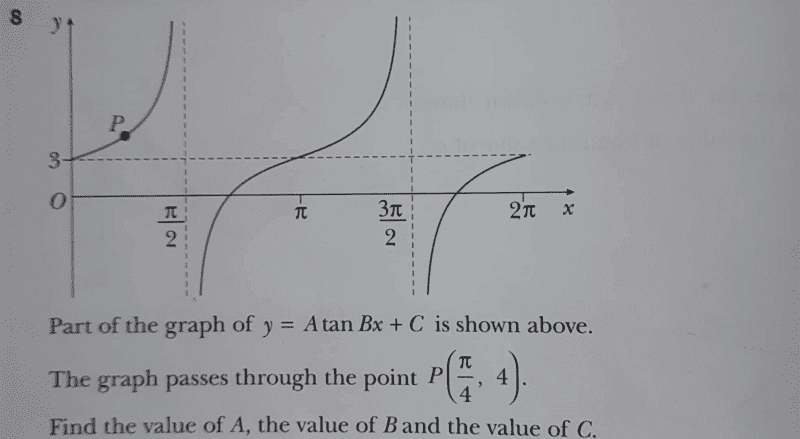
The discussion centers on determining the value of ##A## in a trigonometric graph equation, where participants confirm that ##A=1## based on their calculations. The equation under consideration is ##y=A \tan(Bx) + C##, with ##B## and ##C## correctly identified as ##B=1## and ##C=3##. The discrepancy with the textbook solution, which suggests ##A=2##, is highlighted as incorrect, emphasizing the importance of accurate parameter representation in mathematical problems.

PREREQUISITES
  • Understanding of trigonometric functions, specifically tangent functions.
  • Familiarity with graphing techniques for trigonometric equations.
  • Knowledge of parameter identification in mathematical equations.
  • Basic algebra skills for solving equations.
NEXT STEPS
  • Review the properties of tangent functions and their graphs.
  • Learn how to derive parameters A, B, and C from trigonometric equations.
  • Study common errors in textbook solutions related to trigonometric identities.
  • Explore the implications of parameter misrepresentation in mathematical problems.
USEFUL FOR

Students, educators, and anyone involved in teaching or learning trigonometry, particularly those focused on graphing and parameter analysis in trigonometric functions.

chwala
Gold Member
Messages
2,828
Reaction score
421
Homework Statement
see attached
Relevant Equations
trigonometry
My interest is on finding the value of ##A## only. From my calculations, ##A=1##and not ##2## as indicated on textbook solution.
In my working we have; i.e ##4=A +3.##
The values of ##B##and ##C## are correct though. Kindly advise.

Find the question and textbook solution.
1650518637311.png

1650518659691.png
 
Physics news on Phys.org
chwala said:
In my working
Which you don't post, so we depend on telepathy now.

But I suppose my answer would also be ##A=1## :smile:

##\ ##
 
  • Haha
Likes   Reactions: chwala
Ok I will indeed post my working later. I'll get back on this..finishing on some chores @BvU
 
For tangent graphs, the period is given by;
## Bx= π##,
the period of the given graph is ##x##=##\dfrac {3π}{2}-\dfrac {π}{2}= π##
therefore,
## Bπ= π##, →##B=1##,
The principal axis crosses the y-axis at the point ##(0,3)##, therefore ##C=3##.
Using the given point ##P\left [\frac{π}{4},4\right]##, we shall have,
##y=A tan Bx + C##
##4=A tan \dfrac {π}{4}+3##
##4=A+3##
##A=1##
 
Last edited:
  • Like
Likes   Reactions: BvU
I agree as well that A = 1. The graph of ##y = 2\tan(x) + 3## would pass through the point ##(\pi/4, 5)## rather than the point P shown on the graph. Also, I find it odd that the problem parameters are A, B, and C, but the posted answer uses a, b, and c. That's sloppy.
 
Last edited:
  • Like
Likes   Reactions: SammyS and chwala

Similar threads

  • · Replies 4 ·
Replies
4
Views
3K
Replies
13
Views
2K
  • · Replies 13 ·
Replies
13
Views
3K
  • · Replies 7 ·
Replies
7
Views
2K
Replies
7
Views
2K
  • · Replies 7 ·
Replies
7
Views
1K
Replies
6
Views
2K
Replies
4
Views
2K
Replies
5
Views
2K
Replies
2
Views
2K
