MHB Find $\theta$ for Trig Function 33: No Calculator

  • Thread starter Thread starter bergausstein
  • Start date Start date
  • Tags Tags
    Function Trig
Click For Summary
SUMMARY

The discussion focuses on solving trigonometric equations without a calculator, specifically finding values of $\theta$ for the equations $\sin\theta=\frac{1}{2}$, $\cos\theta=-\frac{\sqrt{3}}{2}$, and $\csc\theta=-\sqrt{2}$. For $\sin\theta=\frac{1}{2}$, the solutions are $30^{\circ}$ and $150^{\circ}$. The second equation yields $\theta=150^{\circ}$ and $210^{\circ}$. The third equation, after inversion, leads to $\theta=225^{\circ}$ and $315^{\circ}$. The discussion emphasizes the importance of understanding the unit circle and the properties of sine and cosine functions.

PREREQUISITES
  • Understanding of the unit circle and special angles in trigonometry
  • Knowledge of trigonometric identities, specifically $\sin(\pi-\theta)=\sin(\theta)$
  • Familiarity with the sine and cosine functions and their properties
  • Ability to visualize trigonometric functions graphically
NEXT STEPS
  • Study the unit circle and its application in solving trigonometric equations
  • Learn about the properties of sine and cosine functions in different quadrants
  • Explore the use of trigonometric identities in simplifying equations
  • Practice solving trigonometric equations without a calculator using various methods
USEFUL FOR

Students studying trigonometry, educators teaching trigonometric concepts, and anyone looking to improve their skills in solving trigonometric equations without computational tools.

bergausstein
Messages
191
Reaction score
0
33. find two values of $\theta$ , $0^{\circ} <\theta<360^{\circ}$ that
satisfy the given trigonometric equation. without using calculator.

a. $\displaystyle \sin\theta=\frac{1}{2}$

b. $\displaystyle \cos\theta=-\frac{\sqrt{3}}{2}$

c. $\displaystyle \csc\theta=-\sqrt{2}$
 
Last edited:
Mathematics news on Phys.org
These questions rely on your knowing the values of certain "special" angles for the trig. functions, and possibly the identities:

$$\sin(\pi-\theta)=\sin(\theta)$$

$$\cos(2\pi-\theta)=\cos(\theta)$$

For part c), I would invert both sides of the equation to get:

$$\sin(\theta)=-\frac{1}{\sqrt{2}}$$

Let's begin with part a). In which quadrants do you expect to find solutions?
 
in part a. $\displaystyle 30^{\circ}$ would satisfy the equation. but i know it's not only the answer. can you help me to find the other.
 
bergausstein said:
in part a. $\displaystyle 30^{\circ}$ would satisfy the equation. but i know it's not only the answer. can you help me to find the other.

$\displaystyle 30^{\circ}$ is indeed one of the solutions (in fact it's the principal one)

A good place to start is working out where $\sin(\theta) > 0$ so you can narrow your search.

The basic definition of $\sin(\theta) = \dfrac{Opp}{Hyp}$. When this is applied to the unit circle you can say that $\sin(\theta) = y$ (because r=1)

Therefore for $\sin(\theta) > 0$ it follows that $y > 0$.

Now in which quadrant(s) is/are $ y > 0$


edit:

Alternatively if you know your graph of $f(\theta) = \sin(\theta)$ you can see that $ \displaystyle f(0) = 0 \ ,\ f(90^o) = 1\ ,\ f(180^o) = 0\ ,\ f(270^o) = -1 \text{ and }\ f(360^o) = 0$

This tells you there are two solutions: one between 0 and 90 which is the 30 you found and one between 90 and 180.
 
Last edited:
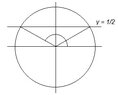
Here's another way to approach it...draw a unit circle and the line $y=\dfrac{1}{2}$, and then draw rays from the origin to the two points where the line intersects the circle, then what are the terminal angles associated with the two rays?

View attachment 1216

The other questions can be done similarly, using vertical lines for the cosine function. This is how I often visualize such problems.
 

Attachments

  • bgangle.jpg
    bgangle.jpg
    6.3 KB · Views: 126
but how would i know the measure of that other angle? what method should i use to determine its measure?
 
The angle on the right, the smaller angle is $0^{\circ}+30^{\circ}$ and so you should be able to see the larger angle is $180^{\circ}-30^{\circ}$.

This is closely related to the identity I gave in my first post:

$$\sin(\pi-\theta)=\sin(\theta)$$

Think of two particles on the unit circle, the first at (1,0) and the second at (-1,0). The first moves counter-clockwise at a constant rate, and its $y$ coordinate is $y=\sin(\theta)$. The second moves at the same rate but in the clockwise direction, and its $y$-coordinate is given by $y=\sin(\pi-\theta)$. Can you see that their $y$-coordinates are the same for all $\theta$? This is how I visualize the identity above.

Can you use the two particle model to visualize the identity I gave in my first post for the cosine function?
 

Similar threads

  • · Replies 4 ·
Replies
4
Views
2K
  • · Replies 3 ·
Replies
3
Views
2K
  • · Replies 5 ·
Replies
5
Views
2K
  • · Replies 2 ·
Replies
2
Views
2K
  • · Replies 1 ·
Replies
1
Views
2K
  • · Replies 2 ·
Replies
2
Views
2K
Replies
3
Views
2K
  • · Replies 19 ·
Replies
19
Views
3K
  • · Replies 1 ·
Replies
1
Views
2K
  • · Replies 2 ·
Replies
2
Views
7K