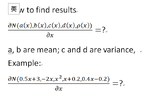
How many times are you going to post the same question? Well, maybe it is not the same! Previously, you said "binormial", which I had first interpreted as "binomial", which you have here, but apparently you meant "bi-normal", a normal distribution in two variables. I would expect "N" to be a normal distribution which has a single variable with the mean and standard deviation as
parameters. I don't know what you mean by "[tex]N(a, b, c, d, \rho)[/tex]", with 5 variables. Also, since N reduces to a function in the single variable, you should get [tex]\frac{dN}{dx}[/tex], not [tex]\frac{\partial N}{\partial x}[/tex] but that is a matter of notation, not substance.
In any case, by the "chain rule", [tex]\frac{dN}{dx}= \frac{\partial N}{\partial a}\frac{da}{dx}+ \frac{\partial N}{\partial b}\frac{db}{dx}+ \frac{\partial N}{\partial c}\frac{dc}{dx}+ \frac{\partial N}{\partial d}\frac{dd}{dx}+ \frac{\partial N}{\partial \rho}\frac{d\rho}{dx}[/tex].
Since a= 0.5x+ 3, da/dx= 0.5, b= -2x, db/dx= -2, [tex]c= x^2[/tex], dc/dx= 2x, d= x+ 0.2, dd/dx= 1, [tex]\rho= 0.4x- 0.2[/tex], [tex]d\rho/dx= 0.4[/tex] so
[tex]\frac{dN}{dx}= 0.5\frac{\partial N}{\partial a}- 2\frac{\partial N}{\partial b}+ 2x\frac{\partial N}{\partial c}+ \frac{\partial N}{\partial d}+ 0.4\frac{\partial N}{\partial \rho}[/tex].