Finding Absolute Zero Values from Best Fit Lines with & w/o Uncertainty

Click For Summary
SUMMARY

This discussion focuses on creating two best fit lines to determine absolute zero values, one assuming no uncertainty in the variable P and the other accounting for uncertainty. The first best fit line utilizes standard linear regression to calculate the slope and y-intercept without error. The second line incorporates error analysis, suggesting that the slope and y-intercept will differ due to uncertainty. Participants emphasize the importance of understanding the expected error analysis in the context of undergraduate University Physics 3.

PREREQUISITES
  • Understanding of linear regression techniques
  • Familiarity with error analysis in statistical modeling
  • Knowledge of best fit line calculations
  • Basic concepts of absolute zero in physics
NEXT STEPS
  • Study linear regression methods in Python using libraries like NumPy and SciPy
  • Learn about error propagation techniques in statistical analysis
  • Explore advanced regression techniques, such as weighted least squares
  • Investigate the implications of uncertainty in experimental physics
USEFUL FOR

Students in undergraduate physics courses, particularly those studying statistical methods in experimental physics, as well as researchers and data analysts working with regression analysis and error assessment.

PancakeSyrup
Messages
6
Reaction score
0
Member advised to use the homework template for posts in the homework sections of PF.
In one of my problems, I have this set of data.
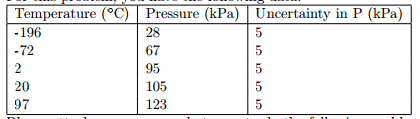
upload_2016-12-14_21-29-5.png


I have to create two best fit lines, and find a value of absolute zero for both.

The first best fit line is to be made assuming there is NO uncertainty in P. This is rather straightforward, just use the normal linear regression, find a slope and find a y-intercept, and there should be no error on either of them.

The second best fit line is to be made assuming there IS uncertainty in P. Am I incorrect in thinking that the best fit line should be exactly the same as the other one, except there would be an error in the slope and y-intercept?
And how would I find this error in them both?Also, I'm not sure if this is posted in the right section, if not please move this to the appropriate section.
 
Physics news on Phys.org
PancakeSyrup said:
In one of my problems, I have this set of data.

View attachment 110417

I have to create two best fit lines, and find a value of absolute zero for both.

The first best fit line is to be made assuming there is NO uncertainty in P. This is rather straightforward, just use the normal linear regression, find a slope and find a y-intercept, and there should be no error on either of them.

There is error in the strictest sense, that is the whole purpose behind regression, to minimize it.

The second best fit line is to be made assuming there IS uncertainty in P. Am I incorrect in thinking that the best fit line should be exactly the same as the other one, except there would be an error in the slope and y-intercept?
And how would I find this error in them both?Also, I'm not sure if this is posted in the right section, if not please move this to the appropriate section.

This really depends on what's expected of you. So, yes, what you said is probably what the professor expects from just the information in the post. Find the best fit line and then carry the error over into the slope and y-intercept.

This isn't the easiest question to answer, because it's hard to judge how much error analysis is expected of you, or what you already know. What class is this for?
 
Student100 said:
There is error in the strictest sense, that is the whole purpose behind regression, to minimize it.
This really depends on what's expected of you. So, yes, what you said is probably what the professor expects from just the information in the post. Find the best fit line and then carry the error over into the slope and y-intercept.

This isn't the easiest question to answer, because it's hard to judge how much error analysis is expected of you, or what you already know. What class is this for?

This is the lab section for undergraduate University Physics 3.
 

Similar threads

  • · Replies 8 ·
Replies
8
Views
2K
  • · Replies 16 ·
Replies
16
Views
6K
  • · Replies 20 ·
Replies
20
Views
4K
  • · Replies 1 ·
Replies
1
Views
1K
  • · Replies 2 ·
Replies
2
Views
2K
  • · Replies 11 ·
Replies
11
Views
3K
  • · Replies 7 ·
Replies
7
Views
2K
  • · Replies 5 ·
Replies
5
Views
2K
  • · Replies 6 ·
Replies
6
Views
3K
  • · Replies 1 ·
Replies
1
Views
2K