Finding amplitude from a diagram

  • Context: High School 
  • Thread starter Thread starter Googl
  • Start date Start date
  • Tags Tags
    Amplitude Diagram
Click For Summary
SUMMARY

The discussion centers on determining the amplitude and wavelength from a diagram in the AQA Physics A AS textbook, specifically exercise 12.2 on page 177. The user struggles to find the amplitude due to the absence of a vertical axis in the graph. It is established that amplitude is defined as the distance from the center line to the highest point on the graph. The conversation also touches on using phase difference formulas and trigonometry to solve related questions, indicating a need for clarity in the representation of the data.

PREREQUISITES
  • Understanding of wave properties, specifically amplitude and wavelength.
  • Familiarity with phase difference calculations in wave mechanics.
  • Basic trigonometry skills for analyzing wave diagrams.
  • Knowledge of graphical interpretation, particularly in physics contexts.
NEXT STEPS
  • Review the definition and calculation methods for amplitude in wave physics.
  • Study the phase difference formula and its applications in wave analysis.
  • Learn about graphical representations of waves and how to interpret them accurately.
  • Explore additional resources on transverse waves, including diagrams and examples.
USEFUL FOR

Students studying physics, particularly those preparing for AQA exams, educators looking for teaching resources, and anyone interested in understanding wave mechanics and graphical analysis in physics.

Googl
Messages
111
Reaction score
1
Hi all,

This is not homework or coursework. I am not sure whether this question would be classed as homework or coursework because it is neither.

I am using the AQA Physics A AS textbook and attempting exercise 12.2 on page 177. In I am stuck on question 4 and I have absolutely no idea on how to find the amplitude. I have spent almost a day but still I haven't been able to find a matching answer. I was hoping someone here might help me.

Here is the full question:

For the waves in Figure 4,

a) determine i the amplitude and wavelength, ii the phase difference between P and R, iii the phase difference between P and S.

I can find the phase differences but not the wavelength and amplitude. I am probably missing something or have missed something and I am looking for a hint.

I managed to find a preview of the page here

I managed to get a screenshot of the page:
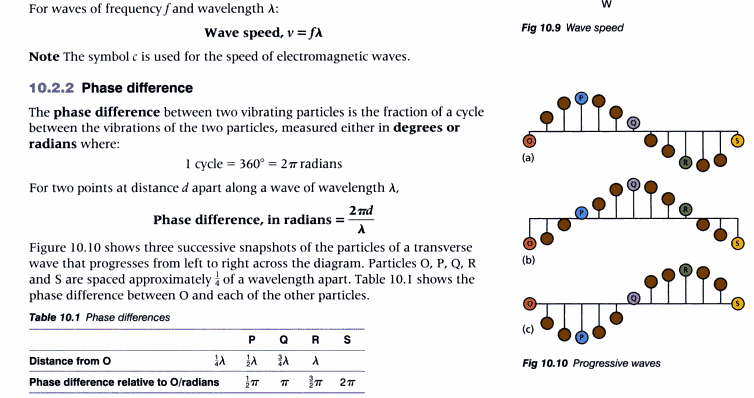
wave1.png


Thank you.
 
Science news on Phys.org
The amplitude is the distance from the center line to a highest point on the graph. You can't tell from the graph because there is no vertical axis.
 
Hi,

I think you can by using the table, the phase difference formula and trigonometry. I have tried that but I don't get the right answer.
 
googl
here are two sketches that illustrates what you are looking for...

If you understand the definition, the concept, I would not waste further time on this silly representation.

http://en.wikipedia.org/wiki/Transverse_wave

good lord...They have managed to take a few simple questions and turn them to a convoluted
interpretation...

What phase difference did you find??

I have no idea how to scale the plots..either vertically or horizontally.

'Distance from 0' as provided in the chart is actually incorrect...what they mean is the 'x' [horizontal distance] from o...

I hope the concepts in the rest of the text are presented more clearly than here!
 

Similar threads

  • · Replies 2 ·
Replies
2
Views
1K
Replies
20
Views
5K
  • · Replies 27 ·
Replies
27
Views
2K
  • · Replies 2 ·
Replies
2
Views
3K
  • · Replies 12 ·
Replies
12
Views
3K
  • · Replies 3 ·
Replies
3
Views
1K
  • · Replies 9 ·
Replies
9
Views
2K
  • · Replies 3 ·
Replies
3
Views
2K
  • · Replies 7 ·
Replies
7
Views
3K