Finding Coordinates for sin(2x)=1/2

  • Context:
  • Thread starter Thread starter markosheehan
  • Start date Start date
  • Tags Tags
    Coordinates
Join the discussion
Registration is free. Ask a follow-up in this thread, or start your own.
5 replies · 4K views
markosheehan
Messages
133
Reaction score
0
View attachment 5960
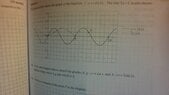
can some one help me with part b finding the co-ordinates of p. i tried this by letting sin 2x=1/2 but when i work out x i do not get the right answer. the right answer is (17pi/12, 1/2)
 

Attachments
  • WIN_20160906_20_40_26_Pro.jpg
    WIN_20160906_20_40_26_Pro.jpg
    63.8 KB · Views: 177
Physics news on Phys.org
Hi markosheehan. I've re-titled your thread to include a description of the problem.

Here's one way to look at it:

The period of $\sin(2x)$ is $\pi$. One solution is $x=\frac{\pi}{12}$.
The next solution occurs at $x=\frac{\pi}{2}-\frac{\pi}{12}=\frac{5\pi}{12}$.
Since $P$ is one period away from $\frac{5\pi}{12}$, the solution we seek is $(x,y)=\left(\frac{17\pi}{12},\frac12\right)$.
 
I still do not understand fully could you explain in a little more detail if possible please
 
Another way to look at it is if given:

$$\sin(\theta)=\frac{1}{2}$$

Then by symmetry and periodicity, we see the general solution is:

$$\theta=\frac{\pi}{2}\pm\frac{\pi}{3}+2k\pi=\frac{\pi}{6}(15k\pm2)$$ where $$k\in\mathbb{Z}$$

Now, referring to the graph, we see that:

$$\frac{5\pi}{2}<2x<3\pi$$

Now, substitute for $2x$, taking the larger general solution

$$\frac{5\pi}{2}<\frac{\pi}{6}(15k+2)<3\pi$$

$$15\pi<\pi(15k+2)<18\pi$$

$$15<15k+2<18$$

$$13<15k<16$$

$$\frac{13}{15}<k<\frac{16}{15}$$

Hence:

$$k\in\{1\}$$

And so the solution we need is:

$$2x=\frac{\pi}{6}(15\cdot1+2)$$

$$x=\frac{17\pi}{12}$$
 
Sorry I am slow but I don't understand how x can be pi/12 and 5pi/12
 
markosheehan said:
Sorry I am slow but I don't understand how x can be pi/12 and 5pi/12

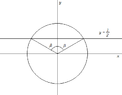
For my approach, please refer to the following diagram:

View attachment 5961

Now, we should recognize that we must have:

$$\beta=\frac{\pi}{3}$$

And so one solution for $$\sin(\theta)=\frac{1}{2}$$ is:

$$\theta=\frac{\pi}{2}\pm\frac{\pi}{3}$$

Now, understanding that the sine function has a period of $2\pi$, we can give the general solution as:

$$\theta=\frac{\pi}{2}\pm\frac{\pi}{3}+2k\pi$$ where $k$ is an arbitrary integer.

And we can rewrite this as:

$$\theta=\frac{\pi}{6}(15k\pm2)$$

Does this make sense?
 

Attachments

  • markotrig.png
    markotrig.png
    1.5 KB · Views: 125