Finding eigenvalues and eigenvectors given sub-matrices

Join the discussion
Ask a follow-up here, or get your own question answered by working scientists, mathematicians and engineers — people, not an autocomplete.
Real named experts · corrections over time · the nuance an AI answer skips
10 replies · 2K views
member 731016
Homework Statement
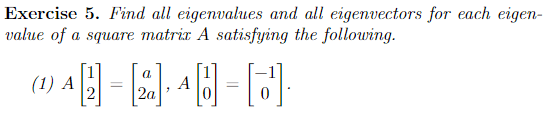
Please see below
Relevant Equations
Please see below
For this,
1685494468803.png

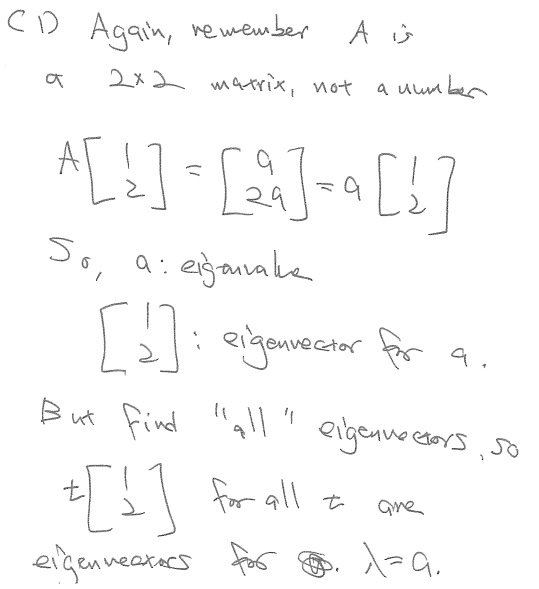
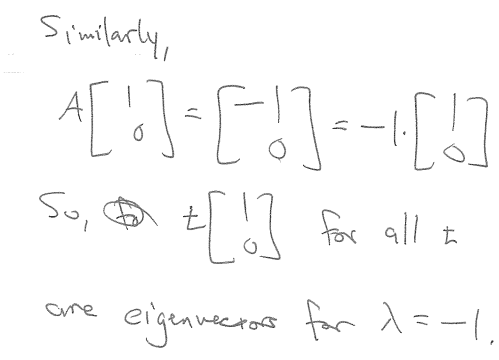
The solution is,
1685494576554.png

1685494595484.png

However, does someone please know what allows them to express the eigenvector for each of the sub-matrix in terms of t?

Many thanks!
 
Physics news on Phys.org
You need to take into account that both conditions hold. If ##a\not = -1##, then there are two eigenvalues and the corresponding eigenvectors are multiples of the two given vectors. If ##a=-1##, then there is only one eigenvalue and all vectors are eigenvectors.
 
Reply
  • Like
Likes   Reactions: member 731016
Thank you for your replies @hutchphd, @FactChecker and @martinbn !

So I am coming to think of it like this considering the most general case I could think of:

##A\vec v = \lambda\vec v##
##At\vec v = \lambda t\vec v## multiply both sides by a scalar ##t## which is a member of the reals
Therefore, the definition of eigenvector and eigenvalue, ##t\vec v## is an eigenvectors for ##\lambda## and ##\lambda## is the eigenvalue for A.

Is that please correct?

Many thanks!
 
ChiralSuperfields said:
##A\vec v = \lambda\vec v##
##At\vec v = \lambda t\vec v## multiply both sides by a scalar ##t## which is a member of the reals
Therefore, the definition of eigenvector and eigenvalue, ##t\vec v## is an eigenvectors for ##\lambda## and ##\lambda## is the eigenvalue for A.

Is that please correct?
Yes, but it would be better if you rephrased your statement to more clearly match the definition of an eigenvector and eigenvalue:
Suppose ##\lambda## and ##\vec v## are eigenvalue and eigenvector of ##A##, respectively. For any ##t \in \mathbb{R}##, where ##t \ne 0##, ##A( \vec {tv}) = t A\vec v = t \lambda \vec v = \lambda \vec {tv}##. So ##\vec {tv}## is also an eigenvector of ##A## with the eigenvalue ##\lambda##.
 
Reply
  • Like
  • Informative
Likes   Reactions: hutchphd and member 731016
FactChecker said:
Yes, but it would be better if you rephrased your statement to more clearly match the definition of an eigenvector and eigenvalue:
Suppose ##\lambda## and ##\vec v## are eigenvalue and eigenvector of ##A##, respectively. For any ##t \in \mathbb{R}##, where ##t \ne 0##, ##A( \vec {tv}) = t A\vec v = t \lambda \vec v = \lambda \vec {tv}##. So ##\vec {tv}## is also an eigenvector of ##A## with the eigenvalue ##\lambda##.
Thank you for your help @FactChecker!
 
FactChecker said:
Actually, I realize that your statement did match the definitions of eigenvector and eigenvalue, but I think that I have rephrased it more as a step-by-step proof.
Thank you for your reply @FactChecker! Yeah I only just realized the definition of eigenvector is for a value of ##\lambda## not the matrix A too!
 
ChiralSuperfields said:
Thank you for your reply @FactChecker! Yeah I only just realized the definition of eigenvector is for a value of ##\lambda## not the matrix A too!
It's for the combination of the matrix, ##A##, and the eigenvalue ##\lambda##
 
Reply
  • Like
Likes   Reactions: member 731016
FactChecker said:
It's for the combination of the matrix, ##A##, and the eigenvalue ##\lambda##
Oh, thank you for you letting me know @FactChecker !