Finding Final Velocity: Calculating the Velocity of a Rock Tossed Straight Up

Click For Summary
SUMMARY

The discussion centers on calculating the final velocity of a rock tossed straight up with an initial velocity of 19 m/s, which then falls into a 10 m deep hole. The key equation used is derived from kinematic principles, specifically the conservation of energy and the equations of motion. The initial velocity is correctly identified as 19 m/s, contrary to the misconception that it should be zero. The problem also highlights the assumption that the rock is thrown from ground level, ignoring the height of the thrower.

PREREQUISITES
  • Understanding of kinematic equations in physics
  • Familiarity with the concept of initial and final velocity
  • Knowledge of gravitational acceleration (9.81 m/s²)
  • Basic principles of energy conservation
NEXT STEPS
  • Study the kinematic equations for uniformly accelerated motion
  • Learn about energy conservation in mechanical systems
  • Explore the effects of initial conditions on projectile motion
  • Review examples of similar physics problems involving vertical motion
USEFUL FOR

Students studying physics, educators teaching kinematics, and anyone interested in understanding projectile motion and energy conservation principles.

Mei_797
Messages
1
Reaction score
0
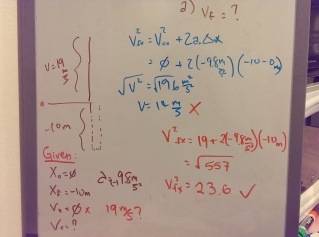
I am not good at typing out formulas and equations on the internet, so I took pictures of what I did instead. I hope that's not too informal.

1. Homework Statement

A rock is tossed straight up with a velocity of 19 m/s. When it returns it fell into a 10 m deep hole.

Q: What is the rock's velocity as it hits the bottom of the hole?
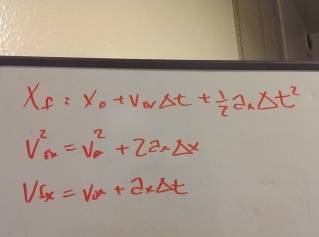
Homework Equations


ndr9xc.jpg


The Attempt at a Solution


11hwbyt.jpg
So in the end I figure out that I am suppose to plug 19 m/s as my initial velocity, but I don't get why.
If the rock is tossed straight up should it not means that the initial velocity = 0 because initially the rock is at rest?[/B]
 
Physics news on Phys.org
According to the OP, "A rock is tossed straight up with a velocity of 19 m/s."

You can't write a plainer statement than that. IDK how you could assume that the rock is at rest, which implies no movement of any kind.
 
Perhaps you are concerned because going from rest to 19m/s instantly would imply infinite acceleration. This is an issue that is always ignored in such problems. Just assume that the rock had some acceleration that got it up to 19m/s at the starting point and go from there.

If you pay careful attention to the problem you can see that there is another thing being ignored, and that is the height of the person throwing the rock. Even though the statement implies that it is being thrown by a person, who would be more than zero meters tall, you are supposed to assume that it leaves the ground going 19m/s. Again, this is just something that is usually ignored in this kind of problem.
 

Similar threads

  • · Replies 2 ·
Replies
2
Views
2K
  • · Replies 6 ·
Replies
6
Views
1K
Replies
1
Views
2K
  • · Replies 1 ·
Replies
1
Views
2K
  • · Replies 15 ·
Replies
15
Views
4K
  • · Replies 1 ·
Replies
1
Views
2K
Replies
40
Views
3K
Replies
1
Views
2K
  • · Replies 5 ·
Replies
5
Views
2K
  • · Replies 14 ·
Replies
14
Views
2K