Finding Focal Length of 2 Lenses Combined

Click For Summary

Homework Help Overview

The discussion revolves around determining the focal lengths of various lenses, specifically bi-convex, plane-convex, bi-concave, and meniscus lenses. Participants are exploring the implications of combining lenses and the appropriate formulas to use in this context.

Discussion Character

  • Exploratory, Conceptual clarification, Mathematical reasoning, Assumption checking

Approaches and Questions Raised

  • Participants are questioning the validity of using the formula f = R/2 for lenses, noting that it applies to mirrors instead. They discuss the Lens Maker's formula and the concept of lens power. There is confusion regarding the signs of focal lengths for different lens types and how to combine them.

Discussion Status

Some participants have provided guidance on using the Lens Maker's formula and the concept of lens power. There is an ongoing exploration of how to correctly apply these concepts to the problem at hand, with no explicit consensus reached yet.

Contextual Notes

Participants are working under the assumption that they must adhere to specific conventions, such as the New Cartesian Convention, and are clarifying the definitions and characteristics of different lens types. There is mention of confusion regarding the combination of lens surfaces versus the combination of lenses themselves.

mr_coffee
Messages
1,613
Reaction score
1
Hello everyone, I'm confused on this issue. How can I tell if the focal length is going to be positive or negative when 2 lens are combined like the ones below:
Here is the directions:
You grind the lenses shown in Figure 34-49 from flat glass disks (n = 1.5) using a machine that can grind a radius of curvature of either 15 cm or 30 cm. In a lens where either radius is appropriate, you select the 15 cm radius. Then you hold each lens in sunshine to form an image of the Sun.
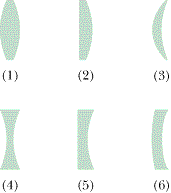
hrw7_34-49.gif

What is the focal length f for each lens?

for some reason I'm getting this wrong, all I'm doing is taking the center of radius and dividing it by 2 to get the focal length. But I'm not getting that right either. I don't see where I'm messing up. THe professor just said, take the given cirvature of raidus which is 15, divide it by 2 and that's ur answer, then you have to decide if its positve or negative. I tried both positive and negative both wrong. Any ideas?

In my notes i have it saying:
Focal length of a convex lens is +
Focal Length of a concave lens is -
so if i had a bi convex, is that like a convex and a concave put together, there for, a end result of a negative focal length because a positive times a negative is -?

Here is my work:

http://img146.imageshack.us/img146/5817/lastscan5bq.jpg
 

Attachments

  • hrw7_34-49.gif
    hrw7_34-49.gif
    2.3 KB · Views: 554
  • hrw7_34-49.gif
    hrw7_34-49.gif
    2.3 KB · Views: 493
Last edited by a moderator:
Physics news on Phys.org
For lenses the f = R/2 is not valid. It is for mirrors.
The correct one is
1/f = (u-1) (1/r1 - 1/r2)

(Use the New Cartesian Convention. Dunno which one you use. But we are supposed to use this :) )

so 1/f = (1.5-1) (1/15+1/15)
so f = 15cm.

And for combination of lenses placed together you may use the power of a lens thing.
P = 1/f f is in m
so combined power is P = 1/f1 + 1/f2
use the sign of focal length with sign.

and as far as i remember bi convex is a lens with both sides convex i.e both sides outward. Then there is a plano concave, plano convex, bi convex. Although I never mess with them, I always get confused.

PS If you don't use the New Cartesian Convention better wait for someone who can help with the Real Virtual thing.
 
Thanks hell raiser, the question wants
(a) What is the focal length f for each lens?
(1) bi-convex wrong check mark cm
(2) plane-convex cm
(3) meniscus convex wrong check mark cm
(4) bi-concave cm
(5) plane-concave cm
(6) meniscus concave cm
hrw7_34-49.gif

So if I'm finding the combined power, is that still the focal length?
Like for instance if i had a (4) bi-concave, which looks like #4 in the drawing.
I would have
f = (1-1.5)(1/15+1/15)
f = 15cm;

) would be concave
( would be convex
and a bi-concave looks like those 2 put together )(
The rule i have is, focal length of a convex is +
The focal length of a concave is a -
so would i do this?
combined power is P = 1/f1 + 1/f2
P = -1/15 + 1/15 = 0?
That makes no sense, do u see where I messed up on understanding what you said? Thanks for the reply!
 
Looks to me that you are confusing combining surfaces with combining lenses. (They are not the same! The power of a lens surface depends on what side of the lens it's on.) You need to use the Lens Maker's formula to find the focal length of these lenses (as hellraiser described). Here's a useful page describing that equation and its sign convention: http://hyperphysics.phy-astr.gsu.edu/hbase/geoopt/lenmak.html#c1

Here's a quick tip: You can quickly tell if a lens is converging (+ focal length) or diverging (- focal length) by comparing the thickness of the middle to the thickness of the edges: if the middle is thicker, it's converging.
 
THanks for the help Doc Al! great website, i forgot all about this site!:biggrin:
 

Similar threads

  • · Replies 7 ·
Replies
7
Views
2K
Replies
3
Views
3K
  • · Replies 3 ·
Replies
3
Views
2K
  • · Replies 5 ·
Replies
5
Views
2K
  • · Replies 8 ·
Replies
8
Views
2K
Replies
1
Views
2K
  • · Replies 2 ·
Replies
2
Views
2K
Replies
2
Views
3K
  • · Replies 1 ·
Replies
1
Views
3K
Replies
28
Views
5K