High School Finding Multiple Ways to Integrate

  • Thread starter Thread starter Comeback City
  • Start date Start date
  • Tags Tags
    Integrate Multiple
Click For Summary
The discussion focuses on integrating the function f(x) = 1/[(e^x)+1] using various methods in preparation for the AP Calculus test. Participants successfully utilized techniques such as trigonometric substitution, u-substitution, and partial fraction decomposition, but one individual sought to explore a series approach. They questioned how to prove the series is equivalent to the algebraic form derived from other methods. Clarifications were provided regarding the correct series expansion and the justification for changing the integral to a series, emphasizing the importance of proper convergence conditions. The conversation concluded with acknowledgments of errors and a better understanding of the integration process.
Comeback City
Messages
417
Reaction score
68
Hello everyone!

Today in my BC Calculus (calc 2) class, we spent time trying to find ways to integrate the same function (all methods we're fluent with, but are reviewing for the upcoming AP test)...
(I apologize in advance that I do not know how to use LaTex, but am trying to learn)

f(x) = 1/[(e^x)+1]

Overall, we were able to integrate using simple methods such as trigonometric substitution, u-substitution, partial fraction decomposition, and with another algebraic method.

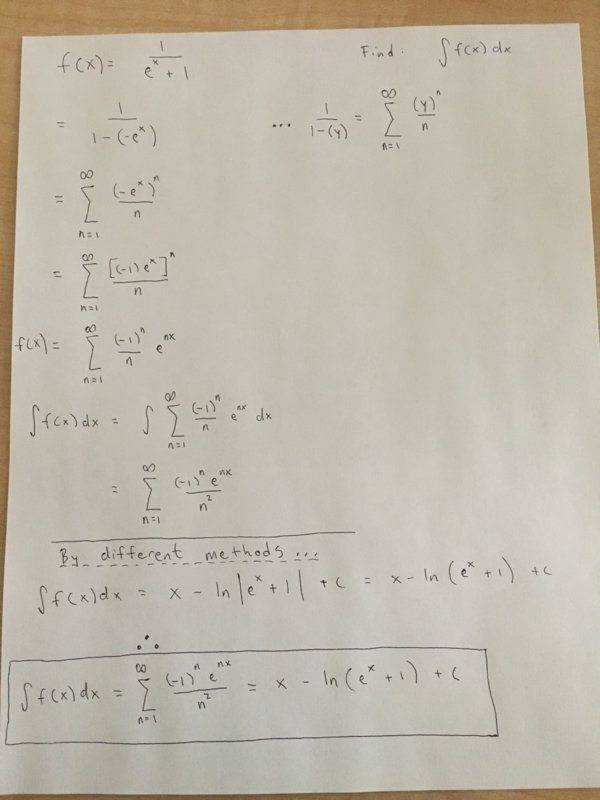
Being me, I didn't think this was enough, and attempted to solve this using a series. Below is my work...
240900


My question... Is there a way to continue this series and prove it is equivalent to the algebraic form found using the other integration methods? That is, besides just saying they come from the same integral.

Thank you in advance :woot:
 
Physics news on Phys.org
Did you justify the change of the integral and the series?
 
Comeback City said:
Hello everyone!

Today in my BC Calculus (calc 2) class, we spent time trying to find ways to integrate the same function (all methods we're fluent with, but are reviewing for the upcoming AP test)...
(I apologize in advance that I do not know how to use LaTex, but am trying to learn)

f(x) = 1/[(e^x)+1]

Overall, we were able to integrate using simple methods such as trigonometric substitution, u-substitution, partial fraction decomposition, and with another algebraic method.

Being me, I didn't think this was enough, and attempted to solve this using a series. Below is my work...

View attachment 240900

My question... Is there a way to continue this series and prove it is equivalent to the algebraic form found using the other integration methods? That is, besides just saying they come from the same integral.

Thank you in advance :woot:

Comparison of your answer with \ln(1 + y) = \sum_{n=1}^\infty (-1)^{n+1}\frac yn for |y| < 1 suggests a problem, and the problem is that you did not start with the correct series expansion of 1/(1 + y).

The binomial series expansion (1 + y)^{-1} = \sum_{n=0}^\infty (-1)^ny^n converges absolutely when |y| < 1. Now 0 < e^x < 1 only for x > 0; for x < 0 you will need to use a different expansion.

I leave you to show that:

(1) For 0 \leq a &lt; b we have <br /> \int_a^b \frac{1}{1 + e^x}\,dx = \int_a^b \sum_{n=0}^{\infty} (-1)^ne^{nx}\,dx <br /> = b - a + \sum_{n=1}^\infty (-1)^{n} \left(\frac{e^{nb}}{n} - \frac{e^{na}}{n} \right).<br /> (2) This last series converges absolutely (by, eg., the ratio test) and we are therefore justified in reordering the terms.
(3) By reordering the terms we can obtain b - a + \sum_{n=1}^\infty (-1)^{n} \left(\frac{e^{nb}}{n} - \frac{e^{na}}{n} \right) = b - a - \ln(e^b + 1) + \ln(e^a + 1) = \left[x - \ln(e^x + 1)\right]_a^b as required.

I also leave you to handle the case a &lt; b \leq 0 where this expansion of 1/(1 + e^x) does not converge.

(The case a &lt; 0 &lt; b can be obtained from the above two since \int_a^b = \int_a^0 + \int_0^b.)
 
  • Like
Likes Comeback City
pasmith said:
Comparison of your answer with \ln(1 + y) = \sum_{n=1}^\infty (-1)^{n+1}\frac yn for |y| &lt; 1 suggests a problem, and the problem is that you did not start with the correct series expansion of 1/(1 + y).

The binomial series expansion (1 + y)^{-1} = \sum_{n=0}^\infty (-1)^ny^n converges absolutely when |y| &lt; 1. Now 0 &lt; e^x &lt; 1 only for x &gt; 0; for x &lt; 0 you will need to use a different expansion.

I leave you to show that:

(1) For 0 \leq a &lt; b we have <br /> \int_a^b \frac{1}{1 + e^x}\,dx = \int_a^b \sum_{n=0}^{\infty} (-1)^ne^{nx}\,dx<br /> = b - a + \sum_{n=1}^\infty (-1)^{n} \left(\frac{e^{nb}}{n} - \frac{e^{na}}{n} \right).<br /> (2) This last series converges absolutely (by, eg., the ratio test) and we are therefore justified in reordering the terms.
(3) By reordering the terms we can obtain b - a + \sum_{n=1}^\infty (-1)^{n} \left(\frac{e^{nb}}{n} - \frac{e^{na}}{n} \right) = b - a - \ln(e^b + 1) + \ln(e^a + 1) = \left[x - \ln(e^x + 1)\right]_a^b as required.

I also leave you to handle the case a &lt; b \leq 0 where this expansion of 1/(1 + e^x) does not converge.

(The case a &lt; 0 &lt; b can be obtained from the above two since \int_a^b = \int_a^0 + \int_0^b.)
Dang, I figured I may have made a mistake early on in the problem... looks like the expansion I attempted to use was a cross between that of (1-x)^-1 and that of e^x itself... wrong in both cases:doh:

The part of your explanation I'm having trouble understanding is...

0 \leq a &lt; b we have <br /> \int_a^b \frac{1}{1 + e^x}\,dx = \int_a^b \sum_{n=0}^{\infty} (-1)^ne^{nx}\,dx<br /> = b - a + \sum_{n=1}^\infty (-1)^{n} \left(\frac{e^{nb}}{n} - \frac{e^{na}}{n} \right).<br />

How exactly does the (b-a) come into play at the beginning of the right side of this equation? If I were to take an educated guess, I'd say it has to do with the fact that n=0 must be changed to n=1 as the initial term of the series, along with the definite integral which, as you show, gives the (b-a).

Besides this part, your explanation makes complete sense, thank you!
 
Math_QED said:
Did you justify the change of the integral and the series?
@pasmith found my error, which was simply that I used an incorrect expansion :headbang:
 
@pasmith
I answered my own question... I see that you removed the n=0 term from the series before even taking the integral. Smart thinking. Everything else makes sense, so thank you for your help!

Edit: It looks like in your series expansion of ln(1+y), you forgot that y is raised to the "n" power within the series.
 
Last edited:

Similar threads

  • · Replies 14 ·
Replies
14
Views
4K
  • · Replies 6 ·
Replies
6
Views
3K
  • · Replies 1 ·
Replies
1
Views
2K
  • · Replies 6 ·
Replies
6
Views
2K
  • · Replies 19 ·
Replies
19
Views
4K
  • · Replies 2 ·
Replies
2
Views
3K
  • · Replies 3 ·
Replies
3
Views
2K
  • · Replies 1 ·
Replies
1
Views
1K
  • · Replies 6 ·
Replies
6
Views
2K
  • · Replies 2 ·
Replies
2
Views
2K