MHB Finding Polar Region Between r=2 and r=4cos(theta)

Click For Summary
SUMMARY

The discussion focuses on finding the polar region between the curves defined by the equations r=2 and r=4cos(θ). The area of interest is determined by calculating the combined area of the red and green regions formed by the intersection of these curves. The red area is established as one-half of the total area, leading to the conclusion that the desired area is (8π/3 - 2√3). The approach using geometry is validated alongside the calculus method for solving the integral in polar coordinates.

PREREQUISITES
  • Understanding of polar coordinates and their conversion to rectangular coordinates.
  • Familiarity with area calculations in polar coordinates.
  • Knowledge of geometric shapes and their area formulas, particularly for sectors and triangles.
  • Basic calculus concepts, specifically integration techniques.
NEXT STEPS
  • Study the derivation of areas in polar coordinates using integration techniques.
  • Learn about the properties of polar curves and their intersections.
  • Explore geometric methods for area calculation, particularly for sectors and triangles.
  • Practice solving integrals involving polar coordinates with examples similar to r=2 and r=4cos(θ).
USEFUL FOR

Students and educators in mathematics, particularly those focused on calculus and geometry, as well as anyone interested in understanding polar coordinate systems and area calculations.

Pindrought
Messages
15
Reaction score
0
I'm really stumped here as usual. Here is what I've managed to figure out.

I'm given two equations.
r=2
r=4cos(theta)I converted them both to rectangular coordinates to get an idea of what the graph would look like.

do1b.png


I need to find either the area in red or the area in green. (In this case, I tried to find the area in green) .If I have the area in red or green, I know that I can just subtract one of them from pi*r^2 which in this case would be 4pi to get the area of the other section.

The problem I am facing right now is setting up the integral the proper way. I was thinking of going about it like this.

so0p.png

ndjm.png


So a few questions. First, did I approach this in a correct way? Second, how would I know how to set this up to solve the integral using polar coordinates instead of converting it all to rectangular form?

Thanks for taking the time to answer, I tried to make this as clear as possible to see where I'm making my mistake or what I should be doing differently.
 
Physics news on Phys.org
I would prefer to do this problem using geometry rather than calculus.


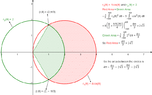
The red area here is one half of the area that you are looking for. The two circles intersect at the points $(1, \pm\sqrt3)$ (by Pythagoras). So the red and green regions together form a $120^\circ$ sector equal to one-third of the left circle. Thus the red and green regions have a combined area $\dfrac{4\pi}3.$ The green triangle has area (half base times height) $\sqrt3.$ So the red region has area $\dfrac{4\pi}3 - \sqrt3.$ The area that you want is twice the area of the red region, namely $\dfrac{8\pi}3 - 2\sqrt3.$

So your answer is correct (and of course the calculus method is just as valid as the geometric method).
 

Attachments

  • circle7.png
    circle7.png
    3.4 KB · Views: 163
Hi,
You wanted to know how to do this using polar coordinates and polar areas. The attachment shows how to do this:

View attachment 7769
 

Attachments

  • johng008.png
    johng008.png
    15.1 KB · Views: 211
Last edited by a moderator:

Similar threads

  • · Replies 15 ·
Replies
15
Views
3K
  • · Replies 6 ·
Replies
6
Views
4K
  • · Replies 5 ·
Replies
5
Views
4K
  • · Replies 1 ·
Replies
1
Views
2K
  • · Replies 4 ·
Replies
4
Views
2K
  • · Replies 3 ·
Replies
3
Views
2K
  • · Replies 4 ·
Replies
4
Views
2K
  • · Replies 11 ·
Replies
11
Views
3K
  • · Replies 8 ·
Replies
8
Views
3K
  • · Replies 3 ·
Replies
3
Views
2K