Finding power figures from graph data

Click For Summary

Discussion Overview

The discussion revolves around calculating power from data obtained through an Optical Rotary Encoder, specifically focusing on the challenges of accurately determining power during the acceleration of a shaft. Participants explore various methods for calculating power, considering the implications of non-constant rotational speed and the limitations of the available data.

Discussion Character

  • Technical explanation
  • Debate/contested
  • Mathematical reasoning

Main Points Raised

  • One participant seeks confirmation on their power calculation method, noting the use of an Optical Rotary Encoder to measure shaft acceleration.
  • Another participant points out that the formula for power assumes constant RPM, which is not applicable due to the acceleration of the wheel during the measurement interval.
  • A suggestion is made to calculate the initial and final energy and divide the difference by time to obtain average power, which is presented as a model-independent approach.
  • Concerns are raised about the uncertainty in determining when acceleration starts, which could affect the accuracy of any calculations.
  • Participants discuss the potential impact of excluding the first interval of data on the power calculation and whether averaging power across multiple intervals would yield different results.

Areas of Agreement / Disagreement

Participants express differing views on the accuracy of the data and the methods for calculating power. There is no consensus on the best approach, and uncertainty regarding the starting point of acceleration remains a significant concern.

Contextual Notes

Limitations include the uncertainty in the timing of acceleration and the nature of the data being sampled at discrete intervals, which may affect the reliability of the power calculations.

lownlazy
Messages
13
Reaction score
0
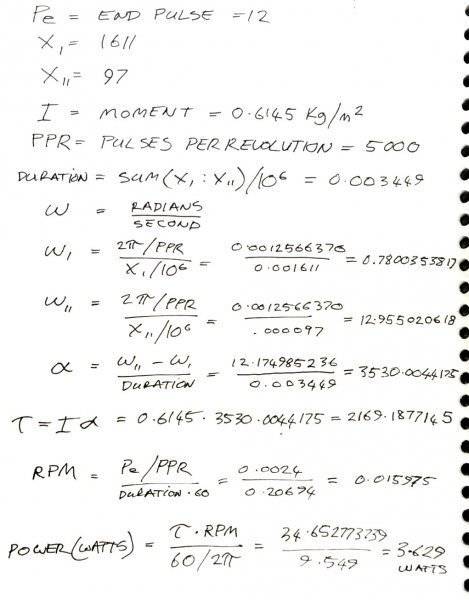
I need help! Could you please double checking my work: calculating a Power information from data I am collecting. I have been Googling and wiki'ing for weeks now and I think I have it right but I need someone to confirm or correct what i have done..

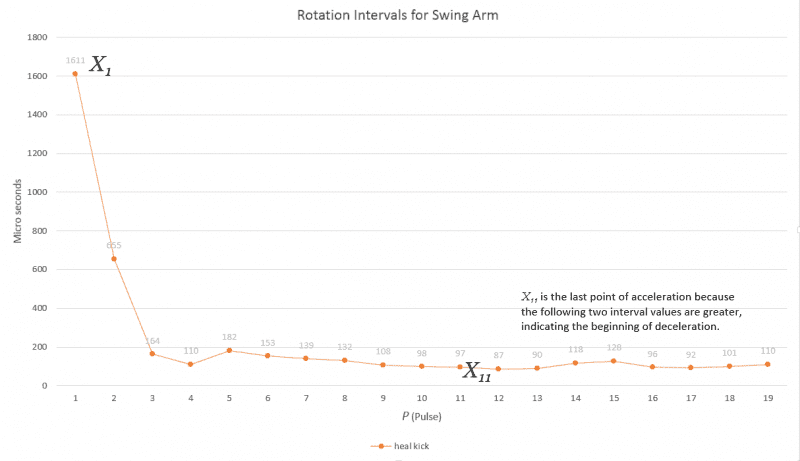
The graph data comes from and Optical Rotary Encoder, which for the unfamiliar, is used to measure/feedback the position of a shaft. In my case I am using it to measure the acceleration of a shaft spin for this project. I have been working on the project for 2 years now and getting past this math stage would be a huge step towards completion.

also, sorry about the Sudo-notation . :)
punchbot math.jpg
swing arm graph.PNG
 
Mathematics news on Phys.org
The formula you use for power assumes a constant rpm, something that is certainly not true.

During the first interval (lasting 1.6ms) the wheel accelerates a lot, assuming a uniform velocity within that timescale (to get an angular velocity) is not a good approximation. This does matter if you want to calculate the acceleration - but that gives larger errors anyway.
I would calculate the initial energy and the final energy, divide the difference by the time and you get the average power in a very model-independent way.
 
mfb said:
I would calculate the initial energy and the final energy, divide the difference by the time and you get the average power in a very model-independent way.

I will give this (above quoted) a go for sure.

In you reply you say that the 1.6 micro-second interval " assuming a uniform velocity within that timescale is not a good approximation." are you saying I am working with "bad" data? If so does this mean that i try your solution, or any solution, that will will yield inaccurate results?
 
Well no method will give exact results as your data is available in those time steps only.
In particular, you do not know when exactly acceleration started, which gives an uncertainty of ~800µs.
 
mfb said:
Well no method will give exact results as your data is available in those time steps only.
In particular, you do not know when exactly acceleration started, which gives an uncertainty of ~800µs.

Yes I should have mentioned this earlier, the acceleration starts in the interval before X1. I didnt include it because it is impossible to know its real angle and is therefore null data. Does this effect what you have replied with so far?
 
Then we don't know when the acceleration starts? Well, it increases the uncertainty.
If there is some physical motivation to assume a constant torque or a constant power, a fit to the data might give better results, but I don't think it helps here.
 
mfb said:
I would calculate the initial energy and the final energy, divide the difference by the time and you get the average power

I was wondering... do you think it would be more accurate to find the power for each of the 12 intervals and get the average from across those?
 
That will give exactly the same result. But it might be interesting to remove the first interval. On the other hand, I would not expect power to be constant, so you have to figure out what exactly you want to calculate anyway.
 

Similar threads

  • · Replies 17 ·
Replies
17
Views
1K
  • · Replies 8 ·
Replies
8
Views
2K
Replies
11
Views
2K
  • · Replies 5 ·
Replies
5
Views
4K
  • · Replies 8 ·
Replies
8
Views
3K
  • · Replies 4 ·
Replies
4
Views
3K
  • · Replies 10 ·
Replies
10
Views
3K
  • · Replies 11 ·
Replies
11
Views
3K
  • · Replies 3 ·
Replies
3
Views
4K
  • · Replies 18 ·
Replies
18
Views
4K