Finding specific weight of unknown fluid in a manometer

Click For Summary
The discussion revolves around calculating the specific weight of an unknown fluid using a manometer. Initially, the user encountered difficulties and obtained an incorrect result, but later repositioned measurement points A and B to the bottom of the manometer, leading to a corrected specific weight of approximately 13.0 kN/m3. There was confusion regarding the distinction between specific weight and density, with clarification that the problem specifically required the former, measured in kN/m3. Another participant noted that their calculation yielded a density of 1.32×10^3 kg/m3, emphasizing the importance of using the correct units. Ultimately, the user successfully resolved their issue by adjusting their approach.
Bolter
Messages
262
Reaction score
31
Homework Statement
See below
Relevant Equations
N/A
Hey everyone!
Here is the problem I have been tackling but did not end up with the correct answer
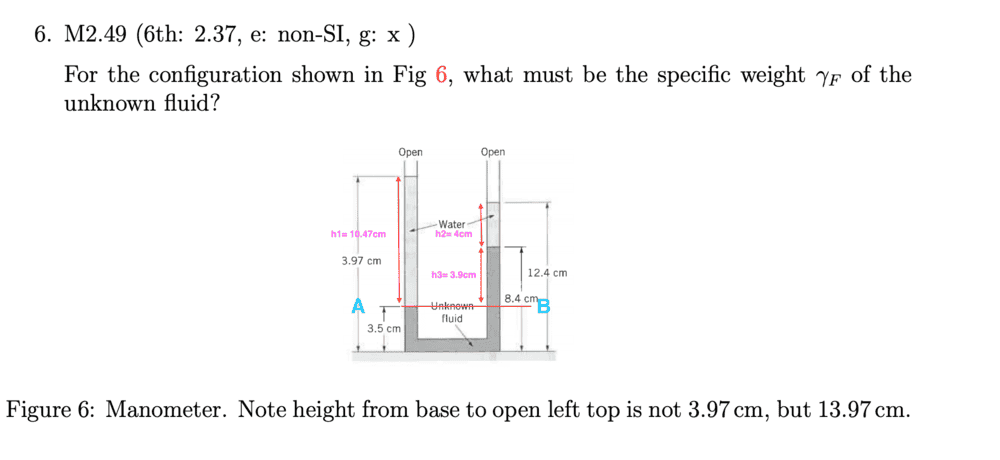
Screenshot 2020-09-30 at 15.28.43.png

The extra red arrows I have labelled in myself and called these distances h1,h2 and h3. I assumed the pressure to be the same at levels A & B, hence i have established expressions for both of these and got the following
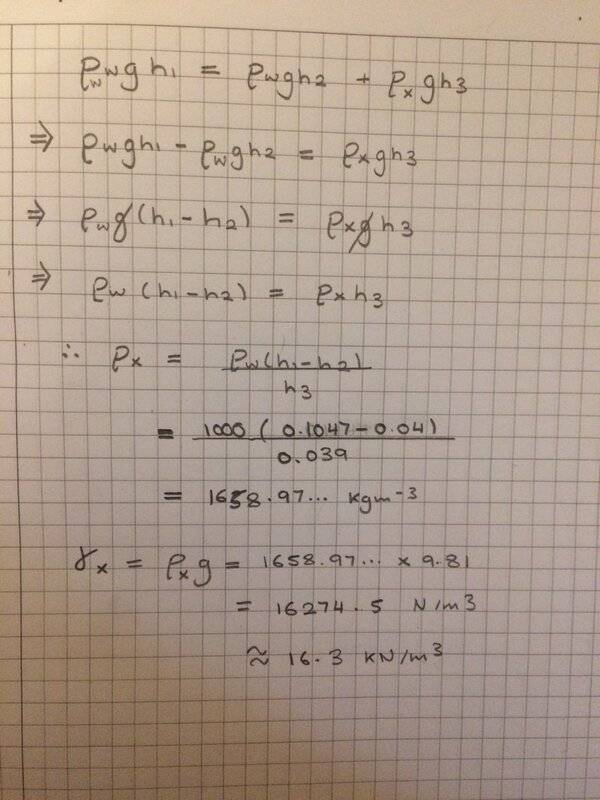
IMG_5301.JPG


However this is not right and the right answer is actually 13.0 kN/m3. What did I do wrong exactly?

Thanks
 
Physics news on Phys.org
Nevermind I think I got the right answer now by doing something slightly different. I repositioned A & B to to be at the bottom of the manometer on both sides like this

Screenshot 2020-09-30 at 15.31.27.png

I redid the method I used before in my first post. I got specific weight to come out as 12.95320... kN/m3 which is approx 13.0 kN/m3 to 3 sig figs
 
Bolter said:
Nevermind I think I got the right answer now by doing something slightly different. I repositioned A & B to to be at the bottom of the manometer on both sides like this

View attachment 270242
I redid the method I used before in my first post. I got specific weight to come out as 12.95320... kN/m3 which is approx 13.0 kN/m3 to 3 sig figs
Probably round off errors. My calculation according to the method in the original post gave, to 3 sig. figs., 1.32×10³ kg/m3. Note the correct units of density; the factor of ##g## cancels out.
 
kuruman said:
Probably round off errors. My calculation according to the method in the original post gave, to 3 sig. figs., 1.32×10³ kg/m3. Note the correct units of density; the factor of ##g## cancels out.

Its not asking for density, its asking for specific weight I believe which has units kN/m3
 
  • Like
Likes kuruman
You are absolutely correct.
 
The book claims the answer is that all the magnitudes are the same because "the gravitational force on the penguin is the same". I'm having trouble understanding this. I thought the buoyant force was equal to the weight of the fluid displaced. Weight depends on mass which depends on density. Therefore, due to the differing densities the buoyant force will be different in each case? Is this incorrect?

Similar threads

Replies
1
Views
2K
Replies
5
Views
2K
  • · Replies 4 ·
Replies
4
Views
27K
  • · Replies 6 ·
Replies
6
Views
2K
  • · Replies 42 ·
2
Replies
42
Views
5K
Replies
14
Views
7K
  • · Replies 20 ·
Replies
20
Views
4K
  • · Replies 8 ·
Replies
8
Views
688
Replies
17
Views
5K
  • · Replies 4 ·
Replies
4
Views
7K