Bow & arrow -- Forces on the Bow

  • Thread starter Thread starter Bolter
  • Start date Start date
  • Tags Tags
    Forces
Click For Summary

Homework Help Overview

The discussion revolves around the forces acting on an archer's left hand while using a bow and arrow, specifically in the context of projectile motion. Participants are tasked with analyzing the forces involved while ignoring the weight of the bow and arrow.

Discussion Character

  • Exploratory, Assumption checking, Conceptual clarification

Approaches and Questions Raised

  • Participants explore the concept of forces acting on the left hand, questioning the presence of a normal force and the implications of equilibrium. Some suggest that the tension in the string is a critical factor, while others express confusion about the forces involved and whether they are overcomplicating the situation.

Discussion Status

The discussion is active, with participants providing insights and questioning each other's reasoning. Some have offered guidance to simplify the analysis by focusing on the left and right hands and the forces they exert. There is recognition of the need to consider the system as a whole rather than breaking it down into components.

Contextual Notes

Participants are instructed to ignore the weight of the bow and arrow, which adds complexity to their analysis of forces. The discussion reflects varying levels of understanding regarding tension and equilibrium in the context of the bow and arrow system.

Bolter
Messages
262
Reaction score
31
Homework Statement
Determine what the magnitude and direction of the force exerted by the archer's left hand
Relevant Equations
SUVAT equations
Hello everyone!

So I have been doing this projectile motion question and do not understand how to do work out which forces act on the archer's left hand in part a)i?

I am specifically told to ignore the weight of the bow & arrow. But this is force that only acts downward for the bow & arrow only, not on the left hand. I can't really deduce what other forces are acting on the left hand in this situation.

Is there a normal force acting on the left hand as a result of supporting weight of the bow & arrow? Since if the archer is initially stationary before firing, then resultant force has to be zero and the body is said to be in equilibrium. I.e. an upward normal force exists on the left hand and is equal in magnitude to the weight of both `& arrow. However I'm not sure if the entire bow & arrow weight is balanced by the normal force?
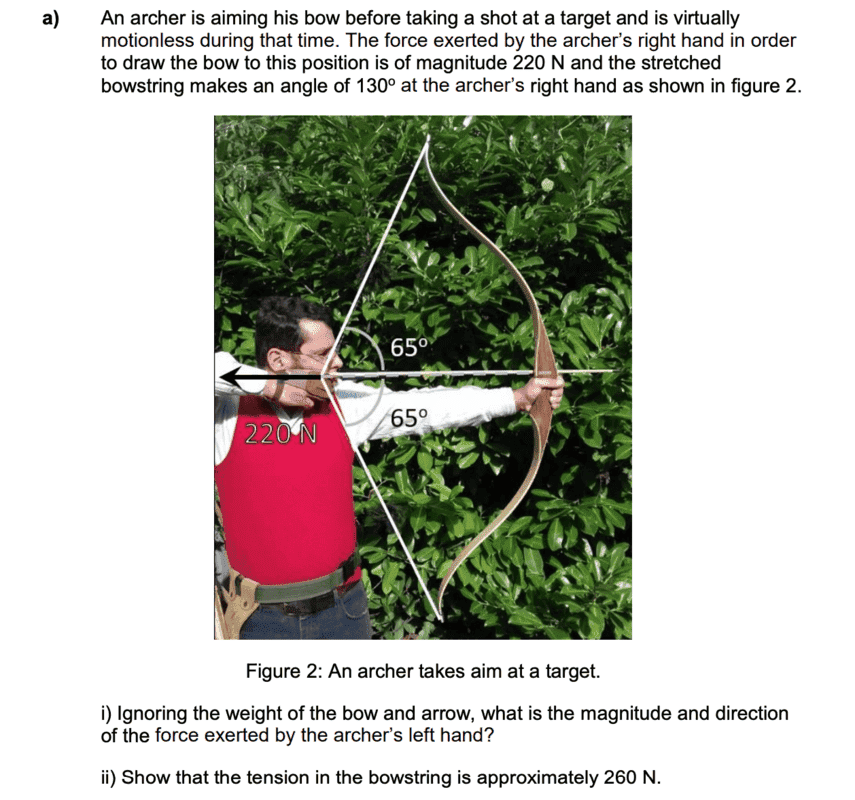
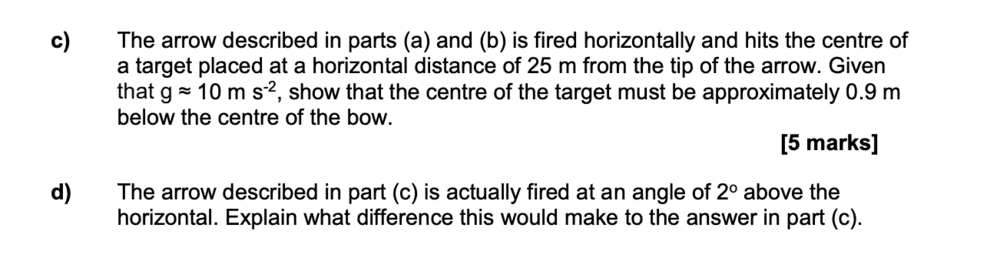
Screenshot 2020-01-08 at 14.25.51.png

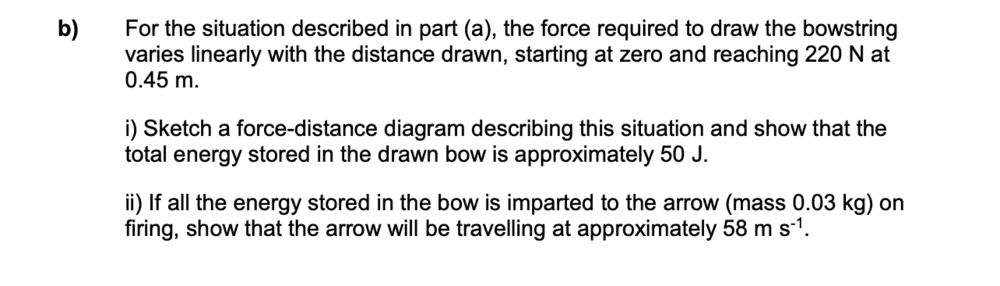
Screenshot 2020-01-08 at 14.26.08.png

Screenshot 2020-01-08 at 14.26.17.png

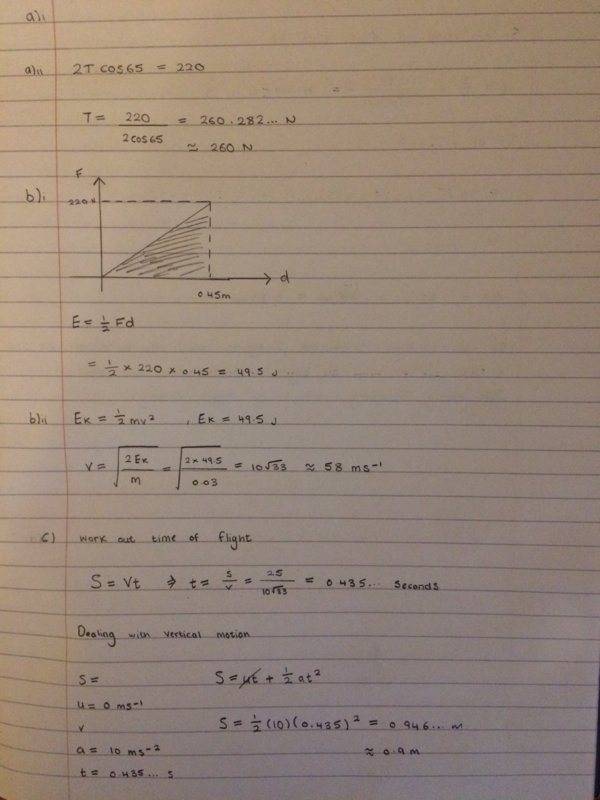
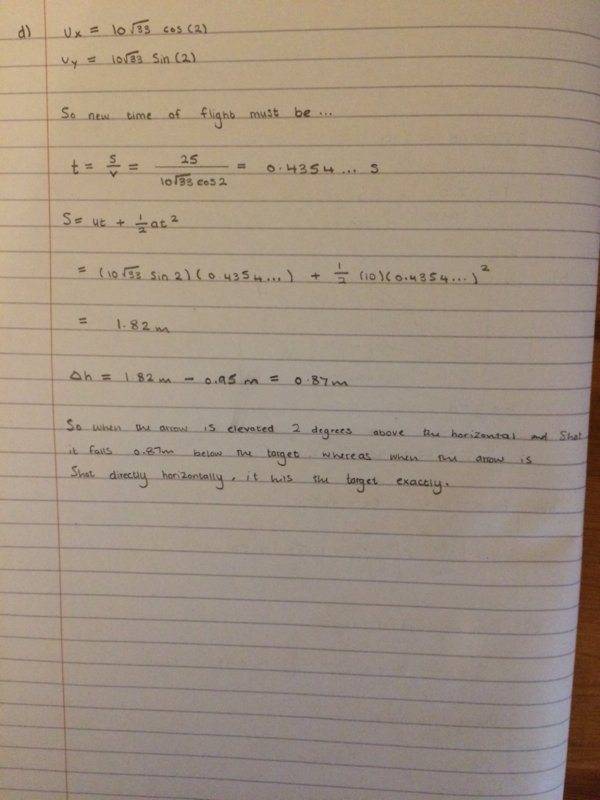
I have tried the rest but unsure if my answers are right

Here they are

IMG_3617.JPG

IMG_3618.JPG


Any help would be appreciated! Thanks
 
Physics news on Phys.org
I must be missing something. Seems to me this is WAY overly complicated. You have a single system of bow and string, joined as one unit. You have a force in one direction on the string and a force in the other direction on the bow. If the forces are different, wouldn't you expect the bow/string unit to move to the left or right? Since they don't, what does that tell you?
 
Bolter said:
Is there a normal force acting on the left hand as a result of supporting weight of the bow & arrow? Since if the archer is initially stationary before firing, then resultant force has to be zero and the body is said to be in equilibrium. I.e. an upward normal force exists on the left hand and is equal in magnitude to the weight of both `& arrow. However I'm not sure if the entire bow & arrow weight is balanced by the normal force?
This is all correct as far as I can tell at a glance, but like phinds said, you're overthinking it. It says to ignore the weight, so ignore the weight. What other force(s) are acting on the bow/arrow/bowstring? That's all you need to consider.
 
phinds said:
I must be missing something. Seems to me this is WAY overly complicated. You have a single system of bow and string, joined as one unit. You have a force in one direction on the string and a force in the other direction on the bow. If the forces are different, wouldn't you expect the bow/string unit to move to the left or right? Since they don't, what does that tell you?

Both left force is equal to the total right force if the object doesn't move in the horizontal direction.

Well the 220N force that is applied to the left gets balanced by the 2 equal horizontal component of tension. But does this tell me anything about what force is exerted by the left hand?
 
jackwhirl said:
This is all correct as far as I can tell at a glance, but like phinds said, you're overthinking it. It says to ignore the weight, so ignore the weight. What other force(s) are acting on the bow/arrow/bowstring? That's all you need to consider.

Tension on the string is the only other force that I can think of that is acting on here
 
You're really close. Now, follow that force up the string. Where does it come from? Where does it go?
 
Bolter said:
Both left force is equal to the total right force if the object doesn't move in the horizontal direction.

Well the 220N force that is applied to the left gets balanced by the 2 equal horizontal component of tension. But does this tell me anything about what force is exerted by the left hand?
You continue to make this ridiculously harder than it is. Forget everything but the left and right hands.
 
jackwhirl said:
You're really close. Now, follow that force up the string. Where does it come from? Where does it go?

I suppose I need to consider the vertical component of tension perhaps

The tension comes from the archer's right hand when the archer pulls the string taut backwards? And horizontal component of tension is exerted on the arrow. Not so sure where the vertical component of tension is exerted on?
 
Bolter said:
I suppose I need to consider the vertical component of tension perhaps

The tension comes from the archer's right hand when the archer pulls the string taut backwards? And horizontal component of tension is exerted on the arrow. Not so sure where the vertical component of tension is exerted on?
You continue to make this ridiculously harder than it is. Forget everything but the left and right hands.

And re-read post #2
 
  • #10
Bolter said:
I suppose I need to consider the vertical component of tension perhaps

The tension comes from the archer's right hand when the archer pulls the string taut backwards? And horizontal component of tension is exerted on the arrow. Not so sure where the vertical component of tension is exerted on?
Nothing is exerted on the arrow until it is loosed, other than the minimal force to hold it up against gravity, which you've been explicitly instructed to ignore.

When you pull on a string, it doesn't magically resist that force. Tension is transferred through a taut string to the other end, and whatever it is anchored to. What is this string connected to?
 
  • Like
Likes   Reactions: Bolter
  • #11
phinds said:
You continue to make this ridiculously harder than it is. Forget everything but the left and right hands.

Sorry this proble
jackwhirl said:
Nothing is exerted on the arrow until it is loosed, other than the minimal force to hold it up against gravity, which you've been explicitly instructed to ignore.

When you pull on a string, it doesn't magically resist that force. Tension is transferred through a taut string to the other end, and whatever it is anchored to. What is this string connected to?

It is connected to the ends of the bow, so tension is transferred to the bow then
 
  • #12
Bolter said:
It is connected to the ends of the bow, so tension is transferred to the bow then
And the bow is not moving, right? Thus the net forces are?
 
  • #13
phinds said:
You continue to make this ridiculously harder than it is. Forget everything but the left and right hands.

And re-read post #2

Ok so right hand has a 220N acting leftwards so left hand has a 220N force acting rightwards? I am sorry if this statement sounds awfully wrong :frown:
 
  • #14
jackwhirl said:
And the bow is not moving, right? Thus the net forces are?

Net force has to be zero
 
  • #15
Bolter said:
Ok so right hand has a 220N acting leftwards so left hand has a 220N force acting rightwards? I am sorry if this statement sounds awfully wrong :frown:
Bolter said:
Net force has to be zero
You've got it. Put it all together now.
 
  • #16
jackwhirl said:
You've got it. Put it all together now.

For the entire system to stay in equilibrium, i.e. the resultant force has to stay zero. A 220N force is exerted by the left hand in the right direction to oppose the 220N force that is exerted by the right hand in the left direction
 
  • Like
Likes   Reactions: jackwhirl
  • #17
Bolter said:
For the entire system to stay in equilibrium, i.e. the resultant force has to stay zero. A 220N force is exerted by the left hand in the right direction to oppose the 220N force that is exerted by the right hand in the left direction
Yes. That's what I told you in post #2. Glad you finally got it. We tend to give pretty decent hints here on PF. You should learn to pay attention to them.
 
  • Like
Likes   Reactions: Bolter
  • #18
phinds said:
Yes. That's what I told you in post #2. Glad you finally got it. We tend to give pretty decent hints here on PF. You should learn to pay attention to them.

Yes my bad, I really did overthink it :rolleyes:
 
  • Like
Likes   Reactions: phinds
  • #19
You did fine. I bet it was a)ii that threw you off. It broke the bow/bowstring into different components in your mind. The answer to a)i is only obvious if you can treat them as one unit.

I still have to stop and think about how tension works for problems like this.
 
  • #20
jackwhirl said:
You did fine. I bet it was a)ii that threw you off. It broke the bow/bowstring into different components in your mind. The answer to a)i is only obvious if you can treat them as one unit.

I still have to stop and think about how tension works for problems like this.

You're certain right it did indeed. I have a habit of always breaking down any force I get into its x and y parts. But this was a good example that taught me you don't necessarily have to think of it like that always, and that it's far more easier to treat it as one whole system.
 
  • #21
Bolter said:
You're certain right it did indeed. I have a habit of always breaking down any force I get into its x and y parts. But this was a good example that taught me you don't necessarily have to think of it like that always, and that it's far more easier to treat it as one whole system.
Right. The first thing you should always do is look at the system as a whole and that will often lead you to the proper way to do whatever breakdown of individual components might be needed (or in this case, not needed).
 

Similar threads

  • · Replies 3 ·
Replies
3
Views
1K
Replies
10
Views
959
Replies
9
Views
6K
Replies
43
Views
3K
  • · Replies 6 ·
Replies
6
Views
6K
  • · Replies 9 ·
Replies
9
Views
3K
Replies
6
Views
3K
  • · Replies 3 ·
Replies
3
Views
2K
  • · Replies 9 ·
Replies
9
Views
2K
Replies
20
Views
2K