Finding speed of a falling brick using distance and the acceleration of gravity

Join the discussion
Registration is free. Ask a follow-up in this thread, or start your own.
5 replies · 3K views
vytrx
Messages
4
Reaction score
3
Homework Statement
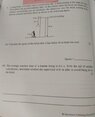
A supervisor 1.8m tall visits a construction site a brick resting at the edge of a roof 50m above the ground suddenly falls at the instant when the brick has fallen 30m without encountering any air resistance, the supervisor sees the brick coming down directly towards him from above as shown in the following figure. (attached) Calculate the speed of the brick after it has falled 30 m from the roof
Relevant Equations
Speed=distance/time
acceleration of gravity is 10m/s^2
Since the brick has fallen 30m and the acceleration of gravity is 10m/s^2 the brick would have fallen 3 seconds speed of brick would then be 30/3 leaving the answer at 10m/s?I am new to physics and this question has left me stumped
 
Attachments
  • 1651731802651.jpg
    1651731802651.jpg
    21.5 KB · Views: 203
Physics news on Phys.org
vytrx said:
Relevant Equations:: Speed=distance/time
That's only true for constant speed. Or, in simple cases, for calculating the average speed.

Do you know the SUVAT equations?

vytrx said:
Since the brick has fallen 30m and the acceleration of gravity is 10m/s^2 the brick would have fallen 3 seconds
You may be confusing speed and acceleration here.
vytrx said:
speed of brick would then be 30/3 leaving the answer at 10m/s?
This is not correct.

:welcome:
 
PeroK said:
That's only true for constant speed. Or, in simple cases, for calculating the average speed.

Do you know the SUVAT equations?You may be confusing speed and acceleration here.

This is not correct.

:welcome:
No I'm not familiar with the SUVAT equations, yes I may be confusing the two would you care to explain how this question is done? I've asked one of my friends that said that the answer was 24.5 but I'm not entirely sure how to get there
 
vytrx said:
No I'm not familiar with the SUVAT equations, yes I may be confusing the two would you care to explain how this question is done? I've asked one of my friends that said that the answer was 24.5 but I'm not entirely sure how to get there
The SUVAT equations are the starting point for a study of physics, so you'll need to learn about them. Try this to get you started.

https://www.ncl.ac.uk/webtemplate/a...mechanics/kinematics/equations-of-motion.html
