Finding the Axis of Rotation with Given CoG and Force Point

Click For Summary

Discussion Overview

The discussion revolves around finding the axis of rotation for a body given its center of gravity and the point of application of an external force, including the force's magnitude and direction. The context involves theoretical considerations and mathematical reasoning related to torque and rotational motion.

Discussion Character

  • Exploratory
  • Technical explanation
  • Mathematical reasoning
  • Debate/contested

Main Points Raised

  • One participant seeks to determine the axis of rotation by finding a point where the net torque from gravity and the external force is zero, suggesting multiple potential axes of rotation exist.
  • Another participant questions the clarity of the initial sketch and asks for clarification on the torque and center of mass.
  • There is a discussion about the correct placement of the center of mass in relation to the external force, with some confusion about the diagram's representation.
  • Participants discuss the nature of the body, clarifying it is a square with negligible thickness and mass, and that the external force is a thrust acting at the bottom right corner.
  • There is a debate about the direction and nature of the external force, with one participant suggesting it should be referred to as thrust and questioning its constancy and application over time.
  • Some participants express uncertainty about the implications of the external force being applied out of the plane of the square.

Areas of Agreement / Disagreement

Participants express various viewpoints regarding the placement of the center of mass, the nature of the external force, and the calculation of torque. There is no consensus on the uniqueness of the axis of rotation or the implications of the external force's application.

Contextual Notes

Participants note limitations in the clarity of the initial problem statement and the diagram, which may affect the understanding of the torque calculations and the axis of rotation. The discussion includes unresolved questions about the mathematical steps involved in determining the axis of rotation.

pointdexter16
Messages
19
Reaction score
2
TL;DR
I want to determine the axis of rotation of a body which is falling under the influence of gravity and an external force is acting on a specific point on it.
[Mentor Note: See post #10 below for an updated problem statement using LaTeX and with a better drawing]
WhatsApp Image 2023-05-03 at 1.04.51 AM.jpeg
421dbcd3-7628-44db-b6ec-3ab215768f24.jpg


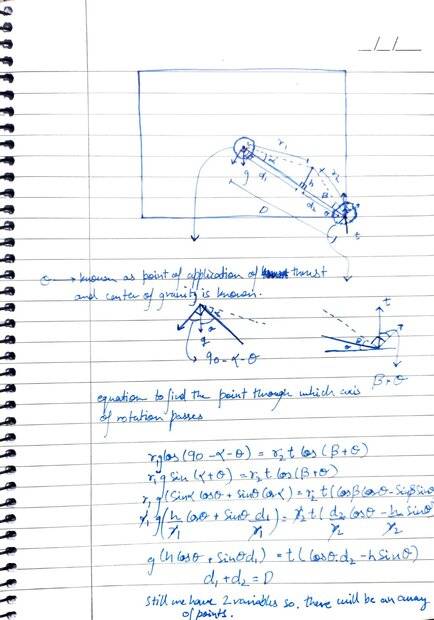
what i want is to find the axis of rotation when the centre of gravity and point on which external force is acting is given along with the magnitude and direction of force. In the example that i used to illustrate the above problem i have taken a simple case where centre of gravity is the centre of the square as mass is uniformly distributed and the point where external force is acting is the bottom left corner of the square.When i was looking for how to determine the axis of rotation it was given that it passes through the point where the torque produce by both gravity and external force is zero therefore making it a point which won't go through rotational motion.Now i tried to determine the point my solving the equation but i ended but with 2 variable in the end which concludes that there will an array of points which intern means that there will be multiple axis of rotation though i believe that i am making some mistake cause intuitively i feels like there should only be one.i am open to other approaches to this problem.please excuse me for my sloppy writing .Thank you
 
Last edited by a moderator:
Physics news on Phys.org
Welcome to PF.

pointdexter16 said:
Please excuse me for my sloppy writing .Thank you
For future posts, please see the "LaTeX Guide" link below the Edit window. That will help you post math equations here at PF. Thanks. :smile:
 
  • Like
Likes   Reactions: Vanadium 50
I can't follow the sketch (so I agree with @berkeman ) but let me ask you two questions:
1. What is the torque on the object?
2. What is its center of mass?
 
Welcome, @pointdexter16 !

Why is the center of mass located all the way to the left end of the falling body?
It is very hard to see your diagram, sorry.

I am referring to "centre of gravity is the centre of the square as mass is uniformly distributed and the point where external force is acting is the bottom left corner of the square."

May it be bottom right corner instead?
 
berkeman said:
Welcome to PF. For future posts, please see the "LaTeX Guide" link below the Edit window. That will help you post math equations here at PF. Thanks. :smile:
ohh thank you will keep in mind
 
Lnewqban said:
Welcome, @pointdexter16 !

Why is the center of mass located all the way to the left end of the falling body?
It is very hard to see your diagram, sorry.

I am referring to "centre of gravity is the centre of the square as mass is uniformly distributed and the point where external force is acting is the bottom left corner of the square."

May it be bottom right corner instead?
yup you are right i typed left instead of right should i repost the problem with better formatting?
 
Vanadium 50 said:
I can't follow the sketch (so I agree with @berkeman ) but let me ask you two questions:
1. What is the torque on the object?
2. What is its center of mass?
1.to calculate torque we need a point right with respect to which we can calculate torque so what i am trying to achieve is find a point where the torque produced by gravity and external force is zero so that i can consider it as a point through which axis of rotation passes.
2.centre of mass and centre of gravity are the geometric centre of the body
 
berkeman said:
Welcome to PF. For future posts, please see the "LaTeX Guide" link below the Edit window. That will help you post math equations here at PF. Thanks. :smile:
should i repost
 
pointdexter16 said:
should i repost
You can just add a new post below with your corrections and LaTeX. When you do that let me know, and I'll add a note to your first post to let folks know to skip ahead to the improved/corrected post. :smile:
 
  • #10
I am basing this off on the fact that axis of rotation passes through the point which has a net total of zero torque so in order to find the point i will choose a random point and solve so that the torque produced by gravity and the external force is zero.
things that are give or know:

1.dimensions of the body(square)
2.centre of mass and centre of gravity coincides and are equal to geometric centre
3.point at which the external force is acting
4.theta
5.magnitude and direction of gravitational and external force
6.distance between centre and point on which external force is acting
##r1.g.cos(90-\alpha-\theta)=r2.t.cos(90-\theta+\beta)##
##r1.g.sin(\alpha+\theta)=r2.t.sin(\theta-\beta)##
##r1.g.(sin(\alpha).cos(\theta)+sin(\theta).cos(\alpha))=r2.t.(sin(\theta).cos(\beta)-sin(\beta).cos(\theta))##
##r1.g.((h/r1).cos(\theta)+sin(\theta).(d1/r1))=r2.t.(sin(\theta).(d2/r2)-(h/r2).cos(\theta))##
take r1 and r2 common and cancel
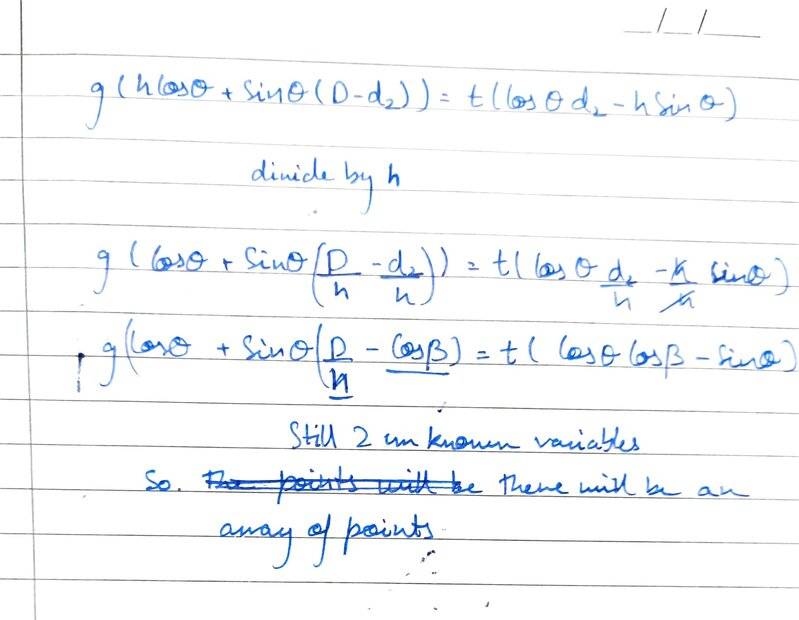
##g.((h).cos(\theta)+sin(\theta).(d1))=t.(sin(\theta).(d2)-(h).cos(\theta))##
##D=d1+d2##
still after substituting values there will be always two unknown variable so there won't be a unique solution
Screenshot 2023-05-05 at 12.01.20 AM.png
 
  • #11
berkeman said:
You can just add a new post below with your corrections and LaTeX. When you do that let me know, and I'll add a note to your first post to let folks know to skip ahead to the improved/corrected post. :smile:
done!!
 
  • Like
Likes   Reactions: berkeman
  • #12
Is the body those two bars?
 
  • #13
erobz said:
Is the body those two bars?
it's a square in the sketch only the bottom right part is visible
 
  • #14
pointdexter16 said:
it's a square in the sketch only the bottom right part is visible
So the body is just a flat plate?
 
  • #15
erobz said:
So the body is just a flat plate?
yes with zero thickness
 
  • #16
pointdexter16 said:
yes with zero thickness
So it has no mass?
 
  • #17
it's not zero but close to that
i took that as the case so that i can solve it in 2D
 
  • #18
erobz said:
So it has no mass?
if you want you can consider it as a cube but then the the point on which the external force is acting is at the bottom right corner but it's z coordinate is equal to the z coordinate of the centre of the cube such that the torque produced in the z axis is zero
 
  • #19
pointdexter16 said:
if you want you can consider it as a cube but then the the point on which the external force is acting is at the bottom right corner but it's z coordinate is equal to the z coordinate of the centre of the cube such that the torque produced in the z axis is zero
Ok, so you want to ignore the fact that the force is applied out of plane. So its a 2D square with some mass evenly distributed, and a force is acting on its lower right corner. What is the nature of the force e.g. its direction and magnitude? How is it being applied?
 
  • #20
direction->perpendicular to lower surface, magnitude->t
 
  • #21
pointdexter16 said:
direction->perpendicular to lower surface,
Perpendicular to the lower edge throughout the motion?
pointdexter16 said:
magnitude->t
t? ( terrible choice for the name of the force by the way- may I suggest instead ##F##) is it a constant magnitude or one that varies in time? Or is it just perhaps an impulsive force ( applied over very short duration of time)?
 
  • #22
erobz said:
Perpendicular to the lower edge throughout the motion?

t? ( terrible choice for the name of the force by the way- may I suggest instead ##F##) is it a constant magnitude or one that varies in time? Or is it just perhaps an impulsive force ( applied over very short duration of time)?
t->thrust
constant
 
  • #23
pointdexter16 said:
t->thrust
constant
Lowercase ##t## is usually reserved for time.

And the direction? Always perpendicular to the lower edge, even as the body rotates?
 
  • #24
yes its a thruster attached there
ok got the t thing will keep in mind
erobz said:
Lowercase ##t## is usually reserved for time.

And the direction? Always perpendicular to the lower edge, even as the body rotates?
 
  • Like
Likes   Reactions: erobz
  • #25
As far as I can tell, this is what you are talking about. At some time ##t=0## we have the initial state:

1683238438052.png


Then at some later time ##t## the system has evolved to:

1683238613397.png

Is this good?
 
  • #26
erobz said:
As far as I can tell, this is what you are talking about. At some time ##t=0## we have the initial state:

View attachment 325953

Then at some later time ##t## the system has evolved to:

View attachment 325955
Is this good?
yes but Ft is acting upward
 
  • #27
1683240696884.png


and

1683240713499.png


?

Familiar with Newtons Second Laws?
 
Last edited:
  • #29
pointdexter16 said:
yes
Ok, well go ahead and write them down to describe ##x(t), y(t), \theta(t)##.
 
  • #30
erobz said:
Ok, well go ahead and write them down to describe ##x(t), y(t), \theta(t)##.
Ok
 

Similar threads

  • · Replies 6 ·
Replies
6
Views
1K
  • · Replies 10 ·
Replies
10
Views
4K
  • · Replies 5 ·
Replies
5
Views
3K
  • · Replies 2 ·
Replies
2
Views
1K
  • · Replies 21 ·
Replies
21
Views
4K
  • · Replies 9 ·
Replies
9
Views
3K
  • · Replies 6 ·
Replies
6
Views
2K
  • · Replies 10 ·
Replies
10
Views
3K
  • · Replies 8 ·
Replies
8
Views
2K
  • · Replies 12 ·
Replies
12
Views
2K