Finding the coefficient of viscosity

Click For Summary
SUMMARY

The discussion focuses on calculating the coefficient of viscosity (η) using the slope of a line derived from experimental data related to flow between a rotating cylinder and a stationary cylinder. Participants emphasized the importance of accurately determining the slope through the change in y over the change in x, with one user reporting a slope of 0.34. The conversation also highlighted the necessity of plotting the data to validate the linearity of the relationship and the potential influence of static friction on the results.

PREREQUISITES
  • Understanding of viscosity and its significance in fluid dynamics
  • Familiarity with linear regression and slope calculation
  • Knowledge of experimental data collection methods
  • Basic skills in data visualization techniques, such as plotting graphs
NEXT STEPS
  • Learn how to calculate viscosity using the slope of a line in fluid dynamics experiments
  • Explore the effects of static friction on viscosity measurements
  • Study methods for plotting experimental data to assess linearity
  • Investigate the principles of flow between rotating and stationary cylinders
USEFUL FOR

Students and professionals in physics, mechanical engineering, and fluid dynamics who are involved in experimental research or practical applications related to viscosity measurement and analysis.

joshm12
Messages
2
Reaction score
0
Homework Statement
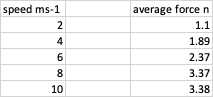
How do I work out the coefficient of viscosity when the slope of a graph =0.34
n= coefficient of viscosity
v=speed of rotation
f= force required to maintain speed
Relevant Equations
F=1.67nv
"Calculate the gradient (or slope) of the line and use this and the equation above to calculate the value for the viscosity, η. You MUST use the gradient to calculate the viscosity." here are the results:

1595948993163.png


I'm not sure if it's just me who finds this confusing
 
Physics news on Phys.org
Hello @joshm12, :welcome: !

What did you find for the slope of the line ? And how did you do that ? By forcing an intercept 0 ?
Did you make a plot to see if that is justified ?

Are these your own measurements or were they given as part of the problem statement ?
 
@BvU I used the change in y/change in x to find the slope of the line and got 0.34. and the measurements were given as part of the problem
 
Last edited:
joshm12 said:
I used the change in y/change in x
Yes, I know that. How did you do it ?
 
This is for flow between a rotating cylinder and a stationary cylinder. Is the gap between the cylinders small?
 
BvU said:
What did you find for the slope of the line ? And how did you do that ? By forcing an intercept 0 ?
Did you make a plot to see if that is justified ?
 
I think @joshm12 didn't bother: he wasn't seen after #3.

The data don't exclude static friction, so ax+b seems equally justified and gives a slope 0.3

1596486928215.png
 

Similar threads

  • · Replies 2 ·
Replies
2
Views
2K
Replies
16
Views
5K
Replies
2
Views
3K
  • · Replies 7 ·
Replies
7
Views
4K
  • · Replies 4 ·
Replies
4
Views
2K
  • · Replies 5 ·
Replies
5
Views
2K
  • · Replies 2 ·
Replies
2
Views
1K
  • · Replies 2 ·
Replies
2
Views
2K
  • · Replies 7 ·
Replies
7
Views
2K
  • · Replies 5 ·
Replies
5
Views
2K