Finding the determinant of a matrix using determinant properties

Click For Summary
To find the determinant of matrix A, it's essential to utilize properties of determinants related to row and column operations. Swapping two rows changes the sign of the determinant, while adding a multiple of one row to another does not alter its value. If a row is multiplied by a nonzero constant, the determinant is also multiplied by that constant. In the discussion, it was clarified that adding rows can lead to a situation where two rows become identical, resulting in a zero determinant. Understanding these properties is crucial for simplifying matrices to compute their determinants effectively.
Bolter
Messages
262
Reaction score
31
Homework Statement
See below
Relevant Equations
None
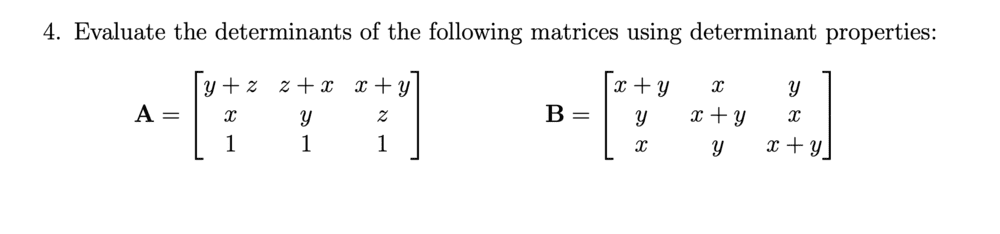
Hi, I have been having some trouble in finding the determinant of matrix A in this Q
Screenshot 2020-09-25 at 14.24.12.png

Which relevant determinant property should I make use of to help me find the determinant of matrix A and maybe matrix B also

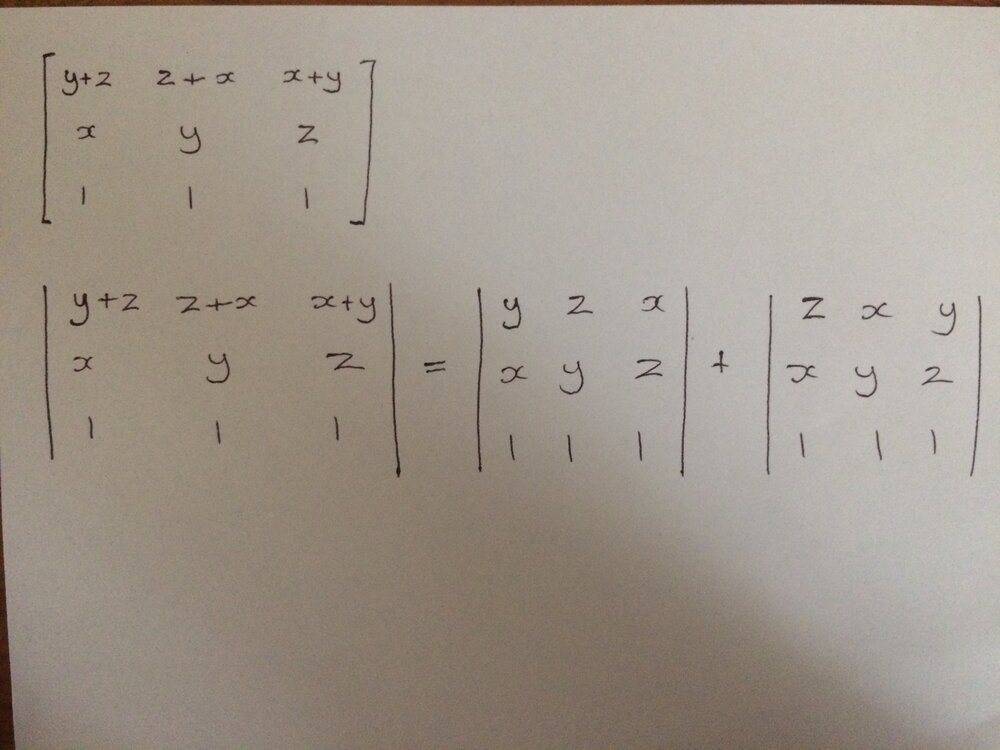
This is what I have tried for matrix A so far but it's not much help really
IMG_5289.JPG

Any help would be much appreciated! Thanks
 
Physics news on Phys.org
What you have assumed is definitely not a property of the determinant: ##det(X + Y) \ne det(X) + det(Y)##. Absolutely not!
 
The determinant properties the problem is talking about are row operations or column operations.
If you swap two rows, it changes the sign of the determinant.
If you replace a row by itself + another row, the value remains the same.
If you replace a row by itself times a nonzero constant multiple, the value of the determinant gets multiplied by that value.

The column operations are similar, with "row" above replaced by "column".
 
Last edited:
  • Like
Likes archaic
PeroK said:
What you have assumed is definitely not a property of the determinant: ##det(X + Y) \ne det(X) + det(Y)##. Absolutely not!

I thought I was using the addition property which I saw in my notes

Screenshot 2020-09-25 at 15.05.36.png
 
Bolter said:
I thought I was using the addition property which I saw in my notes

View attachment 270011
Apologies, I missed what you had done there.
 
Mark44 said:
The determinant properties the problem is talking about are row operations or column operations.
If you swap two rows, it changes the sign of the determinant.
If you replace a row by itself + another row, the value remains the same.
If you replace a row by a nonzero multiple of itself, the value remains the same.
Edit: If you replace a row by itself times a nonzero constant multiple, the value of the determinant gets multiplied by that value.

The column operations are similar, with "row" above replaced by "column".

For the last bit "If you replace a row by a nonzero multiple of itself, the value remains the same." is that the same as saying if one of the row of a matrix is multiplied by a factor, then the determinant of the matrix will be multiplied by this factor.

as in this rule?
Screenshot 2020-09-25 at 15.11.16.png

Also I'm not sure which property to start off with which will help me identify what the determinant will be
 
Last edited by a moderator:
PeroK said:
Apologies, I missed what you had done there.

No worries! Just a bit confused which property I can firstly use that will help break down the matrix to a simpler one so I can find the determinant
 
Bolter said:
For the last bit "If you replace a row by a nonzero multiple of itself, the value remains the same."
I should have said that the value of the determinant is multiplied by the value of that multiple; i.e., if you multiply a row by a constant k, the determinant will be multiplied by the same amount.

I'll edit my earlier reply.
 
Regarding your work in post #1. What happens if you add row 2 to row 1?
 
  • #10
For your first example I would do $$
\begin{vmatrix}
y+z & z+x & x+y\\
x & y & z\\
1 & 1& 1
\end{vmatrix} =
\begin{vmatrix}
x+y+z & x+y+z & x+y+z\\
x & y & z\\
1 & 1& 1
\end{vmatrix}
$$That's just a matrix with determinant of the form ##
\begin{vmatrix}
a & a & a\\
b_1 & b_2 & b_3 \\
c & c& c
\end{vmatrix}##.
 
  • Like
Likes archaic and PeroK
  • #11
NB etothepi did a part for you - he doesn't mean stop there. :oldsmile:

As well as the rules in #3 there is also one about linear combination of rows or of columns which is surely in your textbook, with illustrative examples.
 
Last edited:
  • Like
Likes etotheipi
  • #12
etotheipi said:
For your first example I would do $$
\begin{vmatrix}
y+z & z+x & x+y\\
x & y & z\\
1 & 1& 1
\end{vmatrix} =
\begin{vmatrix}
x+y+z & x+y+z & x+y+z\\
x & y & z\\
1 & 1& 1
\end{vmatrix}
$$That's just a matrix with determinant of the form ##
\begin{vmatrix}
a & a & a\\
b_1 & b_2 & b_3 \\
c & c& c
\end{vmatrix}##.

Hi, I can see what you have did here
So the steps are...

Add row 2 to row 1 which you have shown
then I can multiply row 3 by x+y+z
That gives row 1 and 3 to be identical
then minus row 1 from row 3 to get a zero row

Having a zero row would give a zero determinant. Is that ok?
 
  • #13
That's fine. If ##
\begin{vmatrix}

a & a & a\\

b_1 & b_2 & b_3 \\

c & c& c

\end{vmatrix} = k## for non-zero ##a## & ##c##, then ##\begin{vmatrix}

a & a & a\\

b_1 & b_2 & b_3 \\

a & a& a

\end{vmatrix} = \frac{ak}{c}##. Switching the first and third rows should negate the sign, however evidently you'd just end up with the same matrix, which means that its determinant must be zero. It follows that ##\frac{ak}{c} = 0 \implies k=0##.
 
Last edited by a moderator:
  • Like
Likes Bolter
  • #14
Bolter said:
Having a zero row would give a zero determinant. Is that ok?
Yes. You can determine this in two ways:
1) Using whatever technique you have for evaluating a determinant.
2) If ##\begin{vmatrix}a_1 & a_2 & a_3\\
b_1 & b_2 & b_3 \\0 & 0& 0\end{vmatrix} = D##, then multiplying the third row by nonzero k leaves the values in the third row unchanged, but changes the value of the determinant to kD.

##k\begin{vmatrix}a_1 & a_2 & a_3\\
b_1 & b_2 & b_3 \\0 & 0& 0\end{vmatrix} =
\begin{vmatrix}a_1 & a_2 & a_3\\
b_1 & b_2 & b_3 \\0 & 0& 0\end{vmatrix} =
kD##
Since the matrix we're taking the determinant is the same, it must be that kD = D, or D(k - 1) = 0. So either k = 1 or D = 0. The choice of k is completely arbitrary, so it must be that D = 0.
 
Last edited:
  • Like
Likes Bolter

Similar threads

Replies
1
Views
2K
  • · Replies 1 ·
Replies
1
Views
3K
  • · Replies 14 ·
Replies
14
Views
3K
  • · Replies 25 ·
Replies
25
Views
2K
  • · Replies 9 ·
Replies
9
Views
2K
Replies
24
Views
4K
  • · Replies 4 ·
Replies
4
Views
1K
  • · Replies 10 ·
Replies
10
Views
2K
  • · Replies 20 ·
Replies
20
Views
3K
  • · Replies 69 ·
3
Replies
69
Views
9K