Finding the equation of this tangent

  • Thread starter Thread starter Firepanda
  • Start date Start date
  • Tags Tags
    Tangent
Click For Summary

Homework Help Overview

The discussion revolves around finding the equation of a tangent line to a cubic function represented by y = x(x - L)(1 - x), where L is a parameter between 0 and 1. The original poster attempts to deduce that the slope H of the tangent line, which passes through the origin, is given by H = (1 - L)²/4.

Discussion Character

  • Exploratory, Assumption checking, Mathematical reasoning

Approaches and Questions Raised

  • Participants discuss the relationship between the tangent line and the cubic function, questioning how to derive the slope H. Some participants raise concerns about the information provided and the assumptions made regarding the equation of the curve.

Discussion Status

There is ongoing exploration of the problem, with participants sharing insights and questioning the original poster's assumptions. Some guidance has been offered regarding the relationship between the tangent line and the cubic function, but no consensus has been reached on the deduction process for H.

Contextual Notes

Participants note that the original poster has been given the equation of the curve and that L is a parameter chosen for illustrative purposes. There is mention of additional parts of the problem that may provide further context, but these details are not fully explored in the discussion.

Firepanda
Messages
425
Reaction score
0
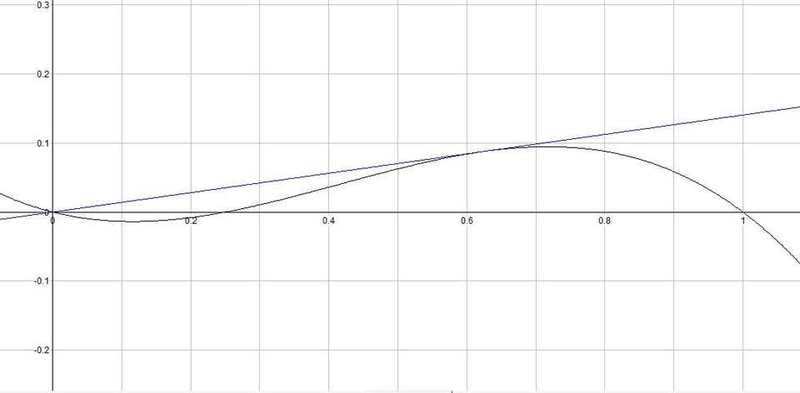
I have this graph

2yvjne1.jpg


The blue line is a tangent to the black

The blue line starts at (0,0)

I need to show that the blue line y=Hx is a tangent to the black line y= x(x-L)(1-x), (0<L<1)

By deducing that H = (1-L)2/4

I took the example L=0.25 in the pic, where H = 9/64 where it's a tangent, and it's like that for any L I choose between 0 and 1

But how can I deduce that H = (1-L)2/4?

I differentiated my function y' = 2x - 3x2 - L + 2xL and I equated it to H but that got me nowhere..

Any help?

Thanks
 
Physics news on Phys.org
What information is given in this problem? What does L represent? Are you given that y = x(x - L)(1 - x)? The slope of the tangent line looks to me to be closer to 1/7.
 
Mark44 said:
What information is given in this problem? What does L represent? Are you given that y = x(x - L)(1 - x)? The slope of the tangent line looks to me to be closer to 1/7.

L is a parameter bounded between 0 and 1

I chose it as 0.25 just to represent the graph

The slop is (1-L)2/4 = (3/4)2/4 = (9/16)/4 = 9/64

That's all the information I have, and yes I was given the equation of the curve
 
You're supposed to deduce that H = (1 - L)2/4; you can't just use it. How did you get the equation of the curve, which you show as y = x(x - L)(1 - x)? Were you given that equation, or did you get it from looking at the graph?
 
Mark44 said:
You're supposed to deduce that H = (1 - L)2/4; you can't just use it. How did you get the equation of the curve, which you show as y = x(x - L)(1 - x)? Were you given that equation, or did you get it from looking at the graph?

I'm aware I can't just use it I was just trying to represent it to everyone that this H is the gradient of the line tangent to the curve and passing through (0,0) and also show to myself what H was doing.

I was given the equation yes, perhaps if I put up the whole question it might be easier.

281629x.jpg


I'm trying to do part iii)

I had the graph as shown, i plotted for some value of L the Hcx and f(x), as shown also. This shows it's a tangent line, and a bifurcation. But of course this isn't deducing anything, I'm wondering how I can do this.
 
Ok no worries I have the answer I believe
 
That's more like it. There's some technical jargon used here that I don't understand - bifurcation. I know what the word means, but I'm not sure what it means in relation to this problem.

Anyway, here are some ideas you might be able to use. In part ii of the problem, harvesting is back in, so you have dx/dt = x(x - L)(1 - x) - Hx. Graphically this represents the signed difference of the y coordinates on the straight line minus those on your cubic.
Multiplying through, I get
dx/dt = -x3 + (L + 1)x2 - (L + H)x
= -x(x2 - (L + 1)x + (L + H))

dx/dt = 0 ==> x = 0 or x2 - (L + 1)x + (L + H) = 0
In the quadratic, we have
[tex]x~=~\frac{L + 1 \pm \sqrt{(L + 1)^2 - 4(L + H)}}{2}[/tex]
[tex]=~\frac{L + 1 \pm \sqrt{L^2 - 2L + 1 -4H)}}{2}[/tex]
[tex]=~\frac{L + 1 \pm \sqrt{(L - 1)^2 -4H)}}{2}[/tex]

Apparently we want the quantity under the radical to be zero. I'm not sure why, but if that's the case, what you're trying to deduce about H just falls out. Presumably you're more familiar with the fine points of this problem, and you can come up with an explanation of why this works.

Notice that I've been working the whole time with dx/dt. At no point did I take the derivative of anything or integrate anything. The problem involves looking at dx/dt as a function in its own right and saying something about it.
 
Yep exactly how I found it! Looked back through my answer to part ii) and it became obvious it's to do with my roots.

Thanks a lot!
 

Similar threads

  • · Replies 1 ·
Replies
1
Views
1K
Replies
1
Views
2K
  • · Replies 2 ·
Replies
2
Views
1K
  • · Replies 6 ·
Replies
6
Views
2K
Replies
5
Views
2K
  • · Replies 4 ·
Replies
4
Views
2K
  • · Replies 4 ·
Replies
4
Views
2K
Replies
2
Views
1K
  • · Replies 8 ·
Replies
8
Views
2K
  • · Replies 4 ·
Replies
4
Views
1K