Finding the Ratio of Dimensions for Equal Hydrostatic Force on a Vertical Plate

Click For Summary

Homework Help Overview

The problem involves determining the ratio of dimensions for a vertical plate, which consists of both rectangular and semicircular portions, submerged in a liquid. The objective is to find the ratio of L to R such that the hydrostatic force on the rectangular portion equals that on the semicircular portion.

Discussion Character

  • Exploratory, Mathematical reasoning, Problem interpretation

Approaches and Questions Raised

  • The original poster attempts to set up equations for the forces acting on both portions of the plate, using hydrostatic principles. They express concern about their understanding and whether their approach is correct.
  • Some participants suggest focusing on rewriting the equations to isolate the ratio L/R and discuss solving a quadratic equation.
  • One participant questions the appropriateness of providing a numerical approximation versus a surd form for the final answer.

Discussion Status

The discussion is active, with participants providing guidance on manipulating equations and addressing the original poster's concerns about their approach. Multiple interpretations of how to express the final answer are being explored, but no consensus has been reached on the preferred format.

Contextual Notes

The original poster notes a language barrier, which may affect their clarity in expressing their understanding of the problem.

dhkdeoen
Messages
11
Reaction score
0
1. A vertical plate consists of rectangular and semicircular portion and has dimensions as shown. It is submerged in a liquid such that the upper edge coincides with the free surface of the liquid. What is the ratio of L/R such that force on the rectangular portion is the same as that on the circular portion?
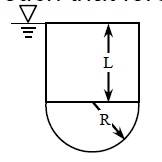
UT7mHCE.jpg


Homework Equations


F=γhA


The Attempt at a Solution


For rectangular part, since height of it is L and width of it is 2R
A=2R*L
h=L/2
so force on retangular part is
Fr=γ*2RL*L/2=γRL2

for semi circular portion
h=L+4R/3∏
A=∏R2/2
∴Fsc=γ(L+4R/3∏)*∏R2/2

Since Fr=Fsc

2RL2=(L+4R/3∏)∏R2(γ canceled out)
.
.
L2=∏RL/2+2/3R2

now I'm stuck here. Am I doing this right? or did I misunderstand the problem?

English isn't my first language, so bear me.
 
Physics news on Phys.org
You're doing just fine. Remember you want an answer for L/R, so if you call that x, all you have to do is rewrite the last equation to get something with x and a few numbers...
 
Looks good so far. How can you turn this into an equation only involving the ratio L/R? How do you solve a quadratic?
 
so..

er.. so I divide both side with R^2

(L/R)^2=pi*L/(2R)+2/3

since L/R=x

x^2=pi/2x+2/3
x^2-pi/2x-2/3=0

and this gives me two roots

x1=1/12(3pi-sqrt(96+9pi^2)=-0.3475...
x2=1/12(3pi+sqrt(96+9pi^2)=1.91832..

so I pick the one bigger than 0; which is x2.

so L/R should be 1.91832, right?
 
dhkdeoen said:
er.. so I divide both side with R^2

(L/R)^2=pi*L/(2R)+2/3

since L/R=x

x^2=pi/2x+2/3
x^2-pi/2x-2/3=0

and this gives me two roots

x1=1/12(3pi-sqrt(96+9pi^2)=-0.3475...
x2=1/12(3pi+sqrt(96+9pi^2)=1.91832..

so I pick the one bigger than 0; which is x2.

so L/R should be 1.91832, right?
Looks right, but I would tend to give the answer in surd form, not reduce it to a numerical approximation.
 
whoa.. it is hard to get back to old thread. Thanks!
 

Similar threads

  • · Replies 1 ·
Replies
1
Views
2K
  • · Replies 31 ·
2
Replies
31
Views
5K
  • · Replies 1 ·
Replies
1
Views
3K
  • · Replies 6 ·
Replies
6
Views
16K
  • · Replies 3 ·
Replies
3
Views
3K
  • · Replies 1 ·
Replies
1
Views
7K
  • · Replies 5 ·
Replies
5
Views
7K
  • · Replies 2 ·
Replies
2
Views
4K
Replies
31
Views
4K
Replies
1
Views
8K