Finding the Uncertainty in the motion of a pendulum

Click For Summary
SUMMARY

The discussion focuses on the calculation of uncertainty in the motion of a pendulum, specifically through the application of the general formula for infinitesimal variations in functions of two variables. The correct expression for the variation is given by $$df = {\partial f\over \partial x} dx + {\partial f\over \partial y} dy$$. A mistake was identified in the original post regarding the expression for gravitational acceleration, where $$g = 4\pi^2\, {L\over T^2}$$ was incorrectly stated. The correct approach involves deriving $$dg$$ using the partial derivatives with respect to length (L) and period (T).

PREREQUISITES
  • Understanding of calculus, specifically partial derivatives.
  • Familiarity with the concept of infinitesimal variations in functions.
  • Knowledge of pendulum motion and the relationship between length, period, and gravitational acceleration.
  • Ability to interpret mathematical expressions and formulas in physics.
NEXT STEPS
  • Study the derivation of partial derivatives in multivariable calculus.
  • Learn about the application of uncertainty principles in experimental physics.
  • Research the mathematical modeling of pendulum motion and its parameters.
  • Explore alternative methods for calculating uncertainty in physical measurements.
USEFUL FOR

Students and educators in physics, particularly those focusing on mechanics and experimental methods, as well as anyone involved in the analysis of uncertainties in measurements.

aatari
Messages
73
Reaction score
3
Homework Statement
What is the expression for the uncertainty in finding from the motion of a pendulum
g = 4π^2 L/T^2

Assuming an uncertainty in L of δL, and uncertainty in T of δT.
Relevant Equations
g = 4π^2 L/T^2
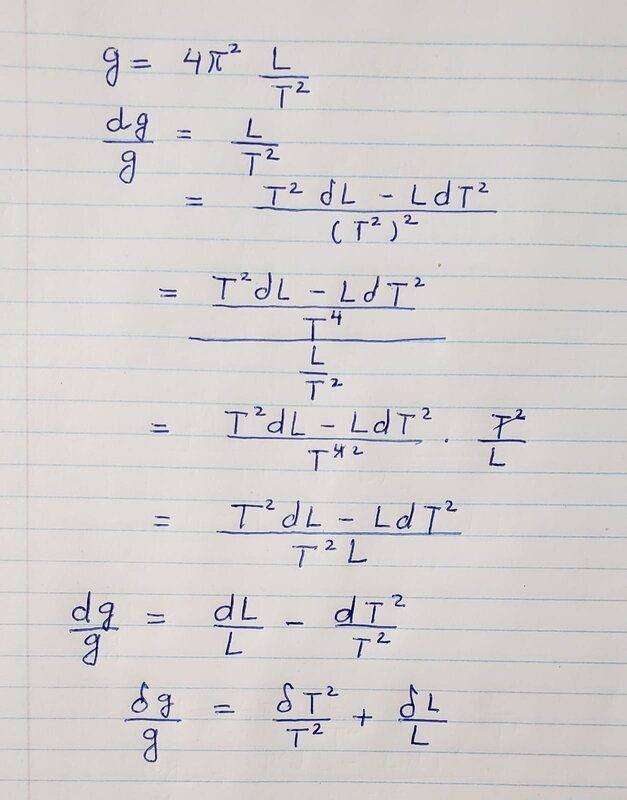
Hi guys can someone look at my work for uncertainty and let me know if it makes sense.
WhatsApp Image 2020-11-05 at 10.08.12 AM.jpeg
 
Physics news on Phys.org
I don't even understand the first step. Where did you find that ?
Nor do I understand the last step. What are you doing there ?

What is the general formula for the (infinitesimal) variation in a function of two variables ##f(x,y)## in terms of the (infinitesimal) variation in ##x## and ##y## ?
 
Are you still there ?
 
sorry just seeing your message now. Actually the question asked to show the expression of uncertainty. I asked the TA and this is apparently correct based on the method in the attached image.
1604718617004.png
 
BvU said:
What is the general formula for the (infinitesimal) variation in a function of two variables f(x,y) in terms of the (infinitesimal) variation in ##x## and ##y## ?
My hunch is that this question and your
1604746057048.png
refer to one and the same:

For a function of one variable we write (casually) $$ {df\over dx} = f'\ \Rightarrow \ df = f'\, dx $$ or (for small ##\Delta x##) : $$\Delta f \approx f'\,\Delta x$$

In the case of two variables this becomes $$df = {\partial f\over \partial x} dx + {\partial f\over \partial y} dy$$leading to (C.14) in your image for the case ##f = {x\over y}##.

In your post #1, however, you write $$ g = 4\pi^2\, {L\over T^2} $$$$ {dg\over g} = {L\over T^2}$$which is something else and simply wrong (effectively, it says ## g = 4\pi^2## ?:) )

Could it be you meant $$ {dg\over g} = { d\,{L\over T^2} \over {L\over T^2}}\quad ? $$

I suggest you go a step back to the general formula and work out ##\partial g\over \partial L## and ##\partial g\over \partial T## to come to an expression for ##dg##.

Once you fully understand that, we can work out an alternative approach using C.4 (and, as I suppose C.3).
 
  • Like
Likes aatari
BvU said:
My hunch is that this question and your View attachment 272252 refer to one and the same:

For a function of one variable we write (casually) $$ {df\over dx} = f'\ \Rightarrow \ df = f'\, dx $$ or (for small ##\Delta x##) : $$\Delta f \approx f'\,\Delta x$$

In the case of two variables this becomes $$df = {\partial f\over \partial x} dx + {\partial f\over \partial y} dy$$leading to (C.14) in your image for the case ##f = {x\over y}##.

In your post #1, however, you write $$ g = 4\pi^2\, {L\over T^2} $$$$ {dg\over g} = {L\over T^2}$$which is something else and simply wrong (effectively, it says ## g = 4\pi^2## ?:) )

Could it be you meant $$ {dg\over g} = { d\,{L\over T^2} \over {L\over T^2}}\quad ? $$

I suggest you go a step back to the general formula and work out ##\partial g\over \partial L## and ##\partial g\over \partial T## to come to an expression for ##dg##.

Once you fully understand that, we can work out an alternative approach using C.4 (and, as I suppose C.3).
Thanks for your suggestion!
 
The book claims the answer is that all the magnitudes are the same because "the gravitational force on the penguin is the same". I'm having trouble understanding this. I thought the buoyant force was equal to the weight of the fluid displaced. Weight depends on mass which depends on density. Therefore, due to the differing densities the buoyant force will be different in each case? Is this incorrect?

Similar threads

  • · Replies 7 ·
Replies
7
Views
5K
Replies
15
Views
1K
  • · Replies 4 ·
Replies
4
Views
1K
  • · Replies 2 ·
Replies
2
Views
1K
  • · Replies 20 ·
Replies
20
Views
2K
Replies
5
Views
944
  • · Replies 14 ·
Replies
14
Views
2K
  • · Replies 9 ·
Replies
9
Views
2K
  • · Replies 23 ·
Replies
23
Views
3K
Replies
17
Views
1K