Bolter
- 262
- 31
- Homework Statement
- Calculate the resistance of load resistor
- Relevant Equations
- V = IR
Question:

I first knew that this would be a series circuit setup, there the current all around the circuit would be the same.
It's given that when it's a open circuit, p.d. across the output is 4000V hence the emf is therefore 4000V. When it gets connected to a load resistor, the voltage share is 3000V thus the voltage share on the internal resistance of the voltage supply must be 1000V
From this I can work out the current flowing through the circuit which gave me 4.1666... x10^-5 Amps
This should mean that 4.1666... x10^-5 amps is also passing through the load resistor, so the resistance of the load resistor is R = V/I or 72 Mega ohms
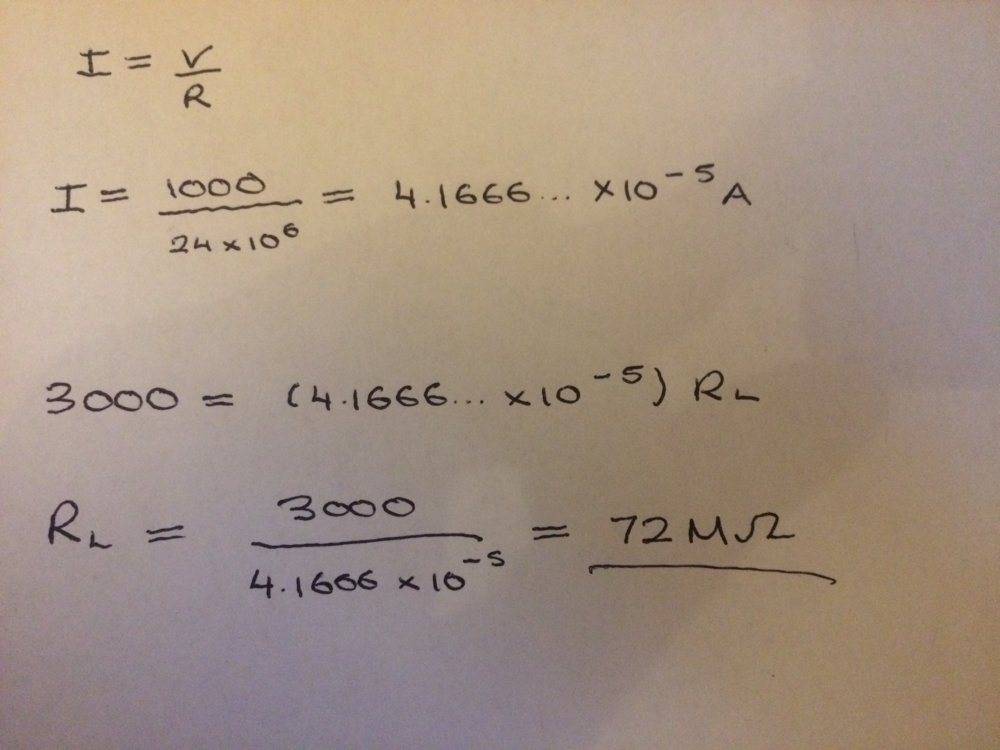
Any help would be really appreciated. Thanks!
I first knew that this would be a series circuit setup, there the current all around the circuit would be the same.
It's given that when it's a open circuit, p.d. across the output is 4000V hence the emf is therefore 4000V. When it gets connected to a load resistor, the voltage share is 3000V thus the voltage share on the internal resistance of the voltage supply must be 1000V
From this I can work out the current flowing through the circuit which gave me 4.1666... x10^-5 Amps
This should mean that 4.1666... x10^-5 amps is also passing through the load resistor, so the resistance of the load resistor is R = V/I or 72 Mega ohms
Any help would be really appreciated. Thanks!