Finding the Vertex Coordinates of a Rectangle In Cartesian Space

Click For Summary
To find the coordinates of all four vertices of a rectangle in any orientation, knowing the length, width, center, and a vertex, one can utilize vector mathematics and rotation matrices. The discussion highlights the approach of calculating the angle between vectors from the vertex to the center and applying a rotation to derive the new coordinates. It is noted that while rotation matrices are a potential solution, they may not be strictly necessary, as the problem can also be approached by solving equations based on the distances from the known vertex to the center. However, a challenge arises due to the existence of two possible solutions for one vertex, necessitating an additional condition to determine the correct position. Overall, the conversation emphasizes the mathematical relationships and geometric principles involved in determining the rectangle's vertices.
Saladsamurai
Messages
3,009
Reaction score
7
I am hoping to find the coordiantes of all 4 vertices when the rectangle is in any orientaion knowing the length l, the width b, the coordinate of its center mark (xcen,ycen), and the coordinate of vertex A as shown below:

This is NOT HOMEWORK so although I think it is possible to do, I am not sure that it is.
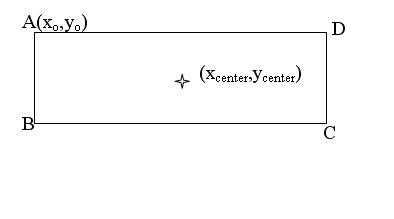
rectangle.jpg


Any ideas?

I am thinking of using the vector that points from A to the center somehow... I know that if I double its length then I have arrived at the vertex C... but how to extract those coordinates, I cannot see.


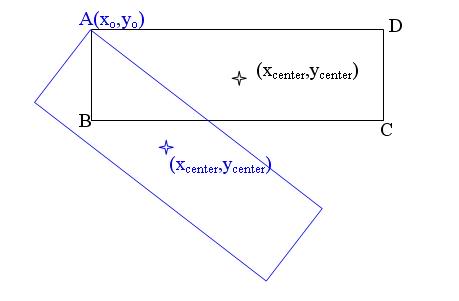
EDIT: Here is a drawing that better illustrates what I am thinking. The Blue Rectangle is the one I want to to find the vertices for. I know all information in blue.

The Black Rectangle shares the same A vertex and is in what I have DEFINED to be standard reference position (SRP).

I could find the angle of the vector that points from A to the center rc of the black rectangle and compare it with the angle of that of the blue rectangle r'c

I know that the difference \theta - \theta ' should be the angle that all vertices should carve out. I just can't see how to make the actual calculations of their cartesian coordinates?
rrrrrr.jpg
 
Last edited:
Physics news on Phys.org
Looking around online and a Rotation Matrix seems promising.

Though I am finding a lot of definitions of a Rotation Matrix, I am not finding many practical examples... so I am not exactly sure what it does.
 
Okay :smile: Here is where I am at: Updated Diagram for reference:

r.jpg


rc and r'c are the vectors from A to the centers.

In order for all vertices to get from the standard ref posotion to the new positions, they must all rotate through the angle phi correct?

If A=A' is locate at the point (x0, y0), then we have the points

A(x0, y0)
B(x0, (y0+b)) *Taking down as +Y and Right as +X
C((x0+L), (y0+b))
D((x0+L), y0)

Now to use a Rotation Matrix to get the new coordinates of A' B' C' D'
I am a little confused.

Do I use the coordinates? Or the vector components of rBA,
rAD, etc... ?

FOR EXAMPLE: If I am looking at the vectors rBA and r'BA

And I know that to get from rBA to r'BA I rotated through the angle Phi. How do I get the new coordiantes of B out of the deal? :confused:
 
Hi,

While this can be done using rotations, I don't think it's necessary.

We know that B is a distance b from A, and a distance rc from the center. In other words, it's at the intersection of two circles. You'd just need to set up the equations and solve them.

One problem I see, which is that there are two solutions for the location of B. You'll need another condition or some way to specify which solution is the desired one.
 
The book claims the answer is that all the magnitudes are the same because "the gravitational force on the penguin is the same". I'm having trouble understanding this. I thought the buoyant force was equal to the weight of the fluid displaced. Weight depends on mass which depends on density. Therefore, due to the differing densities the buoyant force will be different in each case? Is this incorrect?

Similar threads

  • · Replies 5 ·
Replies
5
Views
3K
  • · Replies 1 ·
Replies
1
Views
2K
  • · Replies 30 ·
2
Replies
30
Views
2K
  • · Replies 10 ·
Replies
10
Views
2K
  • · Replies 6 ·
Replies
6
Views
1K
  • · Replies 12 ·
Replies
12
Views
2K
  • · Replies 17 ·
Replies
17
Views
3K
  • · Replies 1 ·
Replies
1
Views
2K
  • · Replies 12 ·
Replies
12
Views
3K
  • · Replies 4 ·
Replies
4
Views
2K