Undergrad Finding the vibrational partition function of a diatomic molecule

Click For Summary
The discussion focuses on the derivation of the vibrational partition function for a diatomic molecule, specifically addressing the approximation of energy levels as harmonic oscillators. The summation in question simplifies to (1 - exp(-hw/KbT))^-1 due to the mathematical properties of geometric series, not solely because of the two degrees of vibrational freedom. The participants clarify that the summation formula, $$\sum_{n=0}^{\infty} x^n = \frac{1}{1 - x}$$ for |x|<1, is essential for this derivation. The conversation emphasizes the mathematical foundation behind the vibrational partition function rather than the physical interpretation of energy levels. Understanding this mathematical approach is crucial for accurately calculating the vibrational partition function.
thegirl
Messages
40
Reaction score
1
Hi,
How did they break down the following summation?
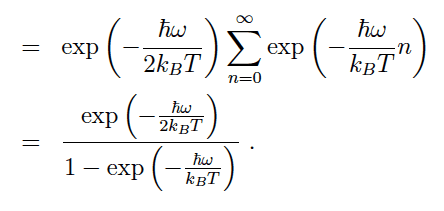
Screen Shot 2016-03-27 at 18.46.06.png

When finding the vibrational partition function ofa diatomic molecule it was approximated that the energy levels of the vibrational part of the diatomic molecule were harmonic and therefore the energy equation for a harmonic oscillator was used. Is the summation made to equal (1 - exp( - hw/KbT))^-1 because there are two degrees of vibrational freedom and therefore two energy levels? Or isit just due to maths?
 
Physics news on Phys.org
It's just the math:
$$
\sum_{n=0}^{\infty} x^n = \frac{1}{1 -x}
$$
for ##|x|<1##.
 
  • Like
Likes vanhees71 and thegirl
Omg, thank you!
 
Thread 'Unexpected irregular reflection signal from a high-finesse cavity'
I am observing an irregular, aperiodic noise pattern in the reflection signal of a high-finesse optical cavity (finesse ≈ 20,000). The cavity is normally operated using a standard Pound–Drever–Hall (PDH) locking configuration, where an EOM provides phase modulation. The signals shown in the attached figures were recorded with the modulation turned off. Under these conditions, when scanning the laser frequency across a cavity resonance, I expected to observe a simple reflection dip. Instead...

Similar threads

  • · Replies 12 ·
Replies
12
Views
3K
  • · Replies 6 ·
Replies
6
Views
2K
  • · Replies 3 ·
Replies
3
Views
2K
  • · Replies 2 ·
Replies
2
Views
8K
Replies
8
Views
3K
  • · Replies 0 ·
Replies
0
Views
3K
  • · Replies 1 ·
Replies
1
Views
2K
  • · Replies 1 ·
Replies
1
Views
1K
  • · Replies 1 ·
Replies
1
Views
3K
  • · Replies 2 ·
Replies
2
Views
2K