Frank-95
- 51
- 1
Hi all :)
I'm trying to figure out the Thevenin equivalent of this circuit:
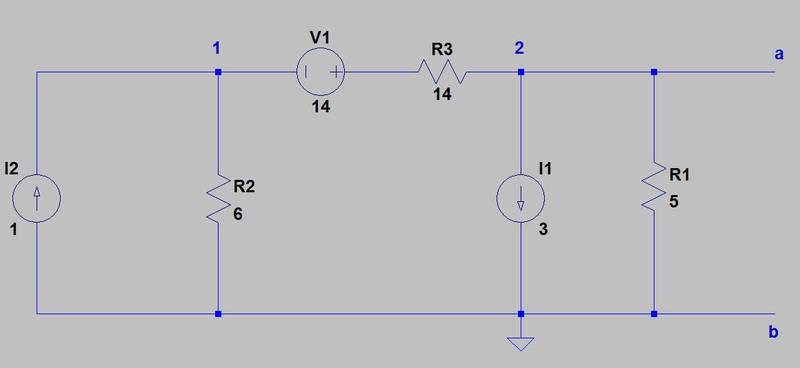
I start by switching off every source and calculating the equivalent resistance:
RTh = RN = (6 + 14) || 5 = 4 Ω
Then I proceed with finding the voltage at 2.
I note that the nodes between 1 and 2 form a supernode:
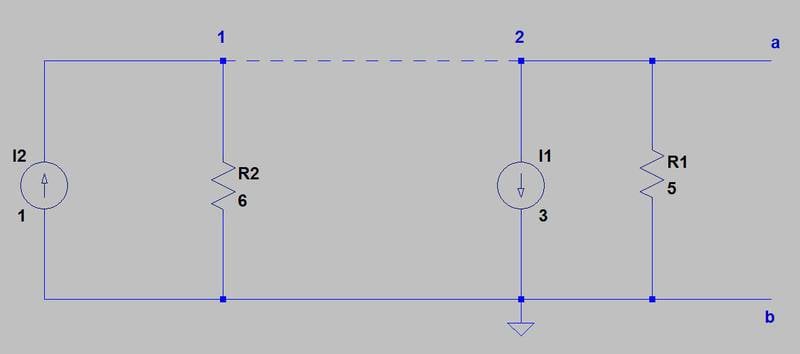
So I set up the (super)nodal equation:
1 = v1/6 + 3 + v2/5
Then I proceed with mesh analysis. I note than the voltage source and the current source I1 form a supermesh.
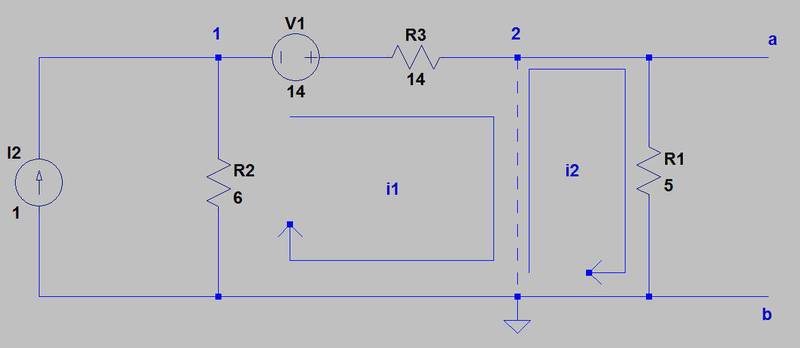
And now I have some problems at setting up the equation :/
I know that:
-14 + 14*i1 + 5*i2 - 6(1 - i1) = 0
To bring this equation as a function of v1 and v2
I tried to think up about these equivalences, but I probably mistakened since the equation would become v1 = 0
14i1 = 14 - v2
5i2 = v2
6(1 - i1) = v1
Thanks in advance :)
I'm trying to figure out the Thevenin equivalent of this circuit:
I start by switching off every source and calculating the equivalent resistance:
RTh = RN = (6 + 14) || 5 = 4 Ω
Then I proceed with finding the voltage at 2.
I note that the nodes between 1 and 2 form a supernode:
So I set up the (super)nodal equation:
1 = v1/6 + 3 + v2/5
Then I proceed with mesh analysis. I note than the voltage source and the current source I1 form a supermesh.
And now I have some problems at setting up the equation :/
I know that:
-14 + 14*i1 + 5*i2 - 6(1 - i1) = 0
To bring this equation as a function of v1 and v2
I tried to think up about these equivalences, but I probably mistakened since the equation would become v1 = 0
14i1 = 14 - v2
5i2 = v2
6(1 - i1) = v1
Thanks in advance :)