Finding this power series -- Where is my error?

4 replies · 2K views · last reply
archaic
Messages
688
Reaction score
214
Homework Statement
Find the power series representation of $$\frac{x}{(1+13x^2)^2}$$
Relevant Equations
N/A
I have used ##\sim## but meant ##\sum_{k=0}^\infty##
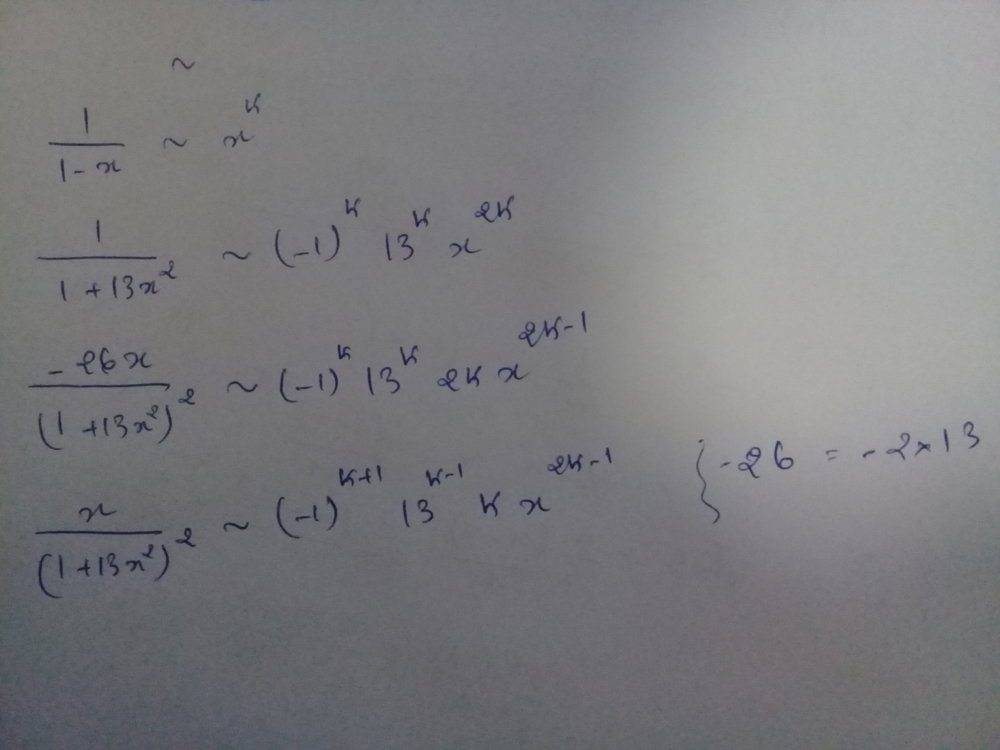
Handwritten derivation of power series steps: 1/(1-x) ~ x^k, then 1/(1+13x^2) ~ (-1)^k 13^k x^(2k), then -26x/(1+13x^2)^2 ~ (-1)^k 13^k 2k x^(2k-1), then x/(1+13x^2)^2 ~ (-1)^(k+1) 13^(k-1) k x^(2k-1), with the note -26 = -2 x 13.

my math homework platform is telling me that this is wrong. I've tried using desmos to test it and it was a perfect match. Any ideas on where I went wrong?
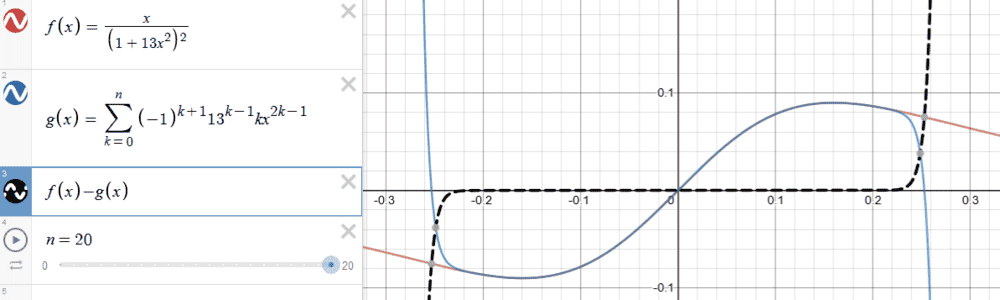
Desmos screenshot comparing f(x) = x/(1+13x^2)^2 with a partial sum g(x) of alternating series, n = 20, plotted over x from -0.3 to 0.3 with a red tangent line and dashed curve.
 
Last edited by a moderator:
What type of input does the platform require? It is possible that it has written it on a different form and only accepts that form.
 
Orodruin said:
What type of input does the platform require? It is possible that it has written it on a different form and only accepts that form.
Online math answer checker showing g(x) = x/(1+13x^2)^2 using f(x) = 1/(1+13x^2), with a power series entry for g(x) and a 'That's incorrect' popup comparing the correct and submitted answers.

This is what they are giving me. If you put ##k=k'+1## in my result, then you'd get theirs, but then the sum should start from ##-1##. They have specifically asked me to have it start from ##0##, though, as is shown.
I've used power series instead of differentiating ##f(x)## because it is faster. The result should still be the same normally. I remember our professor saying something about trivial functions having unique taylor polynomials.
 
archaic said:
View attachment 260819
This is what they are giving me. If you put ##k=k'+1## in my result, then you'd get theirs, but then the sum should start from ##-1##. They have specifically asked me to have it start from ##0##, though, as is shown.
Your first term is equal to zero (it has a factor ##k = 0## in it). So even if you put ##k = k'+1## you can have your sum start at zero.
 
  • Like
Likes   Reactions: archaic
I've emailed my professor, maybe he'll fix it. Thank you @Orodruin I've missed the ##k## factor ^^'.