Finding where a function is sign definite, sign indefinite or sign semidefinite

  • Thread starter Thread starter member 731016
  • Start date Start date
  • Tags Tags
    Function Sign
Click For Summary
The discussion centers on determining the sign definiteness of a function using a Liapunov function, specifically the expression V(x,y) = 1 - cos(x) + y^4. The original poster believes this function is positive definite based on their analysis, but they express confusion regarding the method used to find the domain of attraction. Clarification is sought on the definitions of sign definite, semidefinite, and indefinite, as well as the relationship between the Liapunov function and the system's dynamics. Participants highlight the necessity of knowing the system's dynamics, represented by (dot x, dot y), to accurately assess the domain of attraction. Understanding these concepts is crucial for applying Liapunov functions effectively in stability analysis.
member 731016
Homework Statement
Please see below
Relevant Equations
Please see below
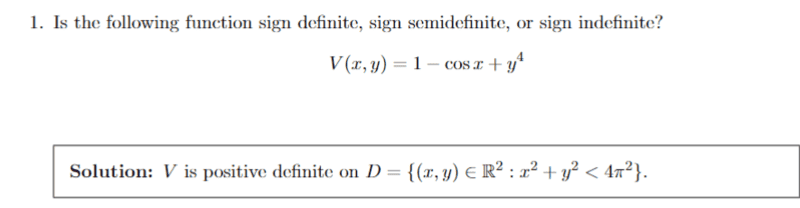
For this problem,
1716936186456.png

However, I'm confused how their got their solution. My solution is, using set builder notation,

##[ (x,y) \in \mathbf{R} : 1 - \cos x + y^4 ≥ 0 ]## which implies that ##V(0,0) = 0## so it satisfies the first condition for being sign definite, sign semidefinite, and sign indefinite. Then from the inequality, we know that for ##x \neq 0, y \neq 0## , then ##V(x,y) = 1 - \cos x + y^4 > 0## so their Liapunov satsifes the conditions for being positive definite. However, I'm confused by how they find the domain (they call it domain of attraction) from ##1 - \cos x + y^4 > 0##.

Does anybody please know how they do that?

Thanks!
 
Physics news on Phys.org
What is the definition of sign definite/semi definite/indefinite?
 
  • Like
  • Love
Likes docnet, member 731016, FactChecker and 1 other person
If you are using a Liapunov function to find a domain of attraction for (I assume) a fixed point at (0,0), then you can't do that without reference to (\dot x, \dot y), and since you haven't given us that information we can't really help you.
 
  • Love
Likes member 731016
Question: A clock's minute hand has length 4 and its hour hand has length 3. What is the distance between the tips at the moment when it is increasing most rapidly?(Putnam Exam Question) Answer: Making assumption that both the hands moves at constant angular velocities, the answer is ## \sqrt{7} .## But don't you think this assumption is somewhat doubtful and wrong?

Similar threads

Replies
1
Views
1K
Replies
7
Views
2K
  • · Replies 40 ·
2
Replies
40
Views
4K
  • · Replies 12 ·
Replies
12
Views
3K
  • · Replies 5 ·
Replies
5
Views
2K
Replies
5
Views
2K
  • · Replies 10 ·
Replies
10
Views
2K
Replies
3
Views
2K
  • · Replies 3 ·
Replies
3
Views
2K
  • · Replies 12 ·
Replies
12
Views
3K