Finite Dimensional Division Algebras - Bresar Lemma 1.1

  • Context: Undergrad 
  • Thread starter Thread starter Math Amateur
  • Start date Start date
  • Tags Tags
    Division Finite
Click For Summary

Discussion Overview

The discussion revolves around the proof of Lemma 1.1 from Matej Bresar's "Introduction to Noncommutative Algebra," specifically addressing the implications of linear dependence among the elements \(1, x, \ldots, x^n\) in the context of finite dimensional division algebras. Participants are exploring the formal reasoning that leads to the conclusion that a non-zero polynomial \(f(\omega) \in \mathbb{R}[\omega]\) exists such that \(f(x) = 0\).

Discussion Character

  • Technical explanation
  • Conceptual clarification
  • Debate/contested

Main Points Raised

  • Peter seeks clarification on how the linear dependence of the elements \(1, x, \ldots, x^n\) leads to the existence of a non-zero polynomial \(f(\omega)\) of degree at most \(n\) such that \(f(x) = 0\).
  • Some participants suggest referring to the definition of linear independence or dependence to understand the implications of the linear combination resulting in zero.
  • Another participant explains that the construction of \(f(x)\) arises from the non-trivial linear combination of the elements, asserting that this must exist due to dimensionality considerations.
  • There is a note about the unconventional choice of variable names, with \(x\) as an element and \(\omega\) as a number, which some find amusing.

Areas of Agreement / Disagreement

Participants generally agree on the need to understand the definitions of linear dependence and the implications of dimensionality. However, there is no consensus on the clarity of the reasoning leading to the polynomial conclusion, as Peter continues to seek further assistance.

Contextual Notes

The discussion highlights the reliance on definitions and dimensional arguments, but does not resolve the specific steps needed to demonstrate the polynomial's existence rigorously.

Math Amateur
Gold Member
MHB
Messages
3,920
Reaction score
48
I am reading Matej Bresar's book, "Introduction to Noncommutative Algebra" and am currently focussed on Chapter 1: Finite Dimensional Division Algebras ... ...

I need help with the an aspect of the proof of Lemma 1.1 ... ...

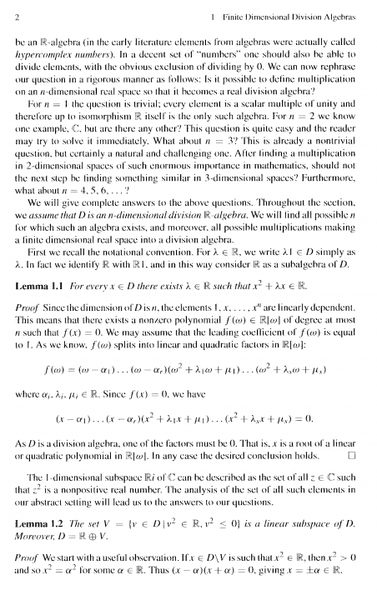
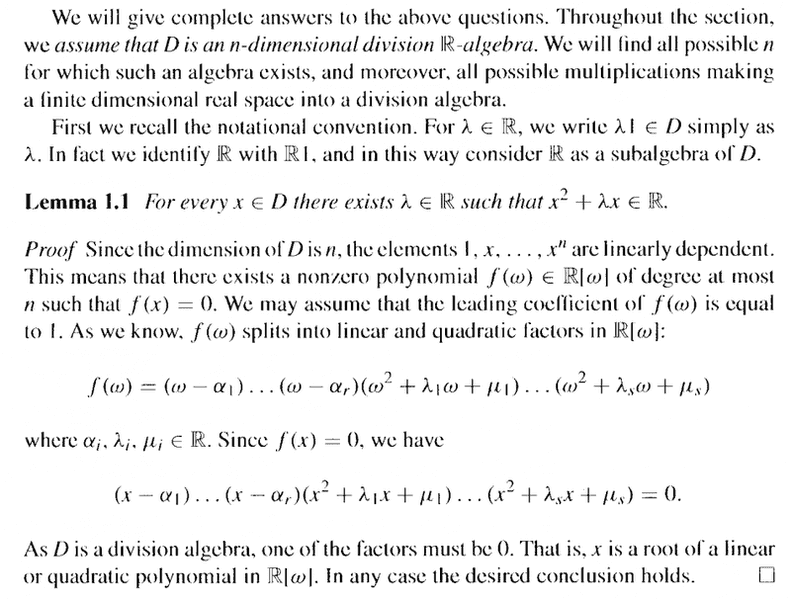
Lemma 1.1 reads as follows:
?temp_hash=761e2d10c7d3b6eaf64f5bbeb2c4a5c7.png


In the above text, at the start of the proof of Lemma 1.1, Bresar writes the following:

" ... ... Since the dimension of ##D## is ##n##, the elements ##1, x, \ ... \ ... \ , x^n## are linearly dependent. This means that there exists a non-zero polynomial ##f( \omega ) \in \mathbb{R} [ \omega ]## of degree at most ##n## such that ##f(x) = 0## ... ... "My question is as follows:

How exactly (rigorously and formally) does the elements ##1, x, \ ... \ ... \ , x^n## being linearly dependent allow us to conclude that there exists a non-zero polynomial ##f( \omega ) \in \mathbb{R} [ \omega ]## of degree at most ##n## such that ##f(x) = 0## ... ?Help will be much appreciated ...

Peter

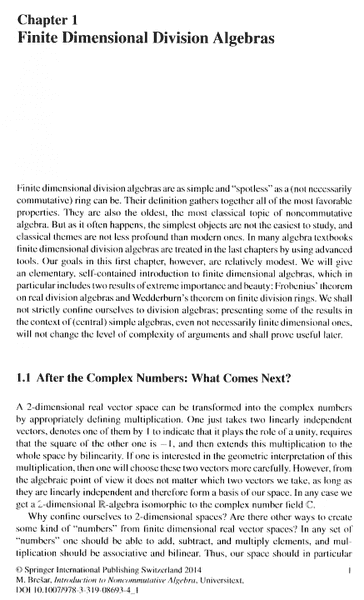
=====================================================In order for readers of the above post to appreciate the context of the post I am providing pages 1-2 of Bresar ... as follows ...
?temp_hash=761e2d10c7d3b6eaf64f5bbeb2c4a5c7.png

?temp_hash=761e2d10c7d3b6eaf64f5bbeb2c4a5c7.png
 

Attachments

  • Bresar - Lemma 1.1.png
    Bresar - Lemma 1.1.png
    56.8 KB · Views: 854
  • Bresar - Page 1.png
    Bresar - Page 1.png
    34.7 KB · Views: 645
  • Bresar - Page 2.png
    Bresar - Page 2.png
    66.8 KB · Views: 704
Physics news on Phys.org
This follows from the definition of linear independence (or dependence). You may want to remind yourself of that definition and write down exactly what it means in this case.
 
zinq said:
This follows from the definition of linear independence (or dependence). You may want to remind yourself of that definition and write down exactly what it means in this case.
Thanks zinq ... but I need some further help ... ...

The linear dependence of the elements ##1, x, \ ... \ ... \ , x^n## meas that we can find elements ##c_0, c_1, \ ... \ ... \ , c_n \in \mathbb{R}## , not all zero, so that:

##c_0.1.+ c_1.x + \ ... \ ... \ + c_n x^n = 0##

BUT ... how do we proceed to demonstrate that this implies that there exists a non-zero polynomial ##f( \omega ) \in \mathbb{R} [ \omega ]## of degree at most ##n## such that ##f(x) = 0## ... ...

Can you help further ... ?

Peter
 
We take ##f(x)=0## by construction of ##c_i## as the a non-trivial linear combination ##0=c_0 \cdot 1 + c_1 \cdot x + \ldots + c_n x^n## which must exist for dimensional reasons.

Then we define ##f(\omega) := c_0 \cdot 1 + c_1 \cdot \omega + \ldots + c_n \cdot \omega^n##, i.e. ##f(\omega) \in \mathbb{R}[\omega]## and ##f(\omega) \leftrightarrow (c_0 , c_1 , \ldots , c_n) \neq 0## because we have more "vectors" ##(1,x,\ldots,x^n)## than the dimension ##n##.

Btw.: Funny choice of variable names. Usually ##x## is the indeterminate and ##\omega## a number. Here it's the other way around.
 
  • Like
Likes   Reactions: Math Amateur
Thanks fresh_42 ... clear and helpful ...

Appreciate your help ...

Peter
 

Similar threads

  • · Replies 2 ·
Replies
2
Views
2K
  • · Replies 14 ·
Replies
14
Views
2K
  • · Replies 3 ·
Replies
3
Views
2K
  • · Replies 9 ·
Replies
9
Views
2K
  • · Replies 6 ·
Replies
6
Views
2K
  • · Replies 11 ·
Replies
11
Views
2K
Replies
2
Views
2K
  • · Replies 2 ·
Replies
2
Views
2K
Replies
3
Views
2K
  • · Replies 6 ·
Replies
6
Views
2K