First Law of Thermodynamics (Eint = Q-W) question. I am only stuck on part (d)

Click For Summary
SUMMARY

The discussion focuses on applying the First Law of Thermodynamics, specifically the equation Eint = Q - W, to solve a series of problems involving internal energy, heat, and work. The user successfully calculated values for paths iaf and ibf but struggled with part (d), which requires determining the heat (Q) for path ib given Eint,b = 27 cal. The correct approach involves recognizing that the work done along path ib is equivalent to the work done along path ibf, leading to the conclusion that Q for path ib can be derived from the established relationships of internal energy and work.

PREREQUISITES
  • Understanding of the First Law of Thermodynamics
  • Familiarity with internal energy (Eint) concepts
  • Knowledge of heat (Q) and work (W) relationships
  • Ability to solve thermodynamic equations
NEXT STEPS
  • Review the derivation of the First Law of Thermodynamics
  • Practice problems involving internal energy calculations
  • Explore the implications of work done in isochoric and isobaric processes
  • Investigate the relationship between heat transfer and work in thermodynamic cycles
USEFUL FOR

Students studying thermodynamics, physics enthusiasts, and anyone seeking to deepen their understanding of energy conservation principles in physical systems.

zag4life
Messages
2
Reaction score
0
When a system is taken from state i to state f along path iaf in the figure, Q = 60 cal and W = 10 cal. Along path ibf, Q = 65 cal.
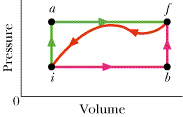
hrw7_18-41.gif

(a) What is W along path ibf? (b) If W = -19 cal for the return path fi, what is Q for this path? (c) If Eint,i = 11 cal, what is Eint,f?(d) If Eint,b = 27 cal what is Q for path ib?(e) For the same value of Eint,b, what is Q for path bf?

Homework Equations


Eint= internal energy of the system; Q= heat; W= work
I have used Eint= Q - W to solve most of the problem.

The Attempt at a Solution


I only am marked wrong on part d which is very frustrating. So far I have:
(a)Wibf = 15 cal because W= Q-E (b) Qfi= -69 cal because Q= -(E)+W (c) Eint,f= 61 cal because Eint,f= Eint+Ei (d) Qib= ? (e) Qbf= 34 because Eint,f =E-Eint,b
Any thoughts?
 
Last edited:
Physics news on Phys.org
Hi, zag4life. Welcome to PF.

How does the work for i \rightarrowb compare to the work for i\rightarrowb\rightarrowf?
 
Well, from b to f, because the volume does not change, work is equal to zero. The work for i,b,f would be the same as the work for i,b I think.
 
Good. So, use that to get Q for ib.
 

Similar threads

  • · Replies 1 ·
Replies
1
Views
17K
Replies
1
Views
2K
Replies
3
Views
1K
  • · Replies 2 ·
Replies
2
Views
13K
  • · Replies 27 ·
Replies
27
Views
3K
Replies
5
Views
3K
  • · Replies 4 ·
Replies
4
Views
3K
  • · Replies 4 ·
Replies
4
Views
3K
  • · Replies 3 ·
Replies
3
Views
3K
Replies
5
Views
3K