Fluid Dynamics - Momentum Equation for Area Change

Click For Summary
SUMMARY

The discussion focuses on the application of the momentum equation for a control volume with a changing area, specifically the equation p1A1 - p2A2 = ṁ(V2 - V1). Participants clarify the significance of the pressure forces acting on the sides of the duct, emphasizing the need to account for the horizontal component of these forces in the momentum equation. The conversation references Newton's 3rd law and Pascal's law to explain how pressure affects fluid dynamics within a duct. The source material cited is "Transport Phenomena" by Bird, Stewart, and Lightfoot, which provides foundational knowledge on macroscopic momentum balances.

PREREQUISITES
  • Understanding of fluid dynamics principles
  • Familiarity with the momentum equation in fluid mechanics
  • Knowledge of Pascal's law and Newton's 3rd law
  • Basic calculus for analyzing changing areas in ducts
NEXT STEPS
  • Study the momentum equation in fluid dynamics, focusing on control volumes
  • Learn about pressure forces in fluid mechanics, particularly in duct systems
  • Explore macroscopic momentum balances in "Transport Phenomena" by Bird, Stewart, and Lightfoot
  • Investigate the implications of changing cross-sectional areas on fluid flow
USEFUL FOR

Mechanical engineers, fluid dynamics researchers, and students studying fluid mechanics who seek to deepen their understanding of momentum equations and pressure effects in varying cross-sectional areas.

Magda
Messages
4
Reaction score
0
Hello :)
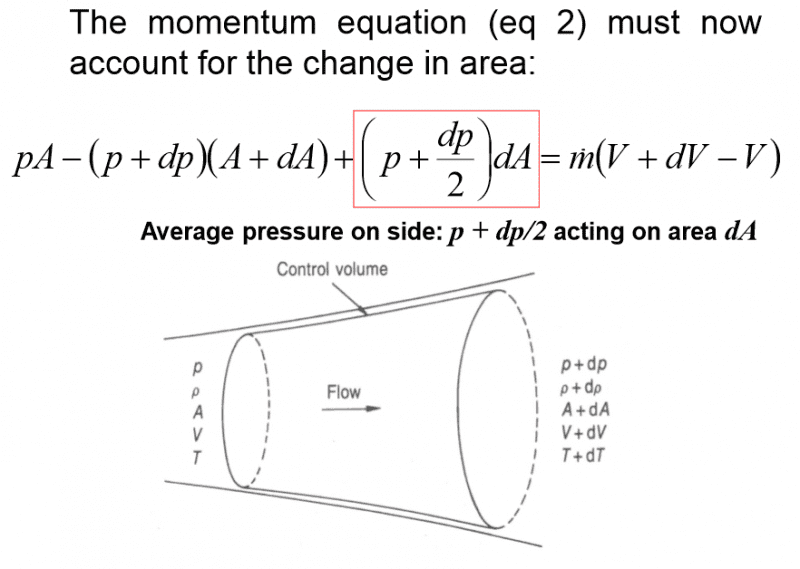
My question concerns a control volume with a changing area. The momentum equation: p1A1-p2A2 = ṁ(V2-V1) is applied to the control volume.
The image shows the equation found when applying the above momentum equation to the control volume:
upload_2014-12-18_18-19-8.png

The bit I'm having difficulty with is the part in the red box, as I don't see how that part fits in with the original momentum equation. Apparently it accounts for the "average pressure on the side" but what does this actually mean? Any help in understanding this would be much appreciated.

Thanks x
 
Physics news on Phys.org
Welcome to PF!
To understand the term in the red box, think about the fact that each element of area dAs of the side of the pipe will exert a force PsdAs on the fluid, where Ps is the pressure at the element of area. Note that this force has a a nonzero horizontal component.
 

Attachments

  • Flow.png
    Flow.png
    2.6 KB · Views: 716
Last edited:
TSny said:
Welcome to PF!
To understand the term in the red box, think about the fact that each element of area dAs of the side of the pipe will exert a force PsdAs on the fluid, where Ps is the pressure at the element of area. Note that this force has a a nonzero horizontal component.

Thank you for your response :)
I’m still slightly confused… why do I need to account for the force acting on the sides? Is it because the non-zero horizontal force component will affect the final force (term p2A2 in the momentum equation)?
 
The impulse-momentum theorem of mechanics states that the x-component of the net impulse acting on a system is equal to the change in x-component of the total momentum of the system. So, the change in x-component of momentum is due to the x-component of the net force from all forces acting on the system. The walls of the pipe exert a nonzero x-component of force on the fluid that needs to be included.
 
  • Like
Likes   Reactions: Magda
TSny said:
The impulse-momentum theorem of mechanics states that the x-component of the net impulse acting on a system is equal to the change in x-component of the total momentum of the system. So, the change in x-component of momentum is due to the x-component of the net force from all forces acting on the system. The walls of the pipe exert a nonzero x-component of force on the fluid that needs to be included.
ok, that makes sense. Thank you so much! x
 
To elaborate on what TSny said, let x represent the axial position along the duct and let R(x) represent the radius of the duct at location x. The surface area of the duct upon which the pressure is acting between x and x + dx is given by ##2\pi R \sqrt{(dR)^2+(dx)^2}=2\pi Rdx \sqrt{1+(\frac{dR}{dx})^2}##. The pressure acts perpendicular to the wall of the duct (Pascal's law), so the horizontal component of the pressure is given by ##p\frac{dR}{\sqrt{(dR)^2+(dx)^2}}##. By Newton's 3rd law, the pressure force that the fluid exerts on the duct wall is equal and opposite to the pressure force that the duct wall exerts on the fluid. So the axial component of the duct wall force acting on the fluid in the control volume is given by:
\left(2\pi R \sqrt{(dR)^2+(dx)^2}\right)\left(p\frac{dR}{\sqrt{(dR)^2+(dx)^2}}\right)=p(2\pi R dR)=pdA

Chet
 
  • Like
Likes   Reactions: Magda
Chestermiller said:
To elaborate on what TSny said, let x represent the axial position along the duct and let R(x) represent the radius of the duct at location x. The surface area of the duct upon which the pressure is acting between x and x + dx is given by ##2\pi R \sqrt{(dR)^2+(dx)^2}=2\pi Rdx \sqrt{1+(\frac{dR}{dx})^2}##. The pressure acts perpendicular to the wall of the duct (Pascal's law), so the horizontal component of the pressure is given by ##p\frac{dR}{\sqrt{(dR)^2+(dx)^2}}##. By Newton's 3rd law, the pressure force that the fluid exerts on the duct wall is equal and opposite to the pressure force that the duct wall exerts on the fluid. So the axial component of the duct wall force acting on the fluid in the control volume is given by:
\left(2\pi R \sqrt{(dR)^2+(dx)^2}\right)\left(p\frac{dR}{\sqrt{(dR)^2+(dx)^2}}\right)=p(2\pi R dR)=pdA

Chet
That was very useful. Thank you Chet :) x
 
Can I ask where is this from? I have a similar problem.
 
Dusan Stan said:
Can I ask where is this from? I have a similar problem.
See the chapter in Transport Phenomena by Bird, Stewart, and Lightfoot covering Macroscopic Momentum Balances.
 

Similar threads

  • · Replies 6 ·
Replies
6
Views
3K
Replies
2
Views
1K
Replies
6
Views
2K
  • · Replies 10 ·
Replies
10
Views
2K
  • · Replies 5 ·
Replies
5
Views
1K
  • · Replies 16 ·
Replies
16
Views
3K
Replies
0
Views
2K
  • · Replies 6 ·
Replies
6
Views
2K
  • · Replies 2 ·
Replies
2
Views
1K
  • · Replies 35 ·
2
Replies
35
Views
4K