Discussion Overview
The discussion revolves around the concept of electric flux and its relationship with electric field lines, particularly in the context of Gauss's law. Participants explore the nature of the area through which electric flux is measured, including the orientation and shape of the surface, and the distinction between electric field magnitude and electric flux.
Discussion Character
- Exploratory
- Technical explanation
- Conceptual clarification
- Debate/contested
Main Points Raised
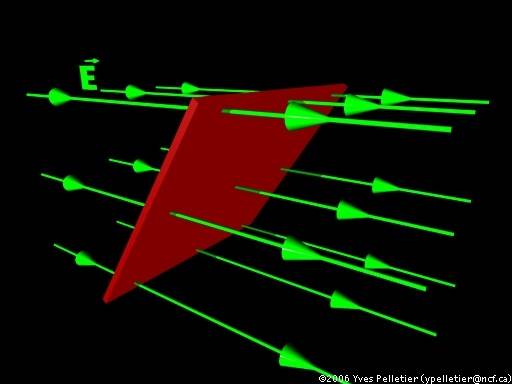
- Some participants inquire about the types of areas through which electric flux can be defined, questioning whether the area must be perpendicular to the field lines or if it can be at an angle.
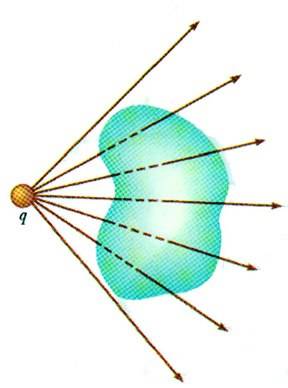
- One participant asserts that all illustrated examples of surfaces are valid for measuring electric flux.
- Another participant explains that the electric flux is calculated as a dot product of the electric field and the area, noting that the flux decreases when the surface is not perpendicular to the field lines.
- It is mentioned that irregular shapes require the use of a differential formula for flux, which involves integration over the surface to account for varying flux across different portions.
- One participant expresses curiosity about the application of integration in physics and questions whether Gauss's law simply states that flux is proportional to charge.
- A participant discusses the independence of flux from the size of the closed surface surrounding a charge, suggesting that any shape can yield the same flux result as long as it encloses the charge.
- There is confusion expressed regarding the difference between electric field magnitude and electric flux, with one participant clarifying that while field lines indicate field strength at a point, flux requires a defined area and depends on the area’s orientation relative to the field.
- Several participants reference Walter Lewin's videos as a helpful resource for understanding these concepts.
Areas of Agreement / Disagreement
Participants generally agree on the validity of various surface types for measuring electric flux and the relationship between flux and charge as stated in Gauss's law. However, there remains some disagreement and confusion regarding the distinction between electric field magnitude and electric flux, indicating that the discussion is not fully resolved.
Contextual Notes
Participants express uncertainty about the implications of surface orientation and shape on electric flux calculations, as well as the mathematical steps involved in integrating over irregular surfaces. The discussion also highlights the need for clarity in understanding the definitions and relationships between electric field and flux.