Calculating Flywheel Inertia Using Conservation of Energy Equations?

Click For Summary
SUMMARY

The forum discussion focuses on calculating the inertia of a flywheel using conservation of energy equations. The user, @forces9912, initially calculated an inertia value of 1.0273 kg/m², which differed significantly from the expected value derived from the formula I = 1/2 m R², yielding 0.0129 kg/m². Key issues identified include the incorrect sign for work loss in the energy equation and the use of an inappropriate radius for calculations. The final corrected formula for inertia incorporates both potential energy and energy loss, leading to a new calculation of I = 0.00065 kg/m².

PREREQUISITES
  • Understanding of conservation of energy principles
  • Familiarity with moment of inertia calculations
  • Knowledge of rotational dynamics
  • Ability to use LaTeX for mathematical expressions
NEXT STEPS
  • Study the derivation of the moment of inertia for complex shapes, including flywheels
  • Learn about the implications of energy loss in mechanical systems
  • Explore the use of LaTeX for formatting equations in scientific discussions
  • Investigate the relationship between linear and angular velocity in rotational motion
USEFUL FOR

Students and professionals in physics, mechanical engineering, and anyone involved in experiments related to rotational dynamics and energy conservation.

forces9912
Messages
6
Reaction score
3
Homework Statement
Problem in the images
Relevant Equations
mgh = 1/2 m v^2 + 1/2 I w^2 - Work
s = u t + 1/2 a t^2
a = v/t
I = 1/2 m R^2
I am stuck on what to do to calculate the inertia of a flywheel using the method described.
I am supposed to use conservation of energy equations to calculate the inertia.
I have a picture of the experiment and also the measurements I have taken.
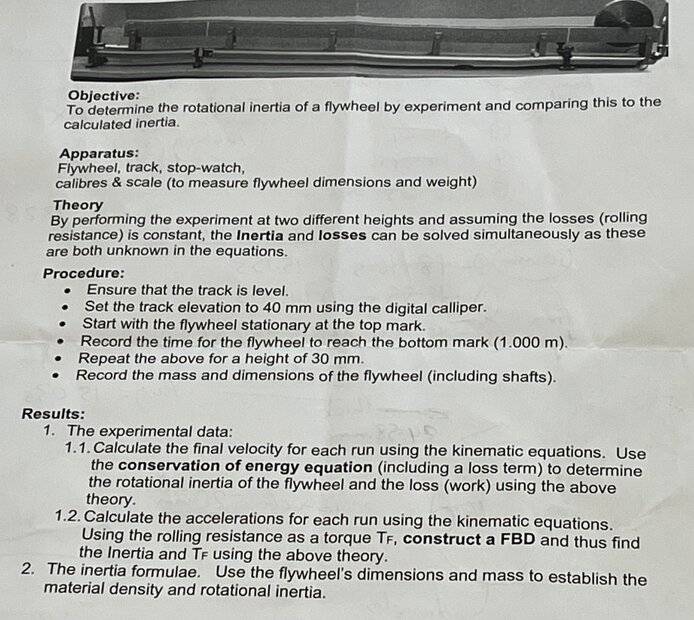
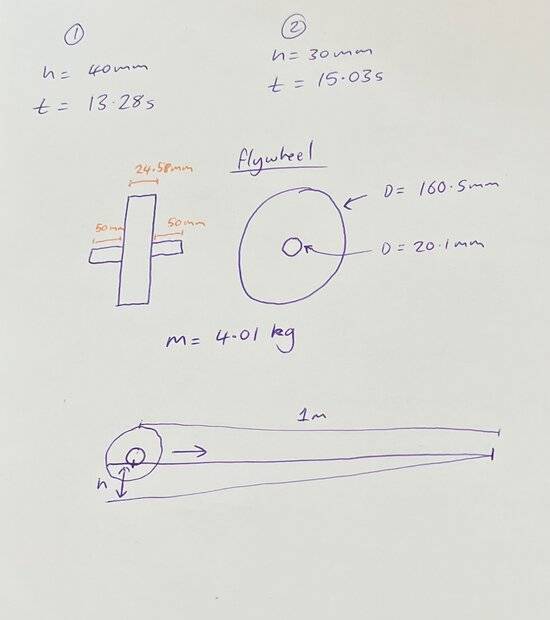
IMG-4383.jpg

IMG-4384.jpg
It seems each method I try I get a different number for Inertia.
Any help on how to tackle this problem would be greatly appreciated.
 
Physics news on Phys.org
The instructions seem to outline an approach. You must make a reasonable attempt at solving the questions before receiving help.

Also, for posting your equations please see the latex guide.

https://www.physicsforums.com/help/latexhelp/
 
Sure, I will show you what I have worked out so far. I am stuck because the I value I worked out of 1.0273 kg/m^2 is very different to when I use I = 1/2 m R^2, where I got 1/2 * 4.01 * 0.08025^2 = 0.0129 kg/m2

IMG-4386.jpg
IMG-4385.jpg
 
For one thing, It should be + W_loss on the RHS, not minus. The initial potential energy goes into three reservoirs. Your equation says you start off with potential energy and the heat that is then converted to kinetic energy. Do you see why that doesn’t make sense?

Also…again please write math equations using latex. The link is in the last post, or there is another on the lower left corner of the reply box. Your other pick is illegible( I’m on my phone-too small), cleanly write equations using the formatting available on the site, so errors can be directly quoted and addressed.
 
Did it really take over 10 seconds to traverse the 1m? That implies less than a tenth of the energy went into linear KE, which is hard to believe.
 
haruspex said:
Did it really take over 10 seconds to traverse the 1m? That implies less than a tenth of the energy went into linear KE, which is hard to believe.
Yes it did. It was a very gentle slope and also it was the shaft of the flywheel that was in contact with the surface. So most of the energy would have gone into rotating the central cylinder of the flywheel, if that makes sense.
 
@forces9912 Do you see why ##W_{loss}## has the wrong sign in your Work-Energy equation?
 
You also appear to be using the wrong radius ##r## in your calculations.
 
Last edited:
  • Like
Likes   Reactions: haruspex
erobz said:
You also appear to be using the wrong radius ##r## in your calculations.
Quite so. @forces9912, which radius should you use to find the rotation rate from the linear speed?
 
  • #10
Welcome, @forces9912 !

Perhaps irrelevant, but I believe that the complete shape of the flywheel (one disc and two journals) should be considered.
The above calculation of the moment of inertia is actually for a simple disc of wider dimension, resulting in a higher value for I.

Please, see:
http://hyperphysics.phy-astr.gsu.edu/hbase/mi.html#mix
Flywheel.jpg

Flywheel 2.jpg
 
  • #11
haruspex said:
Quite so. @forces9912, which radius should you use to find the rotation rate from the linear speed?
Right, I should be using the shaft radius of 0.01005m because that is the part of the flywheel that is in contact with the surface.
Lnewqban said:
Welcome, @forces9912 !

Perhaps irrelevant, but I believe that the complete shape of the flywheel (one disc and two journals) should be considered.
The above calculation of the moment of inertia is actually for a simple disc of wider dimension, resulting in a higher value for I.

Please, see:
http://hyperphysics.phy-astr.gsu.edu/hbase/mi.html#mix
View attachment 333973
View attachment 333974
Amazing graphic of the problem, thank you for that. I will have a read of that
erobz said:
@forces9912 Do you see why ##W_{loss}## has the wrong sign in your Work-Energy equation?
Yes I can see that now, thank you for making it clear
Potential Energy should = KE + KE rot + Energy loss.
 
  • Like
Likes   Reactions: Lnewqban and erobz
  • #12
These are my new calculations for ##I##

##0 = E-E_0 = (PE + K_{trans} + K_{rot}) - (PE_0 + K_{0trans} + K_{0rot})##

##0 = \frac {1}{2}Mv^2 + \frac {1}{2}Iw^2 - Mgh##

##0 = \frac {1}{2}Mv^2 + \frac {1}{2}I\left(\frac{v}{r}\right)^2 - Mgh##

rearranged for ##I##

##I = \frac{Mgh - \frac{1}{2}Mv^2}{\frac{1}{2}\left(\frac{v}{r}\right)^2} = \frac{Mr^2\left(2gh-v^2\right)}{v^2}##

##v = \frac {2d}{t}##

##I = \frac{Mr^2\left(2gh-\left(\frac{2d}{t}\right)^2\right)}{\left(\frac{2d}{t}\right)^2}##

##I = \frac{Mr^2\left(ght^2-2d^2\right)}{2d^2}##

##I = Mr^2 \left( \frac {ght-2d^2} {d^2}\right)##

##M=4.01 ##
##r=0.01005 ##
##h=0.04 ##
##d=1 ##
##t=13.28##

##I = 4.01*0.01005^2 \left( \frac {9.81*0.04*13.28-2*1^2} {1^2}\right)##

##I = 0.00065##
 
  • #13
forces9912 said:
These are my new calculations for ##I##

##0 = E-E_0 = (PE + K_{trans} + K_{rot}) - (PE_0 + K_{0trans} + K_{0rot})##

##0 = \frac {1}{2}Mv^2 + \frac {1}{2}Iw^2 - Mgh##
Where did the frictional work term go? You should be solving for ##I## and ##E_{loss}## simultaneously using the (both) experimental results.
 
  • #14
erobz said:
Where did the frictional work term go? You should be solving for ##I## and ##E_{loss}## simultaneously using the (both) experimental results.
Right, so then my formula will end up like

##0 = (PE + K_{trans} + K_{rot} + E_{loss}) - (PE_0 + K_{0trans} + K_{0rot} + E_{0loss})##

##0 = \frac {1}{2}Mv^2 + \frac {1}{2}Iw^2 + E_{loss} - Mgh##

##E_{loss} = Mgh - \frac {1}{2}Mv^2 - \frac {1}{2}I\left(\frac{v}{r}\right)^2##

and then I put in the data from each experiment and set it to equal each other, and finally solve for ##I##?

such as

##Mg(h_1) - \frac {1}{2}M(v_1)^2 - \frac {1}{2}I\left(\frac{(v_1)}{r}\right)^2 = Mg(h_2) - \frac {1}{2}M(v_2)^2 - \frac {1}{2}I\left(\frac{(v_2)}{r}\right)^2##
 
  • Like
Likes   Reactions: erobz
  • #15
Correct, then sub that result into either equation to get ##E_{loss}##.
 

Similar threads

  • · Replies 40 ·
2
Replies
40
Views
6K
Replies
2
Views
2K
  • · Replies 4 ·
Replies
4
Views
8K
  • · Replies 13 ·
Replies
13
Views
3K
  • · Replies 5 ·
Replies
5
Views
906
  • · Replies 14 ·
Replies
14
Views
3K
Replies
21
Views
2K
  • · Replies 1 ·
Replies
1
Views
3K
  • · Replies 3 ·
Replies
3
Views
1K
Replies
14
Views
2K