How to Graph Potential Energy from Force Fx Along the x-axis?

  • Thread starter Thread starter bestchemist
  • Start date Start date
  • Tags Tags
    Force Particle
Click For Summary
To graph the potential energy from the force exerted on a particle along the x-axis, the force function must be integrated piecewise due to its non-constant nature. For the interval from 0 to 0.5 meters, the force is linear, leading to a potential energy function of U = 2x^2. From 0.5 to 1 meter, the force changes, resulting in a potential energy function of U = -2x^2 + 4x - 1. Beyond 1 meter, since the force is zero, the potential energy remains constant and should not revert to zero. The area under the force-displacement curve is critical for accurately determining the potential energy across these intervals.
bestchemist
Messages
37
Reaction score
0
1. Homework Statement

The figure shows the force Fx exerted on a particle that moves along the x-axis. Draw a graph of the particle's potential energy as a function of position x from 0m to 1.1m. Let U be zero at x=0m.
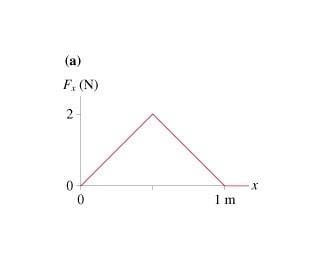

11.P39a.jpg


2. Homework Equations

W = F*d
U = mgh
 
Physics news on Phys.org
Attempt please. Your relevant equations are not correct when the force is not constant. The force is not mg. Are you familiar with calculus or other means of calculating work or PE for non constant (assumed conservative) forces?
 
PhanthomJay said:
Attempt please. Your relevant equations are not correct when the force is not constant. The force is not mg. Are you familiar with calculus or other means of calculating work or PE for non constant (assumed conservative) forces?[/QUOT

Thank you for responding! :)

yeah... I'm not really good with Calculus...
IF those equation don't work then I think I have to use the following equation.

F = dU/dx
U = ∫F dx

but How do I integrate tho since the function of force is not given?
 
bestchemist said:
How do I integrate tho since the function of force is not given?

It is given, via the diagram.
 
voko said:
It is given, via the diagram.

since the slope from 0 to 0.5 is 4 then the force is F = 4x and the integral of that is 2x2 right?
from 0.5 to 1 the force is what? since the slope there is -4, will it be F=-4x?
 
bestchemist said:
since the slope from 0 to 0.5 is 4 then the force is F = 4x and the integral of that is 2x2 right?
yes, it is actually 2x^2 + k, where k is a constant, and since U =0 when x is 0, then k is 0, so U = 2x^2 between x = 0 and x = 0.5, an upward facing parabola
from 0.5 to 1 the force is what? since the slope there is -4, will it be F=-4x?
Not quite, are you familiar with the equation of a straight line , y = mx + b, where m is the slope of the line and b is the value of y at x = 0 (the y-intercept of the extended line)?
 
PhanthomJay said:
Not quite, are you familiar with the equation of a straight line , y = mx + b, where m is the slope of the line and b is the value of y at x = 0 (the y-intercept of the extended line)?

Soooo... From 0.5 to 1, F = -4x +4 since the force at 0.5 is 2 so the y intercept is 4!
And then the integral of F will be U=-(2x^2+4x +k) right??
But somehow when I graph this U graph... It doesn't look right. When I plug 0.6 in for x I got 3.12
I have a feeling that its wrong :( can someone please help.
 
When you have $$ f(x) = \begin{cases} a(x), 0 \le x < 0.5 \\ b(x), 0.5 \le x < 1 \\ c(x) \end{cases} $$ then what is $$ \int_0^x f(x) dx $$?
 
bestchemist said:
Soooo... From 0.5 to 1, F = -4x +4 since the force at 0.5 is 2 so the y intercept is 4!
yes
And then the integral of F will be U=-(2x^2+4x +k) right??
you mean U = -2x^2 +4x + k, I think, where k can be found using the knowledge gained in the first part, U = 0.5 when x = 0.5, solve for k.
But somehow when I graph this U graph... It doesn't look right. When I plug 0.6 in for x I got 3.12
Try again, using the corrected equation for U.

Don't forget you then still need to graph the PE from x =1 to x = 1.1.

As a check of your calculus, remember that the area under the force-displacement curve from F=0 to F=x, is the PE at x.

I'm not so good at calculus, either, just the basics. Haven't used it much since college days.
 
  • #10
voko said:
When you have $$ f(x) = \begin{cases} a(x), 0 \le x < 0.5 \\ b(x), 0.5 \le x < 1 \\ c(x) \end{cases} $$ then what is $$ \int_0^x f(x) dx $$?

PhanthomJay said:
yes you mean U = -2x^2 +4x + k, I think, where k can be found using the knowledge gained in the first part, U = 0.5 when x = 0.5, solve for k. Try again, using the corrected equation for U.

Don't forget you then still need to graph the PE from x =1 to x = 1.1.

As a check of your calculus, remember that the area under the force-displacement curve from F=0 to F=x, is the PE at x.

I'm not so good at calculus, either, just the basics. Haven't used it much since college days.

Thank you guys,

I think I got it!

but for x=1 to x=1.1
isn't the force is zero so the PE is zero too? the slope is zero so F=0 integral of that will be zero too isn't it?
 
  • #11
bestchemist said:
but for x=1 to x=1.1
isn't the force is zero so the PE is zero too? the slope is zero so F=0 integral of that will be zero too isn't it?

Zero derivative does not mean that the function is zero. You want your potential energy to be a smooth function, so it should not be zero at x > 1 because it was not zero at x < 1.
 
  • #12
voko said:
Zero derivative does not mean that the function is zero. You want your potential energy to be a smooth function, so it should not be zero at x > 1 because it was not zero at x < 1.

Sooo
∫F= 0
so U = 0x +k
so U =1?
 
  • #13
Can you answer the question in #8?
 
  • #14
voko said:
Can you answer the question in #8?

nope :(
I got a(x) and b(x) but I don't know c(x)
 
  • #15
c(x) = 0, as given.
 
  • #16
voko said:
c(x) = 0, as given.

U = ∫11.1 0
U= 0x + k
isn't it?
 
  • #17
## U = \int_{1}^{1.1} 0 dx## has almost nothing to do with ## U = \int_0^x f(x) dx ## as requested in #8. It cannot be the answer.
 
  • #18
voko said:
## U = \int_{1}^{1.1} 0 dx## has almost nothing to do with ## U = \int_0^x f(x) dx ## as requested in #8. It cannot be the answer.

I don't know what could it be then
I feel discourage :(
Can you tell me the answer and how you get it step by step, please...
 
  • #19
You need to find this: $$ U(x) = - \int_0^x f(x) dx $$ The complication is that ## f(x) ## is not defined as a simple formula:
$$ f(x) = \begin{cases} a(x), 0 \le x < 0.5 \\ b(x), 0.5 \le x < 1 \\ c(x) \end{cases} $$

Obviously, when ## 0 \le x < 0.5 ##, you can say ## U(x) = - \int_0^x a(x) dx ##.

But when ## x > 0.5 ##, you cannot say that ## U(x) = \int_0^x a(x) dx ##, nor can you say that ## U(x) = \int_0^x b(x) dx ##. However, for any ##f(x)## you can say ## \int_0^x f(x) dx = \int_0^{0.5} f(x) dx + \int_{0.5}^x f(x) dx ##, so, for ## 0.5 \le x < 1, \ U(x) = - \int_0^{0.5} a(x) dx - \int_{0.5}^x b(x) dx ##.

Now you have to find ## U(x) ## for ## x \ge 1 ##.
 
  • #20
voko said:
You need to find this: $$ U(x) = - \int_0^x f(x) dx $$ The complication is that ## f(x) ## is not defined as a simple formula:
$$ f(x) = \begin{cases} a(x), 0 \le x < 0.5 \\ b(x), 0.5 \le x < 1 \\ c(x) \end{cases} $$

Obviously, when ## 0 \le x < 0.5 ##, you can say ## U(x) = - \int_0^x a(x) dx ##.

But when ## x > 0.5 ##, you cannot say that ## U(x) = \int_0^x a(x) dx ##, nor can you say that ## U(x) = \int_0^x b(x) dx ##. However, for any ##f(x)## you can say ## \int_0^x f(x) dx = \int_0^{0.5} f(x) dx + \int_{0.5}^x f(x) dx ##, so, for ## 0.5 \le x < 1, \ U(x) = - \int_0^{0.5} a(x) dx - \int_{0.5}^x b(x) dx ##.

Now you have to find ## U(x) ## for ## x \ge 1 ##.

so for x>1
U(x) = -∫0 0.5 ax dx - ∫0.5 1 bx dx - ∫1x cx dx

right?
 
  • #21
bestchemist said:
so for x>1
U(x) = -∫0 0.5 ax dx - ∫0.5 1 bx dx - ∫1x cx dx

right?

Right!
 
  • Like
Likes 1 person
  • #22
voko said:
Right!

Thank! Finally! let's me try to graph this thing and see it I get it right!
Thanks again! you're awesome!
 
  • #23
Just for the record, can you show your formulae for the potential energy in all the three intervals?
 
  • #24
voko said:
Just for the record, can you show your formulae for the potential energy in all the three intervals?

from 0<x<0.5
U = -2x2

from 0.5<x<1
U = -2x^2 +4x + k
k = -1
so U = -2x2 +4x - 1

and for x >1

U(x) = -∫00.5 ax dx - ∫0.51 bx dx - ∫1x cx dx
U = - 2x2 - ( -2x2 +4x -1)
U = -4x + 1

Is it right?
 
  • #25
bestchemist said:
from 0<x<0.5
U = -2x2

Correct. So ## \int_0^x a(x) dx = 2x^2 ##.

from 0.5<x<1
U = -2x^2 +4x + k
k = -1
so U = -2x2 +4x - 1

This is supposed to be ## - \int_0^{0.5} a(x) dx - \int_{0.5}^{x} b(x) dx ##. From the above, ## \int_0^{0.5} a(x) dx = 0.5 ##. What is ## \int_{0.5}^{x} b(x) dx ##?

and for x >1

U(x) = -∫00.5 ax dx - ∫0.51 bx dx - ∫1x cx dx
U = - 2x2 - ( -2x2 +4x -1)
U = -4x + 1


You equate U with various different things here, so I am not sure I understand what you are saying here.

If ##U = -4x + 1 ## is the end result, it is wrong, because when ## x > 1 ##, the force is zero, so the potential energy has to be constant.
 
  • #26
voko said:
Correct. So ## \int_0^x a(x) dx = 2x^2 ##.


This is supposed to be ## - \int_0^{0.5} a(x) dx - \int_{0.5}^{x} b(x) dx ##. From the above, ## \int_0^{0.5} a(x) dx = 0.5 ##. What is ## \int_{0.5}^{x} b(x) dx ##?


You equate U with various different things here, so I am not sure I understand what you are saying here.

If ##U = -4x + 1 ## is the end result, it is wrong, because when ## x > 1 ##, the force is zero, so the potential energy has to be constant.


For x >0.5

U = -2x^2 - (-2x^2 +4x-1)
U = -4x +1

for X >1 since it is suppose to be constant

U = -4x +1 -(-4x+1)

I guess on this last one lol...Idk what should it be
 
  • #27
bestchemist said:
For x >0.5

U = -2x^2 - (-2x^2 +4x-1)
U = -4x +1

Why? I asked a specific question about ## \int_{0.5}^{x} b(x) dx ##. Answering it would be helpful for you.
 
  • #28
voko said:
Why? I asked a specific question about ## \int_{0.5}^{x} b(x) dx ##. Answering it would be helpful for you.

for x >0.5
F= -4x+4
so ∫f dx

U = - 2x^2 +4x +k

0.51 -4x+4

isn't it?
 
  • #29
You are getting confused because you use the same letters to denote multiple things. Let ## B(x) = \int_{0.5}^{x} b(x) dx ##. What is ## B(x) ##, if ## b(x) = -4x + 4 ##? What is ## U(x) ##, when ## 0.5 \le x < 1 ##?
 
  • #30
voko said:
You are getting confused because you use the same letters to denote multiple things. Let ## B(x) = \int_{0.5}^{x} b(x) dx ##. What is ## B(x) ##, if ## b(x) = -4x + 4 ##? What is ## U(x) ##, when ## 0.5 \le x < 1 ##?

sooo
U = -2x^2 +4x +k ]x - ( (-2x^2 +4x +k)]0.5)

right?
 

Similar threads

Replies
3
Views
1K
  • · Replies 9 ·
Replies
9
Views
19K
  • · Replies 10 ·
Replies
10
Views
2K
  • · Replies 2 ·
Replies
2
Views
1K
Replies
1
Views
2K
  • · Replies 13 ·
Replies
13
Views
1K
  • · Replies 5 ·
Replies
5
Views
2K
Replies
15
Views
2K
  • · Replies 7 ·
Replies
7
Views
1K