panoleks
- 1
- 0
Hello, I have a confusing question, please help.
Suppose I have a structure like on the figure:
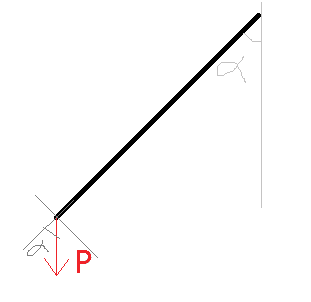 .
.
I want to find force acting along the bar, for example to find critical stresses. My brain thinks in two ways:
1. I can distribute P in the application point as Fb=P*sin(90-al);
2. I can find it from the sum of all of the forces on the y-axis, so it is Fb=P/cos(al).
I feel that the second one is more right than the other one, but the second one seems to be more real. Suppose alpha is zero, in this case Fb is equal to P, so when alpha is increasing it should decrease and the force P will to cause the moment.
If I take a pack of milk in my hand and increase the alpha, I feel that while alpha is increasing it becomes more difficult to hold it, but I think that it's because of the moment produced by the force Fm=P*cos(90-al), but not because of force.
Where is the trouble?
Suppose I have a structure like on the figure:
I want to find force acting along the bar, for example to find critical stresses. My brain thinks in two ways:
1. I can distribute P in the application point as Fb=P*sin(90-al);
2. I can find it from the sum of all of the forces on the y-axis, so it is Fb=P/cos(al).
I feel that the second one is more right than the other one, but the second one seems to be more real. Suppose alpha is zero, in this case Fb is equal to P, so when alpha is increasing it should decrease and the force P will to cause the moment.
If I take a pack of milk in my hand and increase the alpha, I feel that while alpha is increasing it becomes more difficult to hold it, but I think that it's because of the moment produced by the force Fm=P*cos(90-al), but not because of force.
Where is the trouble?