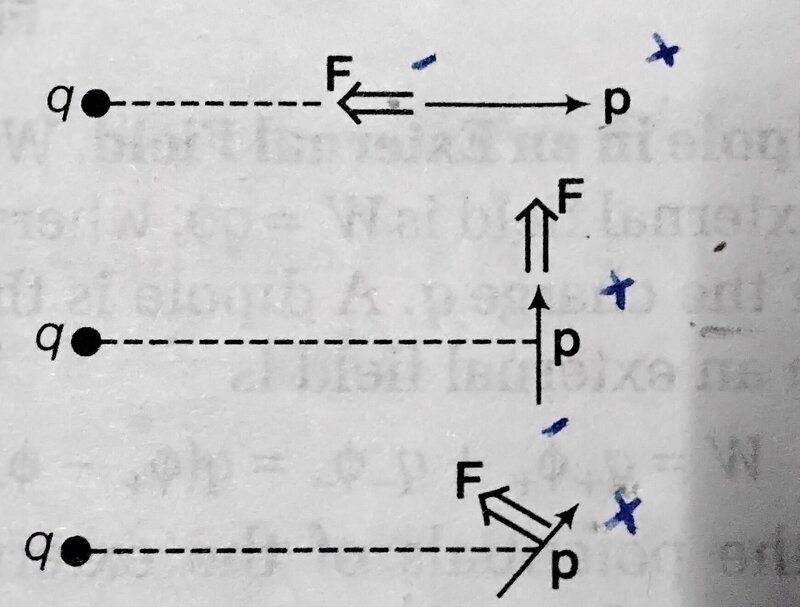
Something looks off (i.e., "wrong") with the problem statement. I'm hoping your instructor didn't give you a bad problem, but it's not unheard of. Then again maybe I'm missing something myself.
From what I can tell, middle and bottom parts look wrong, although maybe the middle part is a trick question.
You haven't shown any work so we're not allowed to help help you until you do. Allow me to correct your statement,
Shreya said:
Relevant Equations:: F=p*(partial derivative of E with respect to direction of p )
That's not quite right. The partial derivative is not necessarily in respect to the direction of [itex]\vec p[/itex], but rather with respect to the spatial coordinates. [itex]\vec F[/itex], [itex]\vec p[/itex], and [itex]\vec E[/itex] are all vectors, and they should be all subject to the chosen coordinate system.
It's true that
[tex]\vec F = \left( \vec p \cdot \vec \nabla \right) \vec E[/tex]
and in Cartesian coordinates this becomes,
[tex]\vec F = \left( p_x \frac{\partial}{\partial x} + p_y \frac{\partial}{\partial y} + p_z \frac{\partial}{\partial z} \right) \vec E[/tex]
but that's still not enough to reconcile the middle and bottom parts, unless maybe I'm missing something.
- Is the dipole in question just an electric dipole (as opposed to a magnetic dipole), and nothing is presently moving?
- Are all three parts intended to be taken separately (i.e., not all charges are all present simultaneously)?
- Is there anything else in this problem that wasn't stated in the problem statement, such as other constraints or other charges or fields around?
- Can you use my equation in Cartesian coordinates (above) to show that there is something wrong with the middle and bottom figures?
[Edit: Nevermind. I was misinterpreting the problem statement. The diagrams are fine.]