Force that the wall exerts on the wedge

Click For Summary
SUMMARY

The discussion focuses on calculating the force that the wall exerts on a wedge inclined at an angle theta, with a block of mass m sliding down the plane. The correct expression for the force, F_ww, is derived by resolving the components of the weight acting on the wedge. The participants clarify that the normal force is n = mg cos(theta), and the horizontal force exerted by the block on the wedge is F = mg sin(theta). The final conclusion emphasizes the need to consider both vertical and horizontal components of forces acting on the wedge.

PREREQUISITES
  • Understanding of Newton's laws of motion
  • Knowledge of vector resolution in physics
  • Familiarity with inclined plane mechanics
  • Basic concepts of forces and normal force
NEXT STEPS
  • Study the derivation of forces on inclined planes in physics
  • Learn about vector resolution techniques in mechanics
  • Explore the concept of normal force in different scenarios
  • Investigate frictionless systems and their applications in physics
USEFUL FOR

Students of physics, mechanics enthusiasts, and anyone studying forces on inclined planes will benefit from this discussion.

klm
Messages
165
Reaction score
0
A wedge with an inclination of angle theta rests next to a wall. A block of mass m is sliding down the plane, as shown. There is no friction between the wedge and the block or between the wedge and the horizontal surface.

Find the magnitude, F_ww, of the force that the wall exerts on the wedge.
Express F_ww in terms of theta and m, along with any necessary constants.
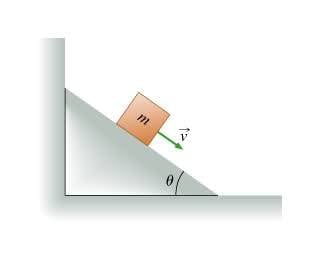
2hmfvqw.jpg


ok i tried it and i got mgcos(theta)^2 . but it saying that is incorrect. i drew my free body diagram and can't figure out where i am going wrong. i found Fnet = mg sin theta as well
 
Physics news on Phys.org
I think what you need to do is calculate the horizontal force exerted by the block on the wedge. And that would be the force that the wedge exerts on the wall and hence the force the wall exerts back on the wedge.

Did you do that?
 
isn't the only force the box acting on the wedge is weight
 
no i mean, like okay we know n=mg cos theta right. and that is the force the box is acting on the wedge and the same the wedge is acting on the box right?
 
Hmm, it's been a while since I did mechanics, but since this is in an incline, there has to be a force in the horizontal vector as well as the vertical doesn't it?

So the horizontal vector would be found by F = mg sin theta
 
I am really not sure though, best if someone else answers this.
 
right i found mgsintheta for my fney x. but i don't understand how that is going to help...sorry!
 
thanks for trying =)!
 
Well what is the answer given?
 
  • #10
i don't know! i have to try to figure what the force of the wall exerts on the wedge.
 
  • #11
Well try putting in mg sin theta as the answer, and cya.
 
  • #12
i don't think it should be mg sin theta only
 
  • #13
nvm i think i figured it out. thanks guys
 
  • #14
What was it? I am interested to know :)
 
  • #15
What you are doing here is resolving components of forces twice. So you need to find the component of weight acting perpendicular to the incling which you have as mg\cos(\theta). Then you have to resolve this force into the component that pushes the block against the wall.
 

Similar threads

  • · Replies 3 ·
Replies
3
Views
1K
Replies
5
Views
2K
  • · Replies 3 ·
Replies
3
Views
2K
  • · Replies 9 ·
Replies
9
Views
2K
  • · Replies 4 ·
Replies
4
Views
2K
  • · Replies 12 ·
Replies
12
Views
3K
  • · Replies 17 ·
Replies
17
Views
2K
  • · Replies 4 ·
Replies
4
Views
2K
  • · Replies 7 ·
Replies
7
Views
2K
Replies
3
Views
2K