Forces induced by a vehicle wheel on the ground

Click For Summary

Discussion Overview

The discussion revolves around the forces acting on a car wheel and how these forces translate to the ground surface. It includes considerations of vertical forces, torque, and horizontal forces, as well as the interaction between the wheel and the ground during motion.

Discussion Character

  • Exploratory
  • Technical explanation
  • Debate/contested

Main Points Raised

  • One participant outlines the forces acting on a car wheel, including vertical force due to the car's weight, torque from the engine, and a horizontal force in the direction of travel, questioning the relationship between these forces.
  • Another participant provides a link to a resource on rolling resistance, potentially suggesting further reading on the topic.
  • One participant agrees with the initial understanding, explaining that the torque from the engine results in a force at the wheel's perimeter that pushes against the ground, leading to a reaction force that propels the car forward.
  • A different perspective is presented, stating that when analyzing the ground plane, there are at most three forces: a normal force, a force in the direction of travel, and a force perpendicular to that direction.

Areas of Agreement / Disagreement

Participants express differing views on the forces at play, with some agreeing on the basic principles while others challenge or refine the understanding of the forces acting at the ground-wheel interface. The discussion remains unresolved regarding the complete nature of these forces.

Contextual Notes

There are limitations in the discussion regarding the assumptions made about the forces and their interactions, as well as the definitions of the forces involved. The relationship between torque and horizontal force is not fully clarified.

Geegeegee
Messages
2
Reaction score
0
Hi, I was wondering whether anyone can help with a question I have about the forces acting on a car wheel and the forces the wheel induces on the ground surface.

The way I understand it, a car wheel traveling on a flat surface has the following forces acting on it:
-vertical force due to the weight of the car (acts at centre?)
-a torque applied by the engine at the axle
-a horizontal force in the direction of travel (is this separate to the torque or just a component of it?)

I was not sure how these forces acting on the wheel can be translated to forces at the ground-wheel interface. I know there will be a horizontal force in the opposite direction of travel, and a possibly eccentric vertical force acting on the ground. Is there also a torque? Or is this completely incorrect? I have included an image of what my understanding is. Any help would be greatly appreciated.
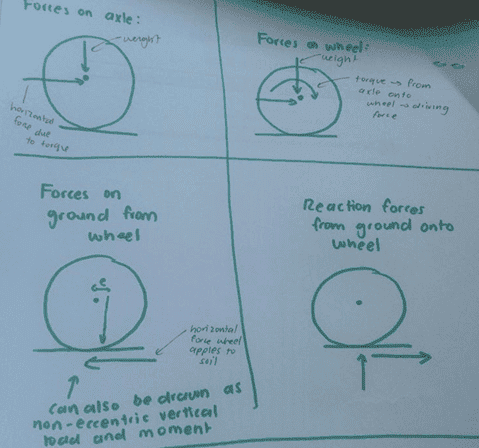
upload_2015-9-9_20-17-50.png
 
Engineering news on Phys.org
You got it right. The torque applied to the wheel from the engine gets transferred to the perimeter of the wheel as a force pushing the road back (via friction between the tire and the road surface). The reaction force from the ground (Newton's third law) pushes the car forward.The weight of the car creates a vertical downward force. The car is supported by the reaction force of the road surface.
 
Forget all the stuff above the ground and simply look at the ground plane. For a two dimensional contact patch, there can be at most three forces. (1) a force normal to the ground, (2) a force in the direction of travel, and (3) a force perpendicular to the direction of travel. That's all.
 

Similar threads

Replies
9
Views
2K
  • · Replies 8 ·
Replies
8
Views
7K
Replies
10
Views
3K
Replies
6
Views
4K
  • · Replies 30 ·
2
Replies
30
Views
2K
  • · Replies 12 ·
Replies
12
Views
4K
  • · Replies 102 ·
4
Replies
102
Views
8K
  • · Replies 3 ·
Replies
3
Views
3K
Replies
1
Views
4K
Replies
13
Views
4K