Forces on ropes connected to a slanted ceiling

  • Context: Undergrad 
  • Thread starter Thread starter SweatingBear
  • Start date Start date
  • Tags Tags
    Forces
Click For Summary
SUMMARY

The forces on two ropes connected to a slanted ceiling remain equal at 150 N each, regardless of the ceiling's angle. This conclusion is based on the principles of equilibrium, where the upward forces must equal the downward forces, and the torques about any pivot point must also sum to zero. The tension in each rope can be derived using torque calculations, specifically by equating the clockwise torque from the weight to the counterclockwise torque from the tension. Thus, the tension in each rope equals half the weight of the suspended object.

PREREQUISITES
  • Understanding of basic physics concepts such as force, tension, and equilibrium.
  • Familiarity with torque and its role in rotational equilibrium.
  • Knowledge of how to apply the principles of symmetry in physics problems.
  • Ability to perform basic algebraic manipulations to solve for unknowns.
NEXT STEPS
  • Study the concept of torque in detail, particularly in static equilibrium scenarios.
  • Learn about the principles of tension in ropes and cables under various loading conditions.
  • Explore real-world applications of equilibrium in engineering and construction.
  • Investigate advanced topics in mechanics, such as dynamics and the effects of varying angles on force distribution.
USEFUL FOR

Physics students, engineering students, and anyone interested in understanding the mechanics of forces and tension in static systems.

SweatingBear
Messages
119
Reaction score
0
Hey forum.

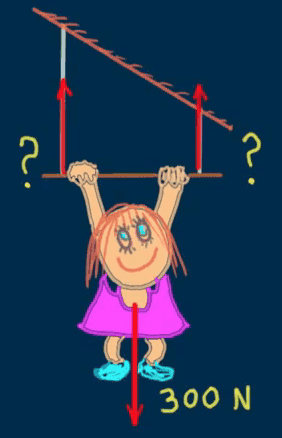
So I was posed the question whether the forces on two ropes will vary or not depending on if the ceiling from which they are hanging is slanted or not. Here's a picture depicting the scenario:
s5TKz.png


I claim they'll equal 150 N respectively, independent of the ceiling slanting or not. But I am not sure how to motivate this (mathematically and/or conceptually). Do you guys have any idea?

Picture-source:
 
Last edited by a moderator:
Physics news on Phys.org
Pretend the top of the picture was covered up so you had no idea about what the ropes attached to. Would it change your solution?

Do you know how to solve this problem in the first place? Assume a horizontal ceiling, if it helps. (Consider torques acting on the rod the girl hangs from.)
 
Doc Al said:
Pretend the top of the picture was covered up so you had no idea about what the ropes attached to. Would it change your solution?

No, I do not think it would. The upward-forces would still have to cancel the downward-forces. But if it was slanted, I am not sure, albeit inclined to believe that the respective forces still equal 150 N. Got any idea?

Doc Al said:
Do you know how to solve this problem in the first place? Assume a horizontal ceiling, if it helps. (Consider torques acting on the rod the girl hangs from.)

Well, in that case the upward-directed forces must equal the downward-directed forces because equilibrium in the system reigns.
 
SweatingBear said:
Well, in that case the upward-directed forces must equal the downward-directed forces because equilibrium in the system reigns.
That's true, but only part of the story. For equilibrium, the torques about any point must add to zero as well. You can use that fact to solve for the tension in each rope.
 
Doc Al said:
That's true, but only part of the story. For equilibrium, the torques about any point must add to zero as well. You can use that fact to solve for the tension in each rope.

Hm, I see your point. But I do not think that is necessary because in that part of the video-series, he has not even mentioned torque. So I am supposing that the question can be answered without respect to torque.

But, if do have to consider torque, I am not really sure how the calculation really goes; care to show?
 
SweatingBear
Is it the slant of the ceiling or the differing lengths of the two ropes that has you wondering?

How does force transmit itself from one location on the rope to the next? Does the tension in a rope vary along its length?
If the roof was so high that you could not tell whether the roof was slanted or not by just looking at it straight up to determine an incline, could you detemine the force at each end on the bar?
 
Cut the girl vertically in half and attach each half to each end of each rope and remove the horizontal rod that she hangs from. The tension in each rope is the same regardless of the slope of the roof assuming equal halves.

Does this help? Sorry for the gruesome picture above.
 
Sorry for the gruesome picture above

figuratively, or literally ( in which case I do not see the gory details :-p )

Great explanation - works for me.
 
256bits said:
SweatingBear
Is it the slant of the ceiling or the differing lengths of the two ropes that has you wondering?

How does force transmit itself from one location on the rope to the next? Does the tension in a rope vary along its length?
If the roof was so high that you could not tell whether the roof was slanted or not by just looking at it straight up to determine an incline, could you detemine the force at each end on the bar?

Hm, interesting thought. I suppose they, in that case, would have to make up 150 N respectively.

Spinnor said:
Cut the girl vertically in half and attach each half to each end of each rope and remove the horizontal rod that she hangs from. The tension in each rope is the same regardless of the slope of the roof assuming equal halves.

Does this help? Sorry for the gruesome picture above.

Yes, quite helpful. :)

Concluding remark: Regardless of if the ceiling is slanted or not, the force on each rope is half of the persons weight i.e. 150 N (respectively).
 
  • #10
SweatingBear said:
Hm, I see your point. But I do not think that is necessary because in that part of the video-series, he has not even mentioned torque. So I am supposing that the question can be answered without respect to torque.
Sure, you can just appeal to symmetry, which is what I was leading you towards with my suggestion to pretend you couldn't see the upper part of the diagram. (It doesn't matter!) Since the bar is horizontal and the girl is even suspended (her weight acting right in the middle), you can conclude that the rope tensions must be equal.
But, if do have to consider torque, I am not really sure how the calculation really goes; care to show?
If you wanted to use torque to figure out the tension in the rope, here's how it goes. We'll use the left end of the bar as the pivot point. The torque from the girl's weight, which acts in the middle of the bar, exerts a clockwise torque of WL/2 (where L is the length of the bar). The right hand rope exerts a counterclockwise torque of TL, where T is the tension. Those torques must balance to have equilibrium, so WL/2 = TL and thus T = W/2. The tension in the right hand rope must equal half the weight. The same logic applies to either end, of course.
 
  • #11
Doc Al said:
Sure, you can just appeal to symmetry, which is what I was leading you towards with my suggestion to pretend you couldn't see the upper part of the diagram. (It doesn't matter!) Since the bar is horizontal and the girl is even suspended (her weight acting right in the middle), you can conclude that the rope tensions must be equal.

If you wanted to use torque to figure out the tension in the rope, here's how it goes. We'll use the left end of the bar as the pivot point. The torque from the girl's weight, which acts in the middle of the bar, exerts a clockwise torque of WL/2 (where L is the length of the bar). The right hand rope exerts a counterclockwise torque of TL, where T is the tension. Those torques must balance to have equilibrium, so WL/2 = TL and thus T = W/2. The tension in the right hand rope must equal half the weight. The same logic applies to either end, of course.

Fantastic answer, thank you Doc Al!
 

Similar threads

  • · Replies 6 ·
Replies
6
Views
3K
  • · Replies 1 ·
Replies
1
Views
2K
  • · Replies 2 ·
Replies
2
Views
2K
  • · Replies 86 ·
3
Replies
86
Views
8K
  • · Replies 32 ·
2
Replies
32
Views
7K
  • · Replies 1 ·
Replies
1
Views
2K
  • · Replies 2 ·
Replies
2
Views
3K
  • · Replies 5 ·
Replies
5
Views
4K
  • · Replies 1 ·
Replies
1
Views
2K
  • · Replies 1 ·
Replies
1
Views
5K