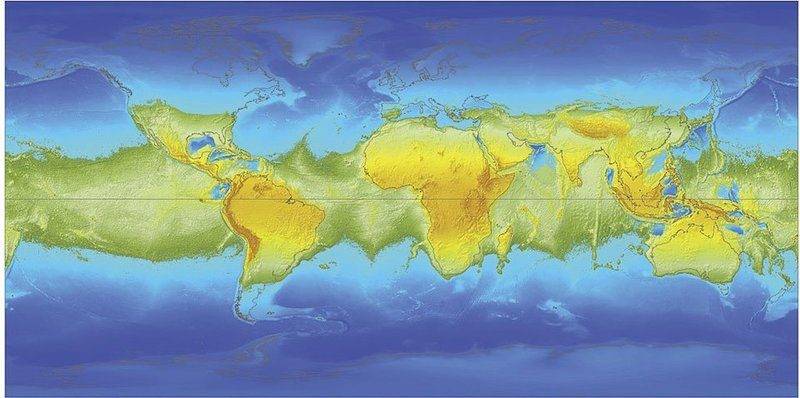
Forget ocean levels rising due to global warming what if

Click For Summary
SUMMARY

The forum discussion centers on the hypothetical scenario of Earth ceasing its rotation, leading to significant climatic and geological consequences. Participants highlight that if Earth stopped spinning, oceans would rush poleward, inundating much of North America. The conversation critiques the scientific accuracy of the "Aftermath" program's portrayal of this scenario, emphasizing that atmospheric convection, rather than the Coriolis Effect, primarily drives climate and water distribution. The discussion also touches on the implications of rotational kinetic energy and draws parallels with Venus's unique rotation and atmospheric conditions.

PREREQUISITES
  • Understanding of atmospheric convection and its role in climate.
  • Knowledge of the Coriolis Effect and its impact on wind patterns.
  • Familiarity with the concept of rotational kinetic energy in physics.
  • Basic knowledge of planetary geology, particularly regarding Venus.
NEXT STEPS
  • Research the effects of Earth's rotation on climate and weather patterns.
  • Study the Coriolis Effect and its implications for meteorology.
  • Explore the physics of rotational kinetic energy and its consequences on planetary bodies.
  • Investigate Venus's geological history and atmospheric dynamics.
USEFUL FOR

Climate scientists, geophysicists, educators, and anyone interested in planetary science and the effects of rotational dynamics on climate and geology.

DaveC426913
Gold Member
2025 Award
Messages
24,256
Reaction score
8,377
...Earth stopped rotating?

Most of North America would be swamped under poleward rushing oceans.

A whimsical but cool look at an Earth stopped in its tracks...

map.jpg


From http://bigthink.com/ideas/21768".
 
Last edited by a moderator:
Earth sciences news on Phys.org
Thank god for angular momentum.
 
Thanks, Dave, for the link.
 
D'uh, what about the tide ??
 
Nik_2213 said:
D'uh, what about the tide ??

What about it? Thoughts?
 
Do we stop too, or do I need to get carbon fiber underwear for the 1600 KPH skid?
 
Jim1138 said:
Do we stop too, or do I need to get carbon fiber underwear for the 1600 KPH skid?

Heh. Well we can pretend that Earth come to a gentle stop. The oceans still rush poleward.
 
As usual for programs like this, it was long on doom and gloom, and short on science.

The whole atmospheric model is ridiculous.

While some atmosphere might initially be drawn from the equatorial regions, the resulting heating would draw it back into the familiar convection loop.

Likewise, the idea of a dry desert mid-band completely ignores what happens when moisture laden winds from the poles crosses the land and drops its load.

While the Coriolis Effect gives us west to east winds in the Northern hemisphere, it is not the primary driver of our climate or H2O distribution, convection is, and this convection would not only continue, but intensify bringing monsoon like conditions to some areas.

I suppose when we have an ignorant populace, it is easy to produce rubbish like this, much like the ridiculous idea that a slight increase in a trace atmospheric gas like CO2 would actually have a significant impact on our climate.
 
chazzone said:
As usual for programs like this, it was long on doom and gloom, and short on science.
What program?

chazzone said:
I suppose when we have an ignorant populace, it is easy to produce rubbish like this...

What rubbish?
 
  • #10
Sorry, I was referring the the "Aftermath" program, "When the Earth Stops Spinning".
That's where I originally saw this map, and it all came flooding back, like a bad dream.
Watch it here:
 
Last edited by a moderator:
  • #11
chazzone said:
Sorry, I was referring the the "Aftermath" program, "When the Earth Stops Spinning".
That's where I originally saw this map, and it all came flooding back, like a bad dream.
Watch it here:


Haha no I don't need to; I'd probably want to take a shower afterwards.

No, this map is not meant to promote any science; it is just from a "Strange Maps" site. I had no idea the map itself might have any kind of sordid history...
 
Last edited by a moderator:
  • #12
Well slow stop or not, the rotational kinetic energy has go somewhere:

\frac{1}{2} I \omega^2 = 2.14×10^20 GJ

Or enough to flash to steam ~5x10^23 kg of cold water. The ocean mass is 1.39x10^ 21 kg. Time to redraw that map all brown, or red because the crust is going to melt too.
 
  • #13
hmmm, any planet around that has no spin but a lot of heat?
 
  • #14
No spin and a lot of heat... to some extent Venus fits. It rotates, but very slowly, and surface temperatures are high enough to melt lead.
 
  • #15
Now, isn't that interesting? :-p
 
  • #16
Actually, Venus rotates in reverse, and is the only planet in the solar system that does so. This is an indication of some cataclysmic event, like a large bolide strike, which would explain the conditions observed.
 
  • #17
But still the 'rotational kinetic energy' has to go somewhere or?

For alternate ideas how you can stop a planet spinning, see Correia et al 2002 and part II (but they did not do the math on conversion of spinning energy).
 
  • #18
chazzone said:
Actually, Venus rotates in reverse

I have learned long ago to not even pretend I understand women.
 
  • #19
What if they used a tractor beam?
 
  • #20
I think Baxter had a story once where humans discovered massive superconducting cables wrapped around Venus which had been used to exchange the spin of the planet to a moon it used to have which would have been flung out of the solar system, at the cost of ruining the planet.
 
  • #21
I too saw the discovery documentary I have agree, it did lack science.

I was actually trying to find a link to it when this little gem popped up:

"If the Earth stopped, all humans would go flying off" - http://community.discovery.com/eve/forums/a/tpc/f/7501919888/m/91919730201/p/1

The title question of that thread says it all really. Don't whether to laugh at the stupidity or cry at the lack of education.
 
Last edited by a moderator:
  • #22
chazzone said:
Actually, Venus rotates in reverse, and is the only planet in the solar system that does so. This is an indication of some cataclysmic event, like a large bolide strike, which would explain the conditions observed.


Right. It's proximity to the sun would mean it could have been hit by a large object coming back from the sun on a comet like trajectory. The slingshot affect of going around the sun would have meant it was traveling at an extremely high speed. If it was close enough to the sun as it went around, it might even have still been partially molten at the time of the collision.

Astronomers speculate that our moon resulted from a collision with a large object that caused what became the moon to be ejected.

collision of Venus with a molten or partially molten mass could produced an extremely high temperature at the time of the collision resulting in the mass "melting" into Venus. Such an event would have evaporated any water, including subterranean water. Water is a light weight gas when compared to other atmospheric gases and could easily escaped Venus gravity at a high temperature.

The dense cloud cover could prevent the surface from receiving any significant solar radiation by reflecting the radiation back into space.

Earth's atmosphere loses heat from updrafts which convert the potential energy of rising gases to potential energy which is not converted back to heat when the air returns to the surface as a downdraft. That process may not exist on Venus because the heavy cloud cover may prevent vertical movement of gases.
 
  • #23
Earth's atmosphere loses heat from updrafts which convert the potential energy of rising gases to potential energy which is not converted back to heat when the air returns to the surface as a downdraft. That process may not exist on Venus because the heavy cloud cover may prevent vertical movement of gases.

I'm having trouble following this statement. Perhaps you'd like to elaborate?
 
  • #24
Studiot said:
I'm having trouble following this statement. Perhaps you'd like to elaborate?

Heated air goes up, loses heat to space.
Air falls, but does not reconvert back to heat.
 

Similar threads

  • · Replies 2 ·
Replies
2
Views
3K
  • · Replies 7 ·
Replies
7
Views
6K
Replies
1
Views
3K
  • · Replies 13 ·
Replies
13
Views
3K
Replies
1
Views
6K
Replies
1
Views
4K
  • · Replies 10 ·
Replies
10
Views
5K
  • · Replies 2 ·
Replies
2
Views
5K
Replies
1
Views
4K
  • · Replies 25 ·
Replies
25
Views
8K