zenterix
- 774
- 84
- Homework Statement
- Consider the periodic function of period ##2\pi##
- Relevant Equations
- $$g(t)=\begin{cases} t\ \ \ \ \ -\frac{\pi}{2}<t<\frac{\pi}{2} \\ \pi-t\ \ \ \ \ \frac{\pi}{2}<t<\frac{3\pi}{2} \end{cases}\tag{1}$$
This function seems to be ##tr\left (t+\frac{\pi}{2}\right )-\frac{\pi}{2}## where ##tr(t)## is the triangle wave function.
$$tr(t)=|t|\ \ \ \ \ -\frac{\pi}{2}<t<\frac{\pi}{2}\tag{2}$$
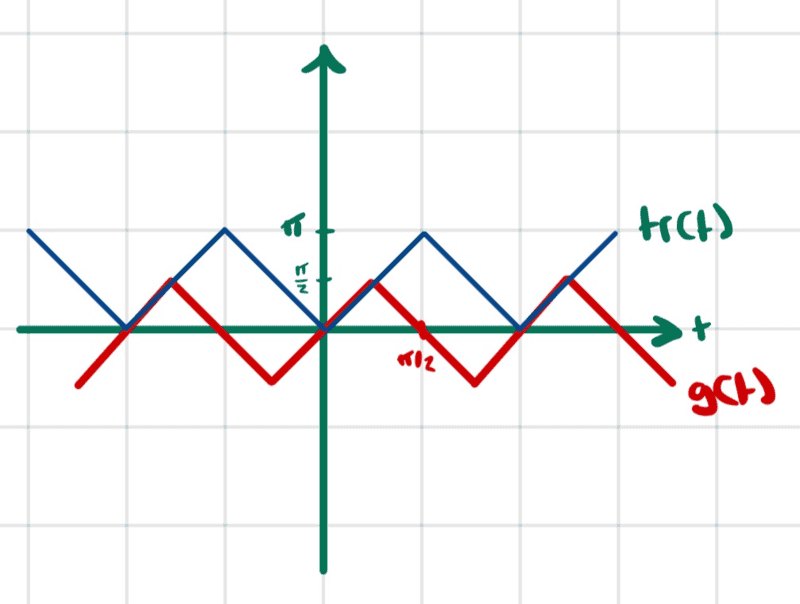
##tr## has Fourier series
$$tr(t)=\frac{\pi}{2}-\frac{4}{\pi}\sum\limits_{n=1}^\infty \frac{\cos{(nt)}}{n^2}\tag{2a}$$
Thus
$$g(t)=tr\left (t+\frac{\pi}{2}\right )-\frac{\pi}{2}\tag{3}$$
$$-\frac{4}{\pi}\sum\limits_{n=1}^\infty \frac{\cos{\left (n\left (t+\frac{\pi}{2}\right ) \right )}}{n^2}\tag{4}$$
Now
$$\cos{\left ( nt +n\frac{\pi}{2} \right )}=\cos{(nt)}\cos{\left (\frac{n\pi}{2}\right )}-\sin{(nt)}\sin{\left (\frac{n\pi}{2}\right )}\tag{5}$$
$$\sum\limits_{n=1}^\infty \cos{\left ( nt +n\frac{\pi}{2} \right )} = (-\sin{t})+(-\cos{2t})+(\sin{3t})+(\cos{4t})+(-\sin{5t})+(-\cos{6t})+\ldots\tag{6}$$
$$=\sum\limits_{k=0}^\infty (-1)^{k+1}\sin{(2k+1)t}+\sum\limits_{k=1}^\infty (-1)^k \cos{(2kt)}\tag{7}$$
If we sub this expression into (4) then
$$g(t)=-\frac{4}{\pi}\left ( \sum\limits_{k=0}^\infty (-1)^{k+1}\frac{\sin{(2k+1)t}}{(2k+1)^2}+\sum\limits_{k=1}^\infty (-1)^k \frac{\cos{(2kt)}}{(2k)^2} \right )\tag{8}$$
If the calculations are correct so far, my question is why this Fourier series has both cosine and sine terms when ##g## is odd.
$$tr(t)=|t|\ \ \ \ \ -\frac{\pi}{2}<t<\frac{\pi}{2}\tag{2}$$
##tr## has Fourier series
$$tr(t)=\frac{\pi}{2}-\frac{4}{\pi}\sum\limits_{n=1}^\infty \frac{\cos{(nt)}}{n^2}\tag{2a}$$
Thus
$$g(t)=tr\left (t+\frac{\pi}{2}\right )-\frac{\pi}{2}\tag{3}$$
$$-\frac{4}{\pi}\sum\limits_{n=1}^\infty \frac{\cos{\left (n\left (t+\frac{\pi}{2}\right ) \right )}}{n^2}\tag{4}$$
Now
$$\cos{\left ( nt +n\frac{\pi}{2} \right )}=\cos{(nt)}\cos{\left (\frac{n\pi}{2}\right )}-\sin{(nt)}\sin{\left (\frac{n\pi}{2}\right )}\tag{5}$$
$$\sum\limits_{n=1}^\infty \cos{\left ( nt +n\frac{\pi}{2} \right )} = (-\sin{t})+(-\cos{2t})+(\sin{3t})+(\cos{4t})+(-\sin{5t})+(-\cos{6t})+\ldots\tag{6}$$
$$=\sum\limits_{k=0}^\infty (-1)^{k+1}\sin{(2k+1)t}+\sum\limits_{k=1}^\infty (-1)^k \cos{(2kt)}\tag{7}$$
If we sub this expression into (4) then
$$g(t)=-\frac{4}{\pi}\left ( \sum\limits_{k=0}^\infty (-1)^{k+1}\frac{\sin{(2k+1)t}}{(2k+1)^2}+\sum\limits_{k=1}^\infty (-1)^k \frac{\cos{(2kt)}}{(2k)^2} \right )\tag{8}$$
If the calculations are correct so far, my question is why this Fourier series has both cosine and sine terms when ##g## is odd.
Last edited: