Fourier Transform of a sin(2pi*x)

Click For Summary

Discussion Overview

The discussion revolves around the Fourier transform of the sine function, specifically sin(2πx). Participants explore the properties of the Fourier transform, the interpretation of amplitude, and the relationship between sine and cosine functions in this context. The conversation includes technical reasoning and conceptual clarifications related to complex numbers and phase relationships.

Discussion Character

  • Exploratory
  • Technical explanation
  • Conceptual clarification
  • Debate/contested

Main Points Raised

  • One participant expresses confusion about the negative amplitude in the Fourier transform of the sine function, questioning the nature of amplitude as a positive quantity.
  • Another participant explains that the Fourier transform involves complex functions with modulus and phase, noting that the negative frequency component of sine is 180 degrees out of phase with the positive frequency component.
  • There is a discussion about the nature of sine as an odd function and cosine as an even function, with participants trying to clarify the implications of these properties on their Fourier transforms.
  • One participant presents a mathematical expression for the Fourier transform of sine, indicating the relationship between the delta functions and the phase factor.
  • Another participant questions whether the negative amplitude reflects the imaginary component of the sine expression, leading to further clarification about the role of the real component of the exponential factor in the Fourier transform.
  • One participant acknowledges their initial confusion but expresses gratitude for the clarifications and mentions finding additional resources to aid their understanding.

Areas of Agreement / Disagreement

Participants exhibit a mix of agreement and disagreement, particularly regarding the interpretation of amplitude and the implications of phase relationships in the Fourier transform. The discussion remains unresolved on certain points, with multiple perspectives presented.

Contextual Notes

Some participants correct earlier statements and refine their understanding, but the discussion does not reach a consensus on all aspects of the Fourier transform of sine versus cosine.

BobP
Messages
70
Reaction score
1
I have been very briefly introduced to Fourier transformations but the topic was not explained especially well (or I just didn't understand it!)

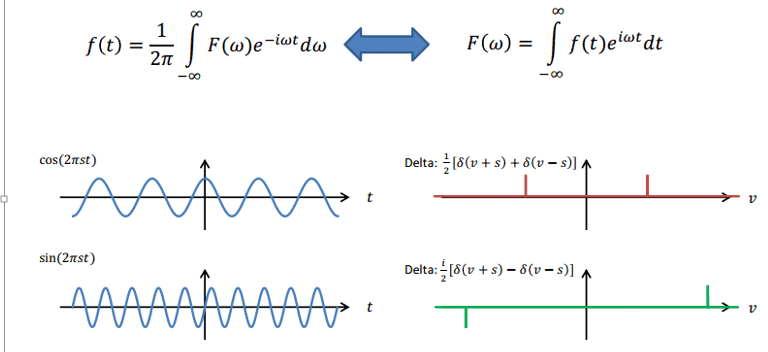
We were shown the graphs with equations below and then their Fourier transformation (RHS). I understand the one for cos(2pist) but NOT the sin(2pist).

Here is my reasoning: The sin wave shown has a constant frequency (that is larger than the cosine function; hence its frequency values are larger). It is possible to have a "-ve" frequency because waves can travel in both directions. I do not understand why the amplitude on the sin graph is negative though? If it was negative on both it would make sense but it isn't!
I know that both FT boil down to a cosine expression (as the sin expression is lost when integrating between infinities) and that makes it even more confusing for me! Please can someone help me understand. thanks
upload_2015-10-1_15-46-56.png
 
Physics news on Phys.org
BobP said:
I do not understand why the amplitude on the sin graph is negative though?
Just a wording correction though, amplitude by definition is a positive quantity. As for your question, two functions connected through Fourier transform are in general complex, that is, they have modulus and phase. The reason why the negative frequency component in the FT of sine points down is that because this component are 180 degree out of phase from the positive frequency component.
BobP said:
I know that both FT boil down to a cosine expression (as the sin expression is lost when integrating between infinities) and that makes it even more confusing for me!
You don't integrate the delta function alone, do you. There is also ##e^{i\omega t}## in the integrand.
 
blue_leaf77 said:
Just a wording correction though, amplitude by definition is a positive quantity. As for your question, two functions connected through Fourier transform are in general complex, that is, they have modulus and phase. The reason why the negative frequency component in the FT of sine points down is that because this component are 180 degree out of phase from the positive frequency component.

But surely the cos points are also 180 degrees out of phase? I am not too sure I understand what you mean by this
 
Oh Wait. Do you mean because sin is an odd function whereas cos is an even function?
 
BobP said:
But surely the cos points are also 180 degrees out of phase? I am not too sure I understand what you mean by this
No, the Fourier transform of cosine is real.
A complex number ##z## can be expresed as ##z=|z|e^{i\theta}## where ##|z|## the modulus and ##\theta## the phase. You can write the Fourier transform of sine as
$$
\frac{1}{2}(\delta(\nu+s) - \delta(\nu-s)) = \frac{1}{2}(\delta(\nu+s) + e^{i\pi} \delta(\nu-s))
$$
EDIT: the Fourier transform of cosine is real and symmetric.
 
Last edited:
blue_leaf77 said:
No, the Fourier transform of cosine is real.
A complex number ##z## can be expresed as ##z=|z|e^{i\theta}## where ##|z|## the modulus and ##\theta## the phase. You can write the Fourier transform of sine as
$$
\frac{1}{2}(\delta(\nu+s) - \delta(\nu-s)) = \frac{1}{2}(\delta(\nu+s) + e^{i\pi} \delta(\nu-s))
$$

so are you saying that the "negative" ampltidue on the sin curve reflects the fact that it is the imaginary component of the sin expression (as per Euler formula)
 
BobP said:
it is the imaginary component of the sin expression
No, the negative sign appears because of the real component of ##e^{i\pi}## instead.
$$e^{i\pi}=-1$$
 
  • Like
Likes   Reactions: BobP
blue_leaf77 said:
No, the negative sign appears because of the real component of ##e^{i\pi}## instead.
$$e^{i\pi}=-1$$
I see...thanks for the help.
Truth be told, I understood none of the maths initially but your help has pointed me to videos / math books that have explained the issue to me so I now understand it (I hope!)

Really grateful!
 

Similar threads

  • · Replies 6 ·
Replies
6
Views
3K
  • · Replies 4 ·
Replies
4
Views
2K
  • · Replies 3 ·
Replies
3
Views
2K
  • · Replies 5 ·
Replies
5
Views
3K
  • · Replies 3 ·
Replies
3
Views
12K
  • · Replies 2 ·
Replies
2
Views
2K
  • · Replies 2 ·
Replies
2
Views
2K
  • · Replies 139 ·
5
Replies
139
Views
11K
  • · Replies 8 ·
Replies
8
Views
5K
  • · Replies 2 ·
Replies
2
Views
1K