Friction Questions: How Does a Car Turn?

  • Level: Undergrad 
  • Thread starter gracy
  • Start date
  • Tags Tags
    Car Friction
9 replies · 2K views · last reply
gracy
Messages
2,486
Reaction score
83
https://www.physicsforums.com/threads/friction-questions-how-does-a-car-turn.150321/
I have a doubt regarding the following line of post 6 of the above particular thread According to below lines of the mentioned post
The applied force will accelerate the box towards the north, so it will move in a curve. The friction force is always along the tangent to that curve and opposite to the direction the box is moving. So the component of friction force in the south direction will increase and the component in the west direction will decrease.
the diagram would be
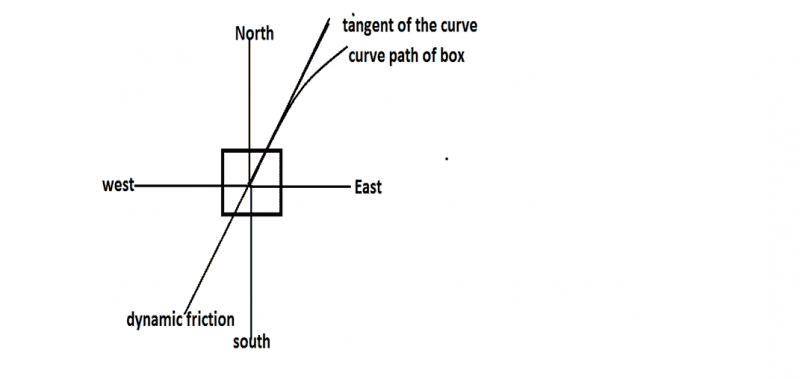
Diagram of a square box at the origin of north, south, east and west axes, with a curved path and its tangent line at the box, and a dynamic friction arrow pointing opposite the tangent direction toward the southwest.


But the below lines of the very same post
If your box is moving east, the dynamic friction force is towards the west. If you suddenly apply a force towards the north at time t=0, the dynamic friction force at t=0 will still be towards the west.
Are contradictory of my diagram this is my opinion ,I think I am wrong I am missing something.Please guide me.
 
Attachments
  • Diagram of a box on a curved path with compass axes North, South, East and West. Labels read: tangent of the curve, curve path of box, and dyanamic friction pointing southwest opposite the tangent direction.
    upload_2015-3-25_0-11-5.png
    9.4 KB · Views: 506
  • Diagram of a square box on compass axes (North, South, East, West) with its curved path and tangent line, and a dynamic friction arrow pointing southwest opposite the motion.
    upload_2015-3-25_0-15-13.png
    47.4 KB · Views: 600
gracy said:
the diagram would be
Diagram of a square box at a crossing of north, south, east and west axes, with a curved path tangent line labelled tangent of the curve, a curve labelled curve path of box, and a line labelled dynamic friction pointing southwest.
Not sure what you are drawing here. To find the direction of the dynamic friction, you must draw the path of the box. It starts out moving east, then begins to curve towards the north as the northern force is applied. Your diagram seems to show the path instantly changing when the force is applied.
 
If I say I have drawn the diagram of that instant when the applied force in north direction has become large enough,will my diagram be correct?
 
One more query friction is
Friction is the force resisting the relative motion of solid surfaces, fluid layers, and material elements sliding against each other.
So ,let's take the two blocks which are in contact are moving with same velocity.That means there is not an relative motion between them so no friction?
 
gracy said:
If I say I have drawn the diagram of that instant when the applied force in north direction has become large enough,will my diagram be correct?
It doesn't seem right to me, but I'm not sure what you are trying to illustrate.
 
gracy said:
So ,let's take the two blocks which are in contact are moving with same velocity.That means there is not an relative motion between them so no friction?
If there's no relative motion between the blocks, then there is no dynamic (kinetic) friction between them. There may well be static friction between them.
 
One typo is here .I meant .That means there is not any relative motion between them ,so no friction?
 
gracy said:
So ,let's take the two blocks which are in contact are moving with same velocity
Doc Al said:
There may well be static friction between them.
As they are moving,will there be static friction?
 
gracy said:
One typo is here .I meant .That means there is not any relative motion between them ,so no friction?
If there is no relative motion, there is no dynamic friction.
 
gracy said:
As they are moving,will there be static friction?
Just because they are moving with respect to some frame does not mean there cannot be static friction between the surfaces. Depends on the situation.

For example: Say one block is sitting on top of the other. And the bottom block is being pulled along (accelerating) while the top block comes along for the ride. In this case, both blocks are moving at the same speed, yet there is static friction between them.
 
  • Like
Likes   Reactions: gracy