How Does Friction Provide Centripetal Force During a Car Turn?

Click For Summary

Discussion Overview

The discussion revolves around the role of friction in providing centripetal force during a car turn. Participants explore the mechanics of how friction from tires contributes to circular motion, addressing questions about force direction, the nature of centripetal force, and the relationship between velocity and force during a turn.

Discussion Character

  • Exploratory
  • Technical explanation
  • Conceptual clarification
  • Debate/contested

Main Points Raised

  • One participant questions how friction from tires provides a centripetal force directed towards the center of the turn, rather than opposing the direction of velocity.
  • Another participant explains that the tires exert an outward force on the pavement, which results in an inward centripetal force on the tires, transmitted throughout the vehicle.
  • It is noted that the orientation of the tires during a turn contributes to the generation of a force perpendicular to the direction of travel, leading to the necessary centripetal force.
  • Some participants express confusion about why the car does not get "sucked" into the center despite the centripetal force being directed inward, questioning the relationship between force and velocity.
  • A participant clarifies that force and velocity do not necessarily align, using the example of a ball thrown upward to illustrate this point.
  • One participant acknowledges their initial confusion and expresses understanding that centripetal force is what enables the car to travel in a circular path.

Areas of Agreement / Disagreement

Participants exhibit a mix of understanding and confusion regarding the mechanics of centripetal force and its relationship to velocity. There is no consensus on the conceptual clarity of these relationships, as some questions remain unresolved.

Contextual Notes

Participants express uncertainty about the directional relationship between force and velocity, and the conditions under which a car maintains a circular path versus spiraling. The discussion highlights the complexity of these concepts without reaching definitive conclusions.

sameeralord
Messages
659
Reaction score
3
Hello guys,

I wasn't interested in these stuff those days and I never got it.
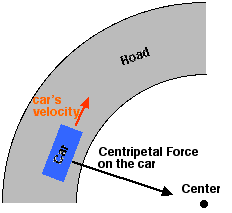
car_in_curve.gif


Now when you do a car turn the friction from the tires provide the centripetal force right. I have few quick questions. How does the friction from tires give a force in the centripetal direction, how come it is not in the direction that is opposite to velocity direction? If the centripetal force is towards the centre why is car going in a circle, wouldn't it be sucked into the centre, Am I missing some resulting forces? Thanks guys :smile:
 

Attachments

  • car_in_curve.gif
    car_in_curve.gif
    2.5 KB · Views: 646
Physics news on Phys.org
The tires exert an outwards force onto the pavement, which responds with an equal and opposing inwards force onto the tires (the Newton 3rd law pair of forces). This inwards centripetal force on the tires is then transmitted to the axles, suspension, body, and the occupants of the car.

At the same time the outwards force from the tires casues the the Earth to be moved a tiny amount "outwards", but since it's so massive, it's generally considered not to be moved at all.

The reason the tires genreate a force perpendicular to the direction of travel is that they're oriented slightly inwards of the actual direction the car is moving, including the rear tires (the entire car is yawed slightly inwards in a corner). This results in a deformation at the contact patch that produces the outward force on the pavement. The pavement also deforms, but by a very small amount and this coresponds to the inwards force from the pavement to the tires at the contact patch.

The car only goes in a circle if the centripetal force exactly equals speed2/r. Otherwise the path is a spiral.
 
Last edited:
Jeff Reid said:
The tires exert an outwards force onto the pavement, which responds with an equal and opposing inwards force onto the tires (the Newton 3rd law pair of forces). This inwards centripetal force on the tires is then transmitted to the axles, suspension, body, and the occupants of the car.

At the same time the outwards force from the tires casues the the Earth to be moved a tiny amount "outwards", but since it's so massive, it's generally considered not to be moved at all.

The reason the tires genreate a force perpendicular to the direction of travel is that they're oriented slightly inwards of the actual direction the car is moving, including the rear tires (the entire car is yawed slightly inwards in a corner). This results in a deformation at the contact patch that produces the outward force on the pavement. The pavement also deforms, but by a very small amount and this coresponds to the inwards force from the pavement to the tires at the contact patch.

Thanks again Jeff :smile: However I'm still confused why the car is not sucked in by the centripetal force why is velocity and car moving in another direction. Isn't the force towards the centre?
 
sameeralord said:
However I'm still confused why the car is not sucked in by the centripetal force why is velocity and car moving in another direction. Isn't the force towards the centre?
I posted before I was done editting my response, the path is only a circle when the centripetal force = speed2 / radius. Otherwise it's a spiral, inwards if the force is greater, outwards if the force is less.
 
Jeff Reid said:
I posted before I was done editting my response, the path is only a circle when the centripetal force = speed2 / radius. Otherwise it's a spiral, inwards if the force is greater, outwards if the force is less.

Thanks but if I consider this force like gravity it would suck the car, I mean isn't the directiion of velocity dependent on the direction of force. Is their some component vector I'm missing. I mean how is the car overcoming inward force.
 
Force and velocity don't have the same direction. Consider a ball thrown upward. The velocity is up, force from gravity(and acceleration) is down.
 
Oh I was just rusty with physics. I see the car wants to travel in a straight line and it is centripetal force that makes it go in a circle. Thanks Jeff and sganesh for the help :smile:
 

Similar threads

  • · Replies 73 ·
3
Replies
73
Views
11K
  • · Replies 15 ·
Replies
15
Views
4K
  • · Replies 6 ·
Replies
6
Views
3K
  • · Replies 6 ·
Replies
6
Views
2K
  • · Replies 8 ·
Replies
8
Views
3K
  • · Replies 12 ·
Replies
12
Views
5K
  • · Replies 10 ·
Replies
10
Views
3K
  • · Replies 16 ·
Replies
16
Views
3K
  • · Replies 5 ·
Replies
5
Views
5K
  • · Replies 16 ·
Replies
16
Views
2K