Frictionless Disk Supported by Massless String

Click For Summary
The discussion centers on the tension in a massless string supporting a frictionless disc, specifically why the tension is Mg/2 instead of Mg. The reasoning is that in the setup, each half of the string supports half the mass of the disc, leading to a balanced force scenario. The tension is halved because both ends of the string are attached to the ceiling, creating a situation where the forces must sum to zero without any acceleration. The conversation also explores variations in setups, noting that while the tension may differ in cases with fixed strings, the total vertical forces always equal the weight of the disc. Ultimately, the principles of static equilibrium and force balance clarify the tension dynamics in these scenarios.
hringsak
In the following diagram, a frictionless disc is supported by a massless string. This problem was given by the author of a book, and a solution was given to some questions that were asked about this diagram. One thing the author said in one of the solutions, was that the tension in the string was equal to Mg/2. Why is this? I would have thought that since the one string is supporting the entire mass of the disc that it should just be Mg.
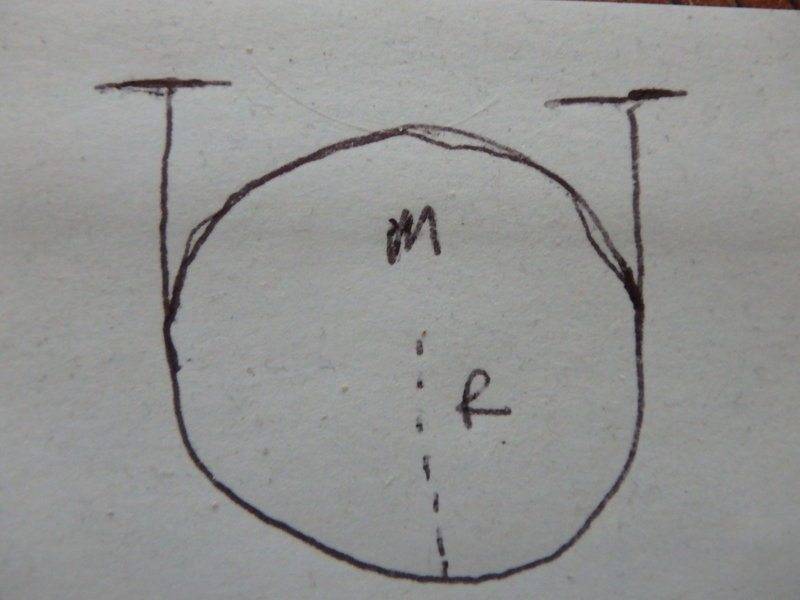
P9300001.jpg
 
Physics news on Phys.org
hringsak said:
One thing the author said in one of the solutions, was that the tension in the string was equal to Mg/2. Why is this? I would have thought that since the one string is supporting the entire mass of the disc that it should just be Mg.
Consider three setups:
1) The one in your diagram.
2) The one in your diagram, except that we've permanently fixed the string to the disk with a glob of glue at the lowest point.
3) Like #2, except that instead of one string passing through the glob of glue we have two strings both ending in the glob of glue and held onto the disk by the glue.

In #3 we clearly have two strings. Is the tension going to be the same or different in the three cases?
 
  • Like
Likes hringsak
Okay, that makes sense that each half of the string is supporting half of the mass. Instead of one end of the string being attached to the ceiling and one end to the disc, where the tension would be Mg, you have just half of the tension at each end. However, because in the midpoint of the string there is no glob of glue, which would provide a balancing force to both halves of the string as in setup #2, doesn't one half pull on the end of the other half, therefore making the tension Mg?

I do get your point that the glue in the middle in setup #2 is not even necessary, but isn't that because the tension from one half is balanced by tension from the other half?
 
Wait, I get it now - because both ends are attached to the ceiling, they each are pulling with just half the force as in the example where just one end is attached to the ceiling. In that example you have the full force of Mg pulling in opposite directions. The fact that in the above diagram, both ends are attached to the ceiling, that results in just half the tension in the string.
 
The object isn't accelerating so the net force in any direction must be zero. Therefore the vertical forces must sum to zero.
 
If the cylinder was rotating and there was friction the net vertical force would still be zero. The tension in the two strings wouldn't be the same but would still sum to mg.
 
For simple comparison, I think the same thought process can be followed as a block slides down a hill, - for block down hill, simple starting PE of mgh to final max KE 0.5mv^2 - comparing PE1 to max KE2 would result in finding the work friction did through the process. efficiency is just 100*KE2/PE1. If a mousetrap car travels along a flat surface, a starting PE of 0.5 k th^2 can be measured and maximum velocity of the car can also be measured. If energy efficiency is defined by...

Similar threads

Replies
14
Views
4K
  • · Replies 19 ·
Replies
19
Views
14K
Replies
3
Views
2K
Replies
13
Views
1K
Replies
5
Views
3K
  • · Replies 7 ·
Replies
7
Views
2K
  • · Replies 24 ·
Replies
24
Views
9K
  • · Replies 5 ·
Replies
5
Views
2K
Replies
6
Views
2K
Replies
16
Views
3K