Frictionless Pulleys With Three Objects - Am I Right?

Click For Summary

Homework Help Overview

The discussion revolves around a physics problem involving a system of three masses connected by strings over frictionless pulleys. The original poster seeks to verify their calculations regarding the acceleration of the system and the tension forces in the strings.

Discussion Character

  • Exploratory, Assumption checking, Conceptual clarification

Approaches and Questions Raised

  • Participants discuss the direction of tension forces in relation to gravitational forces, questioning the original poster's assumptions about the forces acting on the masses. There is an exploration of how changes in mass could affect the behavior of the system.

Discussion Status

Participants are actively engaging in clarifying the roles of tension and gravity in the system. Some guidance is offered regarding the direction of forces, but there is no explicit consensus on the correctness of the original poster's calculations or assumptions.

Contextual Notes

There is a mention of a worksheet lacking answers, which may contribute to uncertainty in verifying the original poster's results. Additionally, the impact of changing the mass of one of the objects is under consideration, indicating a potential exploration of different scenarios.

Procrastinate
Messages
155
Reaction score
0
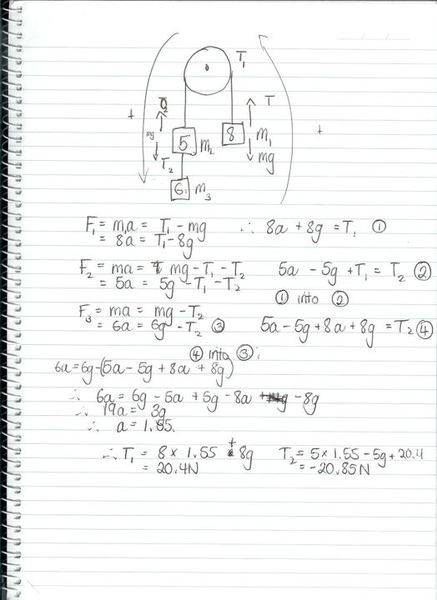
I just want to check whether my answer is right because this worksheet has no answers. Thanks.

The following system of masses are connected by light inextensible strings as shown in the diagram. The string connecting the 5.0 kg mass to the 8.0kg mass passes over a frictionless pulley. Calculate the acceleration of the system and the magnitude of the tension forces T1 and T2.
PULLEYS0001.jpg
 
Physics news on Phys.org
T2 is supposed to be the magnitude of the tension, so it can't be negative. The mistake is in the step F2=mg-T1-T2. Since T2 acts in the same direction as gravity, it should be F2=mg-T1+T2.
 
ideasrule said:
T2 is supposed to be the magnitude of the tension, so it can't be negative. The mistake is in the step F2=mg-T1-T2. Since T2 acts in the same direction as gravity, it should be F2=mg-T1+T2.


Why would T2 act in the direction of gravity? I thought it would be oppose it.
 
Without the 6 kg mass, the 5 kg mass would move up instead of down. The 6 kg mass is dragging the 5 kg mass downwards, so T2 must act in the same direction as the gravity on the 5 kg mass.
 
Well my new answers are: a= 1.55ms^-2 and for the tensions: T1 = 90.8N and T2 = 49.55N

Are they right?

If the 5kg mass was replaced by something heavier than the 8kg mass, would T2 act in accordance with gravity?
 

Similar threads

  • · Replies 18 ·
Replies
18
Views
5K
  • · Replies 3 ·
Replies
3
Views
2K
  • · Replies 10 ·
Replies
10
Views
5K
  • · Replies 22 ·
Replies
22
Views
2K
  • · Replies 15 ·
Replies
15
Views
7K
  • · Replies 29 ·
Replies
29
Views
6K
Replies
3
Views
2K
  • · Replies 17 ·
Replies
17
Views
3K
  • · Replies 12 ·
Replies
12
Views
2K
  • · Replies 5 ·
Replies
5
Views
2K