Front Wheel Drive or Rear Wheel Drive has higher maximum slip ratio?

Click For Summary

Discussion Overview

The discussion revolves around the comparison of maximum slip ratios between front-wheel drive (FWD) and rear-wheel drive (RWD) vehicles, particularly in the context of a graph depicting the relationship between longitudinal force and slip ratio under specific conditions. Participants explore the implications of vehicle design on traction and handling characteristics.

Discussion Character

  • Debate/contested
  • Technical explanation
  • Conceptual clarification

Main Points Raised

  • Some participants question which line on the graph corresponds to FWD or RWD and whether one configuration has a higher maximum slip ratio.
  • Others point out that vehicle configurations (e.g., front engine vs. rear engine) can significantly affect handling characteristics and slip ratios.
  • One participant suggests that FWD vehicles generally have better traction due to the weight distribution over the front wheels, especially in adverse conditions like snow and rain.
  • Another participant asserts that both FWD and RWD can exhibit the same maximum slip ratio, emphasizing that the graph relates to tire behavior rather than vehicle configuration.
  • There is a discussion about the role of normal force and its potential impact on the observed slip ratios, with some suggesting that the type of drive (FWD or RWD) may not be as relevant as the forces acting on the tires.

Areas of Agreement / Disagreement

Participants express differing views on the relationship between vehicle configuration and maximum slip ratio, with no consensus reached on whether FWD or RWD has a higher maximum slip ratio. The discussion remains unresolved regarding the implications of the graph and the factors influencing traction and slip ratios.

Contextual Notes

Participants note that the graph's interpretation may depend on various assumptions, such as the specific conditions of the vehicles being compared and the definitions of terms like slip ratio and traction. The discussion highlights the complexity of vehicle dynamics without resolving these nuances.

calvinyeh
Messages
3
Reaction score
0
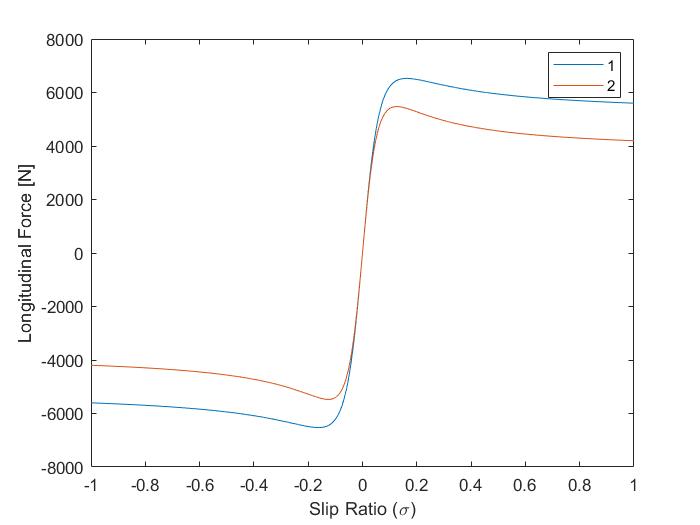
The graph is relationship between longitudinal force and slip ratio under the conditions of 0 longitudinal acceleration and flat road(0 angle of inclination). Which line represent FWD or RWD? Does FWD or RWD have higher maximum slip ratio?
241046
 
Engineering news on Phys.org
too general a question - there are rear wheel front engine vehicles
there are rear whee rear engine vehicles
there are front wheel drive front engine vehicles and the one i really like is
Front wheel drive rear engine vehicle
Buckminster Fuller ( who should have stuck with geodesic domes) introduced the
Dymaxion Chronofile ... i can't make this stuff up!

all with different handling characteristics ..slip ration being one , aspect two dimensional
 
In this case they are both front engine
 
Ok , let us think about this. I assume the chart is for the front tires, correct? Both front engines. which will be able to provide more traction when cornering and why? You have the same forces ( gravity) at static. Why will one be able to handle the straight line momentum better when in a turn? why is this? Both are same tire width, diameter and compound.

The chart is a nice chart but it is just that..a nice chart. there are many many posts relating to tire slip angle on this very mechanical eng forum..suggest you do a search and read upon these.
 
Last edited:
From what I have found, generally FWD vehicles have better traction because the weight of the engine and transmission are over the front wheels. This means better traction in snow and rain than RWD. But RWD has better performance when turning. So does it mean FWD will have a higher maximum slip ratio(before vehicle start slipping) which refers to line 1 in the graph?
 
calvinyeh said:
So does it mean FWD will have a higher maximum slip ratio(before vehicle start slipping) which refers to line 1 in the graph?
The graph you shown is related to a tire, regardless of where it is mounted.

The two cases shown on the graph have both the same maximum slip ratio: 1. When the slip ratio is not equal to zero, the tire is slipping. Slip is necessary to create friction, and thus a friction force (Longitudinal force on the graph). The graph shown relates to the concept of static & kinetic friction like this:

Static+friction+and+kinetic+friction.jpg

The friction force increases linearly in the 'static' region (close to 0 slip); The peak region on your graph relates to the region where it switches from static to kinetic friction. It then stabilizes at a lower constant force at slip ratio = 1.

The difference between the two cases is most likely the normal force acting on the tire. Whether it is RWD or FWD is irrelevant.
 

Similar threads

  • · Replies 3 ·
Replies
3
Views
3K
Replies
1
Views
4K
  • · Replies 7 ·
Replies
7
Views
2K
  • · Replies 102 ·
4
Replies
102
Views
8K
  • · Replies 5 ·
Replies
5
Views
2K
  • · Replies 2 ·
Replies
2
Views
3K
Replies
2
Views
4K
  • · Replies 20 ·
Replies
20
Views
16K
  • · Replies 6 ·
Replies
6
Views
8K
  • · Replies 10 ·
Replies
10
Views
3K