Math Amateur
Gold Member
MHB
- 3,920
- 48
I am reading Tom M Apostol's book "Mathematical Analysis" (Second Edition) ...
I am focused on Chapter 4: Limits and Continuity ... ...
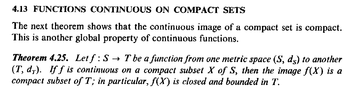
I need help in order to fully understand the proof of Theorem 4.25 ... ... Theorem 4.25 (including its proof) reads as follows:
View attachment 9231
View attachment 9232
In the above proof by Apostol we read the following:
" ... ... The sets $$f^{ -1 } (A)$$ form an open covering of $$X$$ ... ... "Could someone please demonstrate an explicit formal and rigorous proof of this statement ...?
-----------------------------------------------------------------------------------------------------
My thoughts:
Since $$f$$ is continuous we have that each set $$f^{ -1 } (A)$$ is open
and ...
... for $$X \subseteq S$$ we have
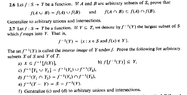
$$X \subseteq f^{ -1 } ( f(x) )$$ ... ... (see Apostol Exercise 2.7 (a) Chapter 2, page 44 ...)
... and we also have $$f(X) \subseteq A_c$$ where $$A_c = \bigcup_{ A \in F } A$$ ...
Therefore $$X \subseteq f^{ -1 } ( f(x) ) \subseteq f^{ -1 } ( A_c )$$ ...Is that correct? ... Does that constitute a formal and rigorous proof?
Hope someone can help ...
Peter
================================================================================The above post refers to Apostol Exercise 2.7 so I am providing access to the same as follows:
View attachment 9233
Hope that helps ...
Peter
I am focused on Chapter 4: Limits and Continuity ... ...
I need help in order to fully understand the proof of Theorem 4.25 ... ... Theorem 4.25 (including its proof) reads as follows:
View attachment 9231
View attachment 9232
In the above proof by Apostol we read the following:
" ... ... The sets $$f^{ -1 } (A)$$ form an open covering of $$X$$ ... ... "Could someone please demonstrate an explicit formal and rigorous proof of this statement ...?
-----------------------------------------------------------------------------------------------------
My thoughts:
Since $$f$$ is continuous we have that each set $$f^{ -1 } (A)$$ is open
and ...
... for $$X \subseteq S$$ we have
$$X \subseteq f^{ -1 } ( f(x) )$$ ... ... (see Apostol Exercise 2.7 (a) Chapter 2, page 44 ...)
... and we also have $$f(X) \subseteq A_c$$ where $$A_c = \bigcup_{ A \in F } A$$ ...
Therefore $$X \subseteq f^{ -1 } ( f(x) ) \subseteq f^{ -1 } ( A_c )$$ ...Is that correct? ... Does that constitute a formal and rigorous proof?
Hope someone can help ...
Peter
================================================================================The above post refers to Apostol Exercise 2.7 so I am providing access to the same as follows:
View attachment 9233
Hope that helps ...
Peter