Fundamental reality: Hilbert space

Click For Summary

Discussion Overview

The discussion centers around the concept of fundamental reality as proposed by Sean Carroll, specifically the idea that reality can be understood as a vector in Hilbert space, with other elements like space, fields, and particles being emergent properties. The scope includes theoretical implications, philosophical considerations, and the relationship between mathematical constructs and physical reality.

Discussion Character

  • Debate/contested
  • Conceptual clarification
  • Exploratory

Main Points Raised

  • Some participants support Carroll's proposal, suggesting it represents a step in the right conceptual direction for understanding reality.
  • Others argue that Hilbert space is an emergent concept that arose from the need to understand quantum mechanics, challenging the notion that it is more fundamental than physical reality.
  • Concerns are raised about the clarity and content of the proposal, with some participants questioning whether it makes sense at all.
  • There is a discussion about the nature of mathematical concepts, with some asserting that they cannot be equated to physical reality, while others suggest that successful mathematical descriptions may imply a form of reality.
  • Participants explore the distinction between ordinary reality and fundamental reality, debating whether mathematical constructs can be considered "real" in the same sense as space and time.
  • Some participants highlight the inconsistency in defining what constitutes reality, questioning whether it is the Hilbert space itself or the vectors within it that describe reality.
  • There is a philosophical inquiry into the meaning of "reality" and whether a purely mathematical model can serve as a sufficient description of reality.

Areas of Agreement / Disagreement

Participants express a range of views, with no consensus reached. Some agree with the potential of Carroll's proposal, while others strongly contest its validity and implications. The discussion remains unresolved regarding the relationship between mathematical constructs and physical reality.

Contextual Notes

Participants note the limitations of the discussion, including the ambiguity in definitions of "reality," the dependence on philosophical interpretations, and the unresolved nature of the mathematical descriptions involved.

Giulio Prisco
Messages
76
Reaction score
25
What do you guys think of this soberly elegant proposal by Sean Carroll?

Reality as a Vector in Hilbert Space

Fundamental reality lives in Hilbert space and everything else (space, fields, particles...) is emergent. Seems to me a step in the right conceptual direction.
 
Physics news on Phys.org
Giulio Prisco said:
Fundamental reality lives in Hilbert space and everything else (space, fields, particles...) is emergent.
It is a well-known fact that the opposite holds:

Hilbert space emerged in the 1920s from the more fundamental reality of having to understand quantum mechanics.

Mathematical concepts can describe aspects of, but they can never be physical reality.
 
Last edited:
  • Like
Likes   Reactions: physika, Interested_observer, AcademicOverAnalysis and 7 others
It is so sketchy that I am not even sure if it makes any sense. Just because one can form gramatically correct sentances, it doesn't mean that it has any content.
 
  • Like
Likes   Reactions: AcademicOverAnalysis and Demystifier
A. Neumaier said:
Mathematical concepts can describe aspects of, but they can never be physical reality.
Well it seems to me that if an abstract mathematical concept seems to provide a correct description of physical reality, and if any more intuitive description seems to fail, and if all that is repeatedly confirmed without exceptions, then the mathematical concept itself is the only statement that we can make about physical reality. Whether this means that the mathematical concept is physical reality, I don't know.
 
Giulio Prisco said:
What do you guys think of this soberly elegant proposal by Sean Carroll?
I think his description of this as an "extremist" position is correct.
 
  • Like
Likes   Reactions: phinds and Demystifier
Giulio Prisco said:
the mathematical concept itself is the only statement that we can make about physical reality.
A concept is not a statement about reality but a language construct.

We know that space and time are real (in the ordinary sense of the word) since we live in it, and these concepts were there long before mathematics. The mathematical description of it had to wait till the 1600s.

On the other hand, nobody has ever seen a physical Hilbert space. Calling it more real than the physical space we live in is selfdelusion.
 
  • Like
Likes   Reactions: martinbn and Demystifier
martinbn said:
It is so sketchy that I am not even sure if it makes any sense.
Sketchy it certainly is. This is a research program, not a research result.

But I think it does make sense.

Think of field vs. particle ontologies in quantum field theory. Particles are easier to visualize and the theory was built up with particles in mind, at least at the beginning. But today there seems to be ample consensus on the idea that fields are fundamental, and particles are an emerging aspect of reality that we observe when we do this or that to observe the field.

It seems to me that Carroll is just pushing this approach one step further down. What really is, the thing itself, is a vector in Hilbert space. Our current description of the world, with fields and particles and things and all that including you and me, is emergent.

For those who like Everett's interpretation, in his last book Carroll argues that all Everett worlds live in the universal reality vector, and the "many worlds" of the popular interpretation of Everett's interpretation are emergent.

It seems to me that this sketchy preliminary proposal could be pursued further to define our description of the world in terms of the universal reality vector and show how it emerges.

See also this post by Scott Aaronson, which seems related.
 
  • Like
Likes   Reactions: PeroK and Demystifier
A. Neumaier said:
We know that space and time are real... On the other hand, nobody has ever seen a physical Hilbert space. Calling it more real than the physical space we live in is selfdelusion.
Didn't they use to say exactly the same thing about atoms?

Yet today atoms (and subatomic entities) form the basis of our consensual understanding of reality.
 
  • Like
Likes   Reactions: PeroK
A. Neumaier said:
A concept is not a statement about reality but a language construct.

We know that space and time are real (in the ordinary sense of the word) since we live in it, and these concepts were there long before mathematics. The mathematical description of it had to wait till the 1600s.

On the other hand, nobody has ever seen a physical Hilbert space. Calling it more real than the physical space we live in is selfdelusion.
Well, know enter this debate about the meaning of the words "real" or "reality". I think there are as many different meanings of this word as there are philosophers using it.

I'd say for the standard bread-and-butter physics all what's real are obejctively observable phenomena. Mathematics is used to describe these phenomena. Why should be Euclidean 3D affine space (a purely matheamtical construct of the human mind) be "more real" than a separable Hilbert space (another purely mathematical construct of the human mind)? Both mathematical constructs are used successfully in the mathematical description of the observable phenomena on different levels of such a description and with different realms of validity.
 
  • Like
Likes   Reactions: PeroK
  • #10
Giulio Prisco said:
Didn't they use to say exactly the same thing about atoms?

Yet today atoms (and subatomic entities) form the basis of our consensual understanding of reality.
For the understanding of reality, but not for reality itself. This makes a big difference!
vanhees71 said:
Why should be Euclidean 3D affine space (a purely mathematical construct of the human mind) be "more real" than a separable Hilbert space
Both are just concepts. Real (in the ordinary sense of the word; I don't care about the philosopher's Spitzfindigkeiten) are space and time, not their description in terms of mathematical concepts.
 
  • Like
Likes   Reactions: physika, Interested_observer and vanhees71
  • #11
A. Neumaier said:
Real (in the ordinary sense of the word; I don't care about the philosopher's Spitzfindigkeiten) are space and time...
I don't disagree, but are you conflating the concepts of ordinary and fundamental reality? I'm trying (at least here) to keep them separate. Fundamental reality is that thing from which you can derive a complete and consistent description of ordinary reality, but not the other way around.
 
  • Like
Likes   Reactions: PeroK
  • #12
Giulio Prisco said:
I don't disagree, but are you conflating the concepts of ordinary and fundamental reality? I'm trying (at least here) to keep them separate. Fundamental reality is that thing from which you can derive a complete and consistent description of ordinary reality, but not the other way around.
You are conflating descriptions of reality with reality itself.

Of course it is very likely that a Hilbert space figures in the description of fundamental reality, but it remains only a description, not the reality behind it.
Giulio Prisco said:
What really is, the thing itself, is a vector in Hilbert space.
You are not even consistent about what 'is' (or better 'describes') reality in your proposal - a Hilbert space or a vector?
 
  • #13
A. Neumaier said:
You are conflating descriptions of reality with reality itself.

Of course it is very likely that a Hilbert space figures in the description of fundamental reality, but it remains only a description, not the reality behind it.

You are not even consistent about what 'is' (or better 'describes') reality in your proposal - a Hilbert space or a vector?
Not my proposal (though I like it).
A vector.
If a description is the best we can do, how do you define the concept of "reality behind it" ?
For example, what is a particle? Is it a little ball with a position that varies in time (like all the little balls that I have seen) ?
But our best theory of particles says that there's no such thing.
So what is a particle?
Is it an excitation of a quantum field?
But quantum field theory says that individual excitations of quantum fields can be defined only in certain cases.
And besides that, what is a quantum field?
It would be nice to have an answer, but does one necessarily exist?
"Imaginability must not be made the test for ontology" (Ernan McMullin)
Isn't it good enough to have a mathematical model, call it reality, and derive ordinary reality from it?
 
  • #14
A. Neumaier said:
You are conflating descriptions of reality with reality itself.

Of course it is very likely that a Hilbert space figures in the description of fundamental reality, but it remains only a description, not the reality behind it.

You are not even consistent about what 'is' (or better 'describes') reality in your proposal - a Hilbert space or a vector?
As an interested observer (with my head spinning a little)

When you guys get there i.e. find out what reality actually is at the fundamental level and work out how everything else is emergent, what words will you use to describe it?

If it is “like” a Hilbert space will you just invent another word?

If it is something else then will the terminology start to become irrelevant since the you cannot peel away another layer?

How would you start to describe the stuff of the fundamental reality?

When you cannot go past stuff?
 
  • #15
Giulio Prisco said:
Isn't it good enough to have a mathematical model, call it reality, and derive ordinary reality from it?
A mathematical model is a model of reality, not reality. Just as a position and momentum vector together are a comprehensive model of a classical point particle, but they are not a particle.
pinball1970 said:
How would you start to describe the stuff of the fundamental reality?
I would call the fundamental reality the universe, and our description of it a mathematical model. The description would involve many other concepts, primarily fields, and particles would be a semiclassical approximate concept valid under certain conditions.
 
  • Like
  • Informative
Likes   Reactions: Rev. Cheeseman, martinbn, vanhees71 and 1 other person
  • #16
Giulio Prisco said:
What do you guys think of this soberly elegant proposal by Sean Carroll?

Reality as a Vector in Hilbert Space

Fundamental reality lives in Hilbert space and everything else (space, fields, particles...) is emergent. Seems to me a step in the right conceptual direction.
I would call this "ironic sciene", a term coined by John Horgan:

"Ironic science resembles literary criticism or philosophy or theology in that it offers points of view, opinions, which are, at best, "interesting," and which provoke further comment. But ironic science does not converge on the truth." https://www.aps.org/publications/apsnews/199612/backpage.cfm
 
  • #17
Giulio Prisco said:
What do you guys think of this soberly elegant proposal by Sean Carroll?

Reality as a Vector in Hilbert Space

Fundamental reality lives in Hilbert space and everything else (space, fields, particles...) is emergent. Seems to me a step in the right conceptual direction.
Google the MWI.
 
  • #18
vanhees71 said:
I think there are as many different meanings of this word as there are philosophers using it.
No, there are more meanings used by philosophers than there are philosophers using it. :oldbiggrin:
 
  • Haha
  • Like
Likes   Reactions: physika, PeroK, DennisN and 1 other person
  • #19
Giulio Prisco said:
What do you guys think of this soberly elegant proposal by Sean Carroll?
 

Attachments

  • wretched_intellect.png
    wretched_intellect.png
    27.8 KB · Views: 212
  • Haha
  • Like
Likes   Reactions: Abhishek11235, PeroK, DennisN and 2 others
  • #20
A. Neumaier said:
A mathematical model is a model of reality, not reality. Just as a position and momentum vector together are a comprehensive model of a classical point particle, but they are not a particle.
So *what is* a classical particle besides that? Does the question even make sense?

Also, in this specific case, since classical particles don't exist, there's no "element of fundamental reality" behind the mathematical description.
 
  • Like
Likes   Reactions: PeroK
  • #21
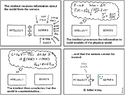
Nice picture!

Of course, counterintuitive doesn't mean wrong. If the theory is correct (within its limits of validity and all that) it can only confirm the information from the senses. Otherwise the theory is not correct.
 
  • #22
Giulio Prisco said:
So *what is* a classical particle besides that? Does the question even make sense?
A classical particle is a miniature version of a planet or a cannon ball., from whose motions the concept was abstracted.
 
  • Like
Likes   Reactions: pinball1970 and vanhees71
  • #23
Giulio Prisco said:
For those who like Everett's interpretation, in his last book Carroll argues that all Everett worlds live in the universal reality vector, and the "many worlds" of the popular interpretation of Everett's interpretation are emergent.
Isn't this just standard MWI?
 
  • Like
Likes   Reactions: vanhees71
  • #24
atyy said:
Isn't this just standard MWI?
Yes but no :-) This is what Everett meant and what many experts (eg Carroll, Wallace) think, but the simplified picture of splitting worlds and the MWI label make one tend to forget that the world is One Big World, not many small worlds.
 
  • #25
A. Neumaier said:
Mathematical concepts can describe aspects of, but they can never be physical reality.
Which to my ears is very similar to the saying "the map is not the territory."
 
  • Like
Likes   Reactions: Interested_observer, Demystifier, vanhees71 and 1 other person
  • #26
A. Neumaier said:
I don't care about the philosopher's Spitzfindigkeiten
TIL a new German word... :oldwink:
 
  • Like
Likes   Reactions: Prishon and vanhees71
  • #27
A. Neumaier said:
On the other hand, nobody has ever seen a physical Hilbert space. Calling it more real than the physical space we live in is selfdelusion.
Being completely agnostic on these questions, I might say that anyone who thinks they know what must and what cannot be is deluded.

Could we with all our senses and intelligence actually be the product of a purely mathematical system? It sounds mad but on what grounds can it be dismissed - notwithstanding a priori faith in the opposite?
 
  • Like
Likes   Reactions: vanhees71
  • #28
PeroK said:
Could we with all our senses and intelligence actually be the product of a purely mathematical system? It sounds mad but on what grounds can it be dismissed - notwithstanding a priori faith in the opposite?
That it sounds mad is sufficient for dismissal.

We could be an implementation of a mathematical algorithm, but not a mathematical system, since the latter is an object in nonphysical, timeless Platonic reality.
 
  • Like
  • Wow
Likes   Reactions: physika, pinball1970 and vanhees71
  • #29
A. Neumaier said:
That it sounds mad is sufficient for dismissal.

We could be an implementation of a mathematical algorithm, but not a mathematical system, since the latter is an object in nonphysical, timeless Platonic reality.
Die Glaube ist immer maechtiger als der Zweifel.

Hermann Hesse
 
Last edited:
  • Like
Likes   Reactions: vanhees71
  • #30
Giulio Prisco said:
What do you guys think of this soberly elegant proposal by Sean Carroll?

Reality as a Vector in Hilbert Space

Fundamental reality lives in Hilbert space and everything else (space, fields, particles...) is emergent. Seems to me a step in the right conceptual direction.
Complete nonsense. But if he wants to believe that...
 
  • Like
Likes   Reactions: vanhees71

Similar threads

  • · Replies 1 ·
Replies
1
Views
577
  • · Replies 30 ·
2
Replies
30
Views
3K
  • · Replies 9 ·
Replies
9
Views
3K
  • · Replies 5 ·
Replies
5
Views
3K
  • · Replies 10 ·
Replies
10
Views
3K
  • · Replies 59 ·
2
Replies
59
Views
5K
  • · Replies 3 ·
Replies
3
Views
2K
  • · Replies 2 ·
Replies
2
Views
2K
  • · Replies 10 ·
Replies
10
Views
2K