Galois Groups .... A&F Example 47.7 .... ....

  • Context: High School 
  • Thread starter Thread starter Math Amateur
  • Start date Start date
  • Tags Tags
    Example Groups
Click For Summary
SUMMARY

The discussion centers on Example 47.7 from "A First Course in Abstract Algebra" by Anderson and Feil, specifically addressing the field extension degree ##[ \mathbb{Q} ( \zeta ) : \mathbb{Q} ] = 2##, where ##\zeta = e^{2\pi/3} = -\frac{1}{2} + i\frac{\sqrt{3}}{2}##. Participants clarify that the irreducible polynomial for ##\zeta## over ##\mathbb{Q}## is ##x^2 + x + 1##, which confirms the degree of the extension. The conversation emphasizes the importance of understanding irreducible polynomials and their degrees in field theory.

PREREQUISITES
  • Understanding of Galois theory and field extensions
  • Familiarity with irreducible polynomials in algebra
  • Knowledge of complex numbers and their properties
  • Basic concepts of vector spaces and dimensions
NEXT STEPS
  • Study the properties of irreducible polynomials in field theory
  • Learn about Galois groups and their applications in algebra
  • Explore the concept of field extensions in more depth
  • Investigate the discriminant of polynomials and its implications for irreducibility
USEFUL FOR

Students and educators in abstract algebra, particularly those focusing on Galois theory and field extensions, as well as mathematicians seeking to deepen their understanding of polynomial irreducibility.

Math Amateur
Gold Member
MHB
Messages
3,920
Reaction score
48
I am reading Anderson and Feil - A First Course in Abstract Algebra.

I am currently focused on Ch. 47: Galois Groups... ...

I need some help with an aspect of the Example 47.7 ...

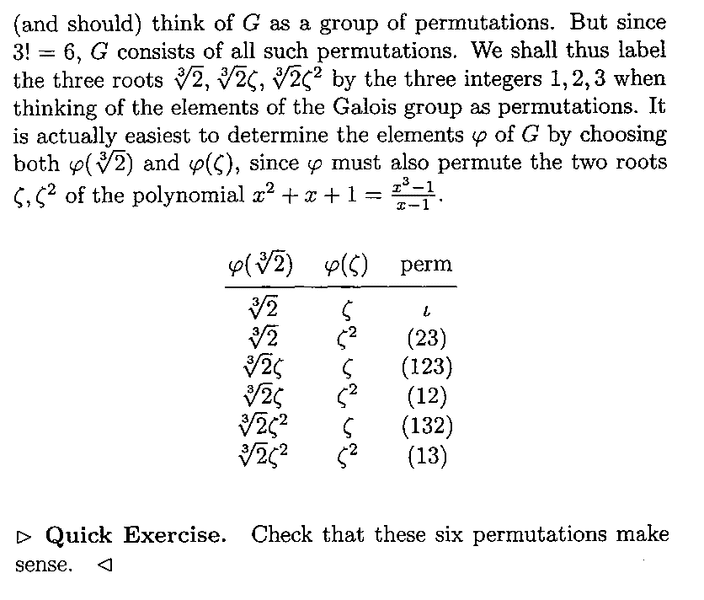
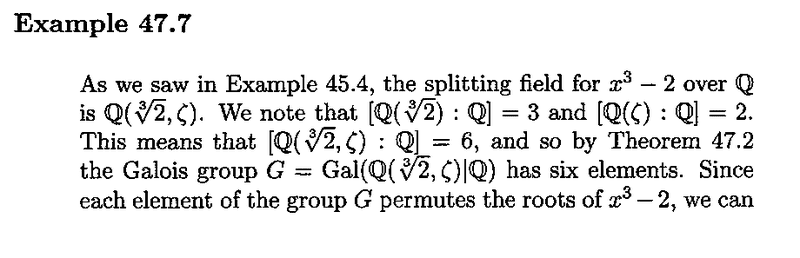
Example 47.7 and its proof read as follows:
?temp_hash=e93975e84859680939c75229187ec6ed.png

?temp_hash=e93975e84859680939c75229187ec6ed.png


In the above example, Anderson and Feil write the following:

"... ... We note that ##[ \mathbb{Q} ( \sqrt[3]{2} ) : \mathbb{Q} ] = 3## and ##[ \mathbb{Q} ( \zeta ) : \mathbb{Q} ] = 2##. ... ... "
Can someone please explain to me how/why ##[ \mathbb{Q} ( \zeta ) : \mathbb{Q} ] = 2## ... ... ?

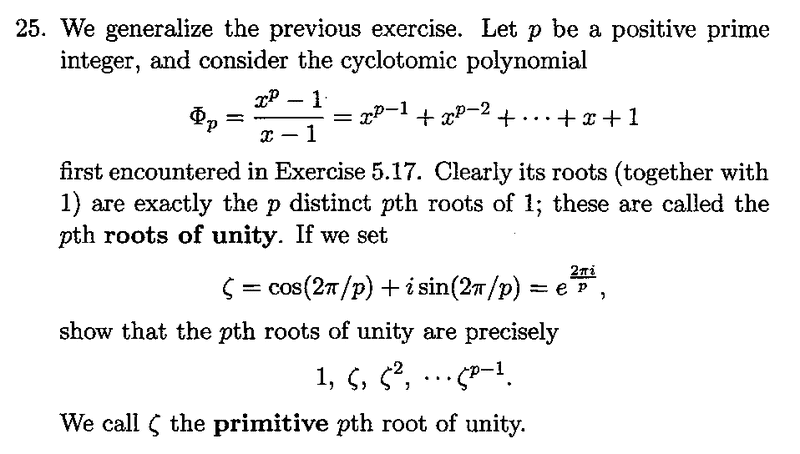
Anderson and Feil give the definition of ##\zeta## in Chapter 9 in Exercise 25 ... as follows ... :
?temp_hash=e93975e84859680939c75229187ec6ed.png


Hope someone can help ...

Peter
 

Attachments

  • A&F - 1 - Example 47.7 ... .PART 1 ... ....png
    A&F - 1 - Example 47.7 ... .PART 1 ... ....png
    25 KB · Views: 552
  • A&F - 2  - Example 47.7 ... .PART 2 ... ....png
    A&F - 2 - Example 47.7 ... .PART 2 ... ....png
    40.6 KB · Views: 739
  • A&F - Defn  of pth root of unity ... Ex 25, Ch 9 ....png
    A&F - Defn of pth root of unity ... Ex 25, Ch 9 ....png
    27 KB · Views: 572
Physics news on Phys.org
Math Amateur said:
Can someone please explain to me how/why ##[ \mathbb{Q} ( \zeta ) : \mathbb{Q} ] = 2## ... ... ?
##\zeta=e^{2\pi/3}=-\frac12 +i\frac{\sqrt 3}2## so that ##\zeta^2=-\zeta=1/\zeta##, and ##\zeta^3=1##.

Hence every positive or negative integral power of ##\zeta## lies in ##\{1,\zeta,-\zeta\}## so that every element of ##\mathbb Q(\zeta)## can be written as ##a+b\zeta##, where ##a,b\in\mathbb Q##.

So a basis for ##\mathbb Q(\zeta)## as a vector space over ##\mathbb Q## is ##\{1,\zeta\}##, so that the dimension of the VS is 2.
 
  • Like
Likes   Reactions: Math Amateur
to answer your question, ask yourself how to find the dimension of the field generated by an element. hopefully you know it means to know the degree of the irreducible polynomial satisfied by that element. If not, master that fact. then ask yourself what irreducible polynomial is satisfied by a cube root of 1. I really recommend you try a little harder to answer these questions on your own. the key is to review the meaning of the terms in the question. here the key fact is that for an element a, the field F(a) is isomorphic to the quotient F[X]/(g) where g is the unique monic irreducible polynomial in F[X] satisfied by a. Hence a basis for that vector space over F is given by 1, X,...,X^n-1, where n = degree(g). This is fundamental.
 
  • Like
Likes   Reactions: Math Amateur
Thanks to Andrew and mathwonk for the help and advice ... ...

Now, following the advice provided by mathwonk, my reasoning is as follows:The polynomial satisfied by a cube root of ##1## is ##x^3 - 1## ... ... but this is not irreducible in ##\mathbb{Q}## since:

##x^3 - 1 = ( x - 1 ) ( x^2 + x + 1 )##If we focus on the irreducible polynomial ##( x^2 + x + 1 )## we find that the roots of this polynomial are

##\zeta = - \frac{1}{2} + \frac{ \sqrt{3} i }{ 2}##, and ##\zeta^2 = - \frac{1}{2} - \frac{ \sqrt{3} i }{ 2}## ...... so the degree of the minimum polynomial for ##\zeta## is ##2## ...

... and therefore ##[ \mathbb{Q} ( \zeta) : \mathbb{Q} ] = 2## ...Is the above reasoning correct?

Peter
 
That's perfect. Now ask yourself why you did not get this on your own. Clearly you can do this sort of thing. Maybe like me you just get impatient to know the answer and lose confidence that it will come to you. Because of the advice I gave you, I myself earlier today hung in a little longer on a problem that was bugging me in elementary algebraic geometry. I wanted to look at the solution online but reminded myself I had told you that one would be better off doing it oneself. so I kept at it, and I got it! you realize of course that computing the actual solutions is superfluous once you know two facts: the polynomial X^2+X+1 is irreducible, and has degree 2. Of course knowing the roots are complex IS one way to show it is irreducible. but you could also calculate the discriminant, see it is negative and stop there. nice work!
 
Last edited:
  • Like
Likes   Reactions: Greg Bernhardt and Math Amateur

Similar threads

  • · Replies 2 ·
Replies
2
Views
1K
  • · Replies 23 ·
Replies
23
Views
3K
  • · Replies 5 ·
Replies
5
Views
2K
  • · Replies 19 ·
Replies
19
Views
4K
Replies
8
Views
2K
  • · Replies 2 ·
Replies
2
Views
2K
  • · Replies 6 ·
Replies
6
Views
2K
  • · Replies 1 ·
Replies
1
Views
640
  • · Replies 1 ·
Replies
1
Views
1K
  • · Replies 3 ·
Replies
3
Views
2K