Gauss' Law: Charge of a Hydrogen Atom

Click For Summary

Homework Help Overview

The discussion revolves around applying Gauss' Law to analyze the charge distribution in a hydrogen atom, which consists of a positive point charge and a negative charge density that varies with distance from the center. Participants are tasked with finding the constant in the charge density equation and determining the electric field inside and outside the atom.

Discussion Character

  • Exploratory, Conceptual clarification, Mathematical reasoning

Approaches and Questions Raised

  • The original poster attempts to derive the constant C from the charge density equation and relates it to the volume of the atom. Some participants suggest that the charge density is not uniform and propose using integration to find the total charge. Others question the integration approach and seek clarification on the volume element in spherical coordinates.

Discussion Status

Participants are actively engaging with the problem, raising questions about the assumptions made regarding charge density and the methods for calculating the electric field. There is a recognition of the need for integration and clarification on the proper setup for the volume element in spherical coordinates.

Contextual Notes

Some participants note the importance of using the homework template for clarity and adherence to forum guidelines. There are also mentions of difficulties in reading provided images, which may affect the discussion.

Lucas Silva
Messages
4
Reaction score
0
New user has been reminded to fill out the Homework Help Template when starting a new schoolwork thread.
Suppose the hydrogen atom consists of a positive point charge (+e), located in the center of the atom, which is surrounded by a negative charge (-e), distributed in the space around it.

The space distribution of the negative charge changes according to the law p=Ce^(−2r/R), where C is a constant, r is the distance from the center of the atom, and R is Bohr's radius.

Find the value of the constant C by using the electrical neutrality of the atom.

Find the electrical field for r<R

Find the eltrical field for r > R

So what I've done is:

Since p stands for charge density, p = Q/V , where V = 4/3 Pi R^3 and Q = -Q

Thus, p = C*exp^(−2r/R) = -Q / 4/3 Pi R^3

Solving for C... C=[ -3*Q* r^2 * exp(2R/r)] / 4*Pi* R^3

For the electrical field I couldn't think of anything...
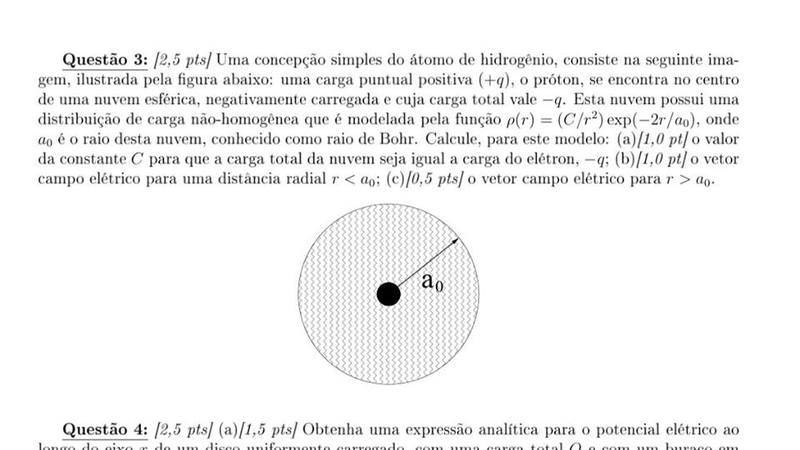
25498140_1753981091293170_484160954989525020_n.jpg

Sorry for the portuguese image... It was the only I could find. Note Ao = R
 

Attachments

  • 25498140_1753981091293170_484160954989525020_n.jpg
    25498140_1753981091293170_484160954989525020_n.jpg
    42.7 KB · Views: 820
Physics news on Phys.org
Your equation for finding the charge assumes uniform charge density. The density is not uniform, so you will have to do an integral. For the electric field you need to use Gauss's Law.
 
  • Like
Likes   Reactions: Lucas Silva
kuruman said:
Your equation for finding the charge assumes uniform charge density. The density is not uniform, so you will have to do an integral. For the electric field you need to use Gauss's Law.
But if I integrate considering Q = ∫ ρ dV

Considering a Gaussian Surface with thickness of dr' ; the volume would be 4 * pi * r' * dr'
Where dV = 4 Pi r' dr' ... integrating from 0 to R I will get the same result as before.
 
Not quite.
$$Q=\int{\rho(r) dV}=\int{\frac{C}{r^2}~e^{-\frac{2r}{a_0}}dV}$$
What is ##dV## in spherical coordinates?

Also, for future reference please use the homework template when posting homework problems or your post may be deleted.
 
  • Like
Likes   Reactions: Lucas Silva
kuruman said:
Not quite.
$$Q=\int{\rho(r) dV}=\int{\frac{C}{r^2}~e^{-\frac{2r}{a_0}}dV}$$
What is ##dV## in spherical coordinates?

Also, for future reference please use the homework template when posting homework problems or your post may be deleted.
Thank you ! Sorry for not using the homework template, I was really in a rush.

25498084_1754624474562165_3109908276171862683_n.jpg

25587810_1754624471228832_786956988775670899_o.jpg
 

Attachments

  • 25498084_1754624474562165_3109908276171862683_n.jpg
    25498084_1754624474562165_3109908276171862683_n.jpg
    17.8 KB · Views: 667
  • 25587810_1754624471228832_786956988775670899_o.jpg
    25587810_1754624471228832_786956988775670899_o.jpg
    19.3 KB · Views: 598
Sorry, I cannot read the pictures. Your writing is small and faint and lighting is poor. If you do not have the time to learn and use LaTeX, please write bigger use blank ink and a lot of light before taking another picture.
 

Similar threads

  • · Replies 6 ·
Replies
6
Views
3K
  • · Replies 5 ·
Replies
5
Views
874
  • · Replies 7 ·
Replies
7
Views
4K
Replies
5
Views
2K
  • · Replies 1 ·
Replies
1
Views
901
  • · Replies 19 ·
Replies
19
Views
2K
  • · Replies 5 ·
Replies
5
Views
3K
Replies
2
Views
2K
Replies
7
Views
2K
  • · Replies 13 ·
Replies
13
Views
5K